


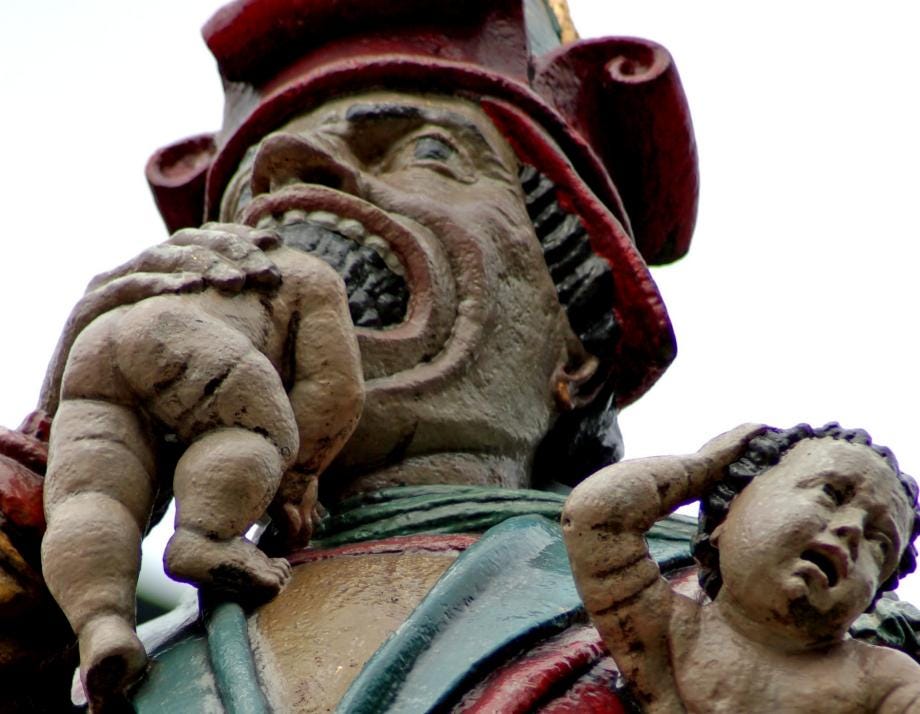
Standing in the heart of Bern, amid the postcard-perfect sandstone and the gentle curve of the river Aare, a figure looms that belongs in another time entirely. Or perhaps another world.
His mouth is open. There’s a child halfway in.
Three more squirm in the bag slung over his shoulder, and another dangles from his meaty fist. The giant’s eyes bulge with a terrible hunger, or perhaps madness. His pointed hat, once brightly painted, has faded with the centuries but not his appetite.
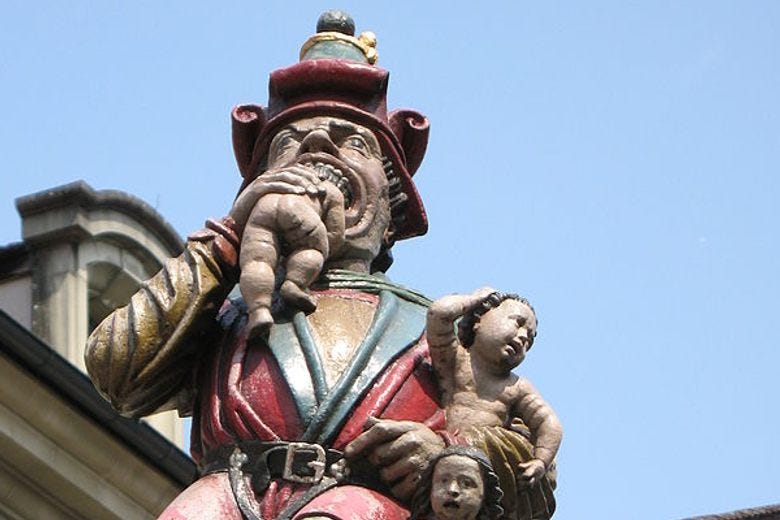
For nearly five hundred years, this thing has stood sentinel in Bern’s central plaza, and for nearly five hundred years, no one has been able to say with certainty why it’s there. The sculptor, Hans Gieng, left no explanation when he carved it around 1550. No surviving letters, no manifestos, nothing but this nightmare in stone.
What if the Kindlifresser isn’t just some Medieval bogeyman? What if the answer has been hiding in plain sight, carved into the oldest texts we possess?
The Giant Problem
The Swiss have two names for Hans Gieng’s statue. Kindlifresser is the official one, the one in the guidebooks. But ask an old-timer in Bern what stands in the plaza, and they’ll tell you: it’s the ogre. Just “the ogre,” like that explains everything.
Maybe it does.
Biblical scholars spend a lot of time arguing about giants. Were the Nephilim real? What exactly were the Anakim that made hardened Israelite warriors feel “like grasshoppers”? Who were the Rephaim, and why does their name literally mean “the dead ones”? But there’s one giant nobody argues about because the text is too specific, too insistent. Og, King of Bashan. Deuteronomy gives us measurements. His bed was thirteen feet long and made of iron. Not stone, not wood. Iron, as if the scribes wanted to make absolutely certain future readers understood this was physical evidence, not metaphor.
The Israelites killed Og and burned sixty of his cities to ash. They didn’t take prisoners. They didn’t leave survivors. Every man, woman, and child in Bashan died. That’s genocide, the kind of total war you don’t wage against regular human enemies.
So what does any of this have to do with a fountain in Switzerland? Everything, actually. Because “ogre” isn’t just a random fairy tale word. Linguists have traced it back through Old French, through Latin, all the way to one source: Og. The king of Bashan became the root word for every child-eating giant in Western folklore. When medieval Europeans needed a name for the monsters in their stories, they reached back to the oldest, most terrifying giant they knew. The one from the Bible. The last of the Rephaim.
And the Swiss, without explanation, decided to call their child-eating statue an ogre.
That’s not cute. That’s not coincidence. That’s memory. The Book of Enoch, excluded from most Bibles but preserved in Ethiopian Christianity, describes what the Nephilim and their giant offspring did before the Flood. They “consumed all the acquisitions of men,” and when that wasn’t enough, they started eating people. Children first. The Jewish mystical text called the Zohar elaborates: these giants specifically hunted human infants. That’s why God sent the Flood. Not just because humans were wicked, but because the giants had corrupted everything. The earth had to be scoured clean.
The Hunger of the Old Ones
Look closer at the giant stories scattered through ancient Near Eastern texts, and a pattern emerges. These weren’t just big people. They were predators. Cannibals. Child-eaters.
The Book of Enoch, excluded from most Biblical canons but preserved by the Ethiopian Orthodox Church, is explicit about this. The Nephilim “consumed all the acquisitions of men” and when that wasn’t enough, “began to sin against birds, and beasts, and reptiles, and fish, and to devour one another’s flesh, and drink the blood.” Children first. Always the children.
Jewish mystical texts elaborate on this theme. The Zohar speaks of demonic giants who specifically target infants and young children. Medieval rabbinical commentaries suggest that the reason God sent the Flood wasn’t just human wickedness but the giants themselves. The Nephilim had corrupted the earth so thoroughly that only a complete reset would do.
Now look at the Kindlifresser again. Look at that bag of children. That open mouth. That terrible hunger frozen in stone. Could Hans Gieng have been trying to tell us something? Not about witches or Jews or wayward brothers, but about something much older, something that once walked the earth and might still lurk in our collective memory?
The Swiss Witch Problem
Switzerland in the 1500s was drowning in witch trials. The Alpine valleys seemed to breed heresy like morning mist. Between 1427 and 1700, Swiss territories executed between four and six thousand people for witchcraft, an extraordinary number for such a small region. And what was the primary accusation against these witches? Child murder. Child consumption. The same charge leveled at Jews in blood libels, the same crime attributed to the Biblical giants.
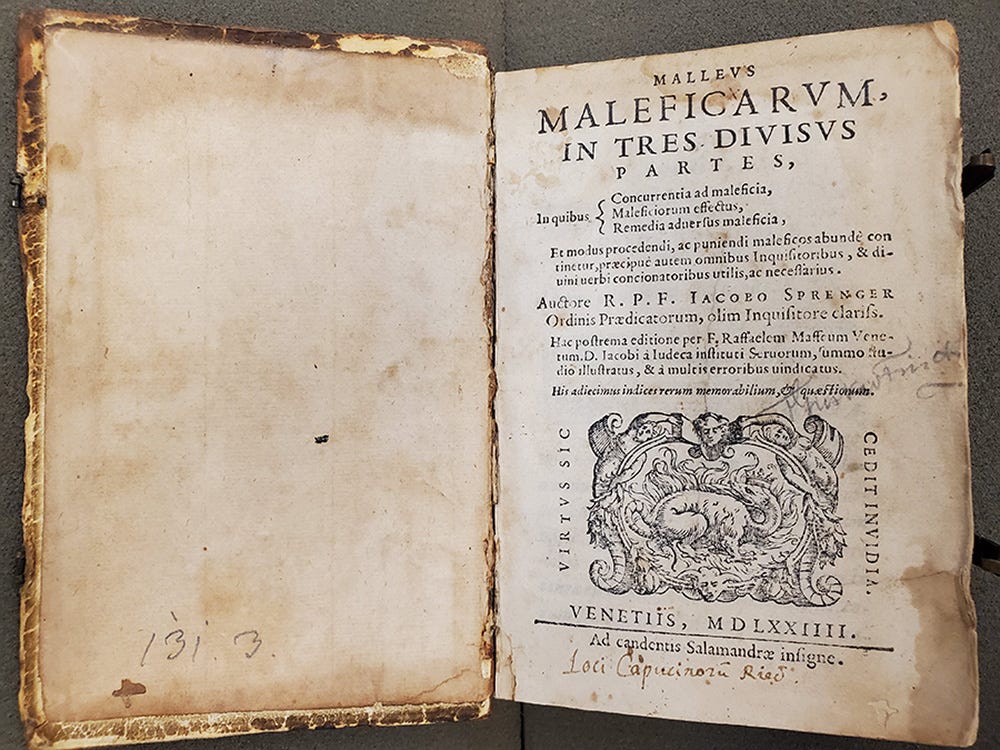
But here’s where the story gets strange. In many Swiss witch trials, the accused didn’t confess to working alone or even with other human witches. Under torture, they spoke of meeting with ancient beings. Giants. The “old ones” who had never truly left. A trial record from 1570 in Neuchâtel, just a few dozen miles from Bern, preserves testimony from a woman named Marguerite who claimed she’d been taken to a midnight gathering where “men of great size, higher than the church steeple” demanded she bring them children from the village. She said they were hungry. Always hungry. The judges dismissed this as demonic delusion, but what if she was describing something else?
What if she was describing something from personal experience?
The Foundation of Bern
Every city has a foundation myth. Bern’s is simple: Duke Berchtold V went hunting in 1191, killed a bear, and founded a city on the spot. Hence “Bern” from Bären, the German word for bears. But peel back that story, and you find something older. Much older.
The name “Berchtold” itself derives from “Berchta” or “Perchta,” a pre-Christian Germanic goddess who wandered the winter nights. Her job? To slit open the bellies of children who hadn’t been good. To this day, Alpine regions celebrate Perchta festivals where masked figures representing her servants parade through villages, frightening children into obedience. Sound familiar?
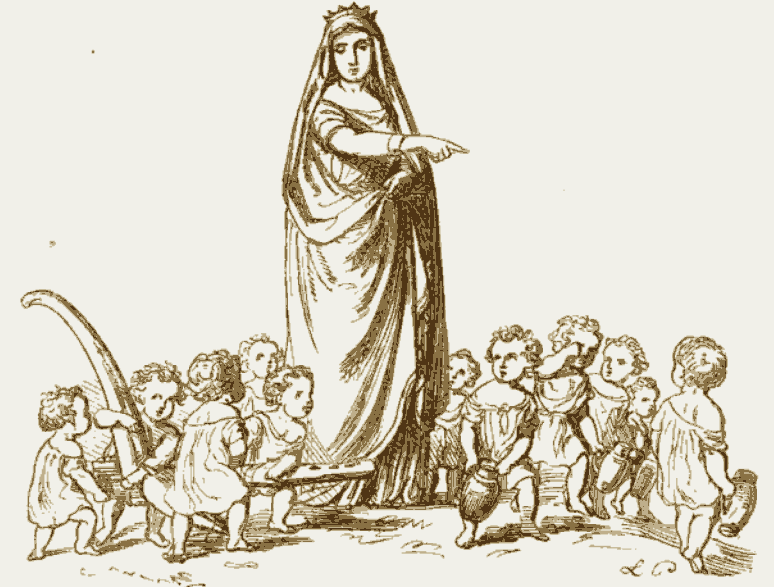
Perchta was also the guardian of the wild places. The forests. The mountains. The liminal spaces where giants were said to dwell. Berchtold’s older brother, that jealous sibling who supposedly went mad with envy? There’s no historical record of him. No documents. No contemporary accounts. Just the local legend, whispered from generation to generation, about a child-eater who stalked Bern’s streets. What if that wasn’t Berchtold’s brother at all? What if it was something that was already there when Berchtold arrived, something that had always been there, since before Rome, since before the Celts, since the days when giants walked the earth?
The Warning
Here’s what keeps me up at night about the Kindlifresser: Hans Gieng didn’t just carve one statue. He carved eleven fountains for Bern in the 1550s. Soldiers. Heroes. Moses. The usual civic propaganda. But then this thing. This monstrosity. And he put it in the center of town, not hidden away, not in a church where its meaning could be controlled by priests. Right there in the plaza where everyone would see it. Where children would pass it every day. That’s not decoration. That’s not art for art’s sake. That’s a warning.
Maybe the good people of Bern in 1550 understood something we’ve forgotten. Maybe they knew their city was built on older foundations. Maybe they knew that beneath the Christian veneer, beneath the Republic and the prosperity and the bear-themed civic pride, something ancient still lingered. The Bible tells us the giants were wiped out. Og of Bashan was the last. But the Bible also tells us strange things came from mixing the divine and the human, that there were beings in the earth that God himself regretted creating. What if they didn’t all die in the Flood? What if some slept? What if some hid in mountain caves and deep valleys, waiting?
The Kindlifresser stands in Bern still, mouth open, eyes bulging. Children pass him every day now, laughing, taking selfies, completely unafraid. Maybe that’s good. Maybe the statue did its job, whatever that job was. Or maybe it’s just waiting for us to forget what it means, for the memory to fade completely, for the warning to become nothing more than a weird tourist attraction. The statue doesn’t blink. It doesn’t move.
It just waits, mouth open, in the center of Bern, the way it has for five hundred years.
I've been thinking about giants. I have infant grand children. They come up to my knees. To them I am a giant. Though only a year old and won't "remember" this time of their life they dream worlds that will be with them forever. Grown men dream of giants because they were once surrounded by giants! A few grown people eat their children. Most protect their children with their lives. Thus we have terrifying satanic cabals and we have the forgiving God and loving Christ. It is all being exposed. The war is spiritual. The war is real.
So scary and yet so true. Glad to have found your Substack, Wise Wolf.