



I’ve spent twenty years reading strange texts. Comparative mythology, occult manuscripts, ancient religious documents. You do this long enough and patterns start showing up in places they shouldn’t. Here’s one that won’t leave me alone.
Three stories from completely different cultures tell what looks like the same tale. Cain kills Abel in Genesis. Set murders and dismembers Osiris in Egyptian mythology. The Fisher King bleeds from a wound that won’t heal in Arthurian legend. On the surface they’re unrelated. Different time periods, different religions, different narrative purposes. But strip away the cultural dressing and you get an identical skeleton underneath. Brother kills brother. The righteous one’s bloodline gets severed. The land itself goes barren in response. Something broken waits centuries for restoration that can only come through divine intervention.
This isn’t proof of anything. I’m not claiming hidden conspiracies or secret knowledge. But the parallels are strange enough to warrant mapping out. What follows is pattern recognition from two decades of cross-referencing ancient sources. Make of it what you will.
THE FIRST MURDER
Genesis 4 gives you the basic story everyone knows. Two brothers bring offerings to God. God accepts Abel’s sacrifice and rejects Cain’s. Cain gets jealous, lures Abel into a field, and kills him. Most Sunday school lessons end there with a warning about jealousy and you go home for coffee.
But look what happens immediately after.
Genesis 4:25 says God gives Adam and Eve another son named Seth, and the text specifically identifies him as a replacement “instead of Abel, whom Cain killed.” That’s unusual phrasing. Not “another son” or “a third son.” A replacement, as if Abel was carrying something specific that needed to continue. The word choice matters because it suggests Abel wasn’t just another kid in the family tree.
Go back three verses to Genesis 3:15, right after the serpent ruins everything in Eden. God makes a cryptic promise that’s puzzled theologians for millennia. “I will put enmity between you and the woman, and between your seed and her seed. He shall bruise your head, and you shall bruise his heel.” Seed of the woman versus seed of the serpent. Two bloodlines in eternal conflict. A deliverer is coming who will crush the enemy.
If you’re tracking the genealogy that’s supposed to produce this promised deliverer, Abel was carrier number one. The first righteous son. And Cain killed him before he could have children. From a purely functional genealogical standpoint, murder is castration. Both permanently end your ability to continue your line. Abel’s bloodline didn’t just get interrupted or wounded. It got terminated completely, severed at the root.
There’s another detail most people miss. When God confronts Cain about the murder, he tells him that Abel’s blood is crying out from the ground. Then in the very next verse, God curses the ground itself because of what it absorbed. “When you till the ground, it shall no longer yield its strength to you.” The earth becomes barren, refusing to produce crops, directly because of Abel’s spilled blood soaking into it.
Keep that image of blood crying from cursed, barren ground in your head. We’ll come back to it.
THE EGYPTIAN MIRROR
Now flip over to ancient Egypt and the Osiris myth, one of the foundational stories of Egyptian religion. Three sons are born to the sky goddess Nut and the earth god Geb. Their names are Osiris, Set, and Horus. Osiris becomes king of Egypt, ruling wisely and well. He’s beloved by gods and humans alike. Set, his brother, grows jealous of this favor and decides to do something about it.
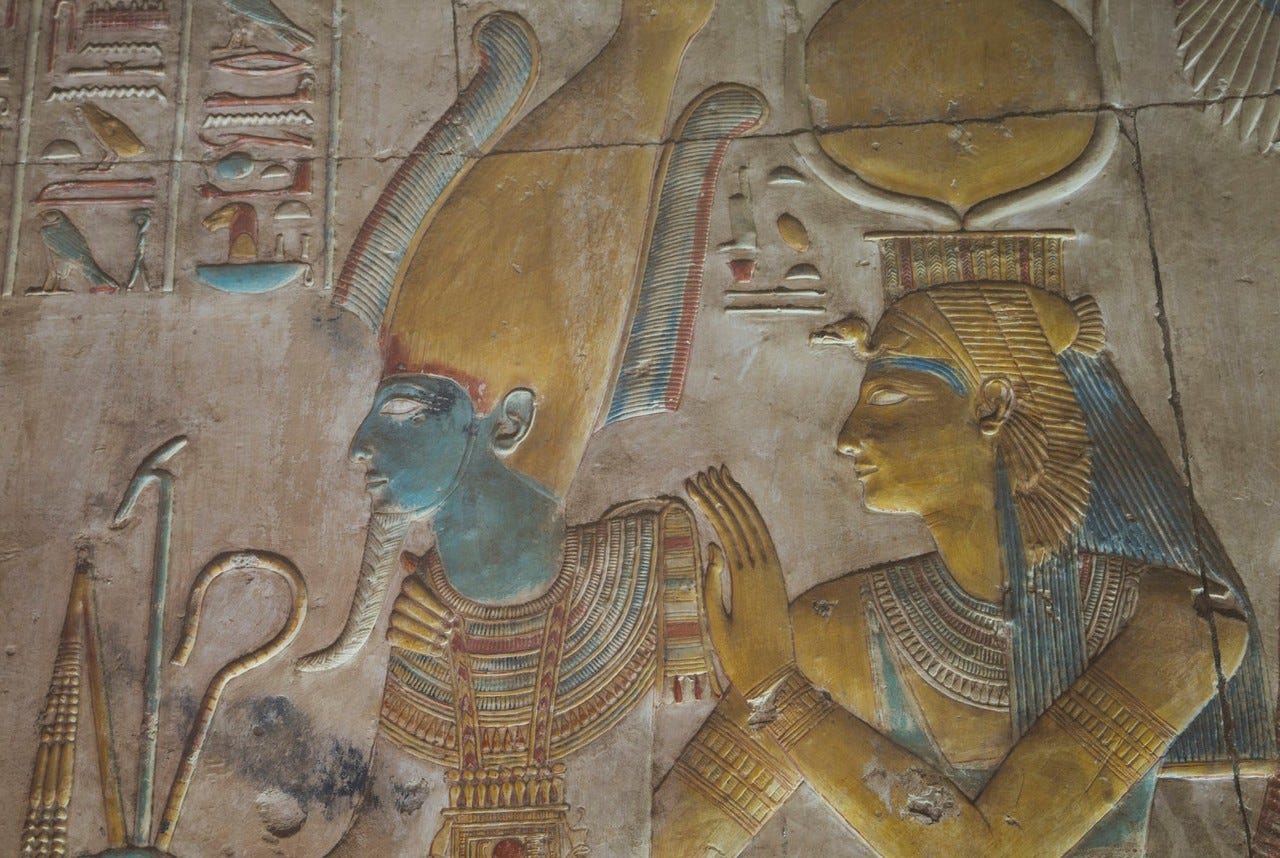
Set tricks Osiris, murders him, and then dismembers the body into fourteen pieces that he scatters across Egypt. With the rightful king dead and literally torn apart, Set seizes the throne for himself. But Osiris’s wife and sister Isis refuses to accept this. She searches the length of Egypt and manages to collect thirteen of the fourteen pieces of her husband’s body. The fourteenth piece, his phallus, is missing. Depending on which version you read, it was either eaten by fish in the Nile or simply lost forever.
So Isis does what any determined goddess would do. She uses magic to fashion a replacement phallus, reassembles Osiris’s body, and through ritual manages to conceive a son. That son is Horus, who grows up specifically to avenge his father’s murder. Horus eventually defeats Set in battle and restores proper order to Egypt.
Look at the structural elements here. Three sons born to a primal couple. Brother murders brother out of jealousy. The righteous one is killed and his reproductive capacity is literally destroyed. The evil brother takes power. A third figure emerges as the restorer and avenger. It’s the same pattern as Genesis, just wearing Egyptian clothes.
Now look at the names themselves, because this is where it gets genuinely odd. Genesis gives us Cain, Abel, and Seth. The Egyptian myth gives us Set, Osiris, and Horus. The third son in Genesis is named Seth. The murderous brother in Egypt is named Set. These aren’t just similar names. The Hebrew שֵׁת (Šēṯ) and the Egyptian Swtḫ are philologically identical. Same name, same consonants, same basic sound.
But here’s the twist that makes this more than coincidence. The roles are completely flipped between the two versions. In Genesis, Seth is the good guy, the righteous replacement for murdered Abel, the one who carries forward the blessed lineage. In Egypt, Set is the villain, the jealous murderer, the usurper of the rightful throne. It’s like looking at the same story reflected in a mirror where the names stayed the same but got attached to opposite characters. The evil Egyptian Set corresponds to the biblical Cain. The murdered Egyptian Osiris corresponds to the biblical Abel. The avenging Egyptian Horus corresponds to the biblical Seth who replaces the severed line.
Which version came first? Conventional academic dating places Egyptian pyramid texts around 2400 BC, while Genesis is traditionally dated to around 1400 BC when Moses supposedly wrote it down. So on paper, Egypt looks older by a thousand years. But here’s the problem with that reasoning. Myths exist in oral tradition for centuries or millennia before anyone bothers writing them down. Moses didn’t invent these stories. He compiled and recorded traditions that had been passed down since the events they describe.
And there’s a basic principle in folklore and textual criticism that stories tend to elaborate over time, not simplify. Complexity accumulates. Details multiply. Magic gets layered in. The Genesis version is spare and direct. Cain killed Abel in a field. God gave Seth as replacement. End of basic story. The Egyptian version is baroque and ornate. Set dismembered Osiris into fourteen specific pieces scattered across specific locations. Isis used elaborate magic and created a golden phallus for ritual conception. Divine battles and cosmic implications. Which narrative sounds like the original seed? Which sounds like centuries of priestly embellishment and theological elaboration?
Consider also what Genesis 11 tells us about Babel. God confused human languages and scattered people across the earth. If that happened, then every dispersed group took the same core stories with them. Same basic memories of early human history. But different languages, different cultures, different religious frameworks would reshape those stories. They’d adapt to new pantheons, new ritual systems, new theological needs.
Egypt remembered the story of the murdered brother and the severed bloodline. But somewhere in the centuries of retelling, the Messianic angle got lost or transformed. It became a story about seasonal cycles, agricultural renewal, and pharaonic succession. The narrative form survived intact. The deeper meaning drifted and changed.
WHEN MURDER WASN’T ENOUGH
If Cain’s murder of Abel was attempt number one to terminate the promised seed, then Genesis 6 represents attempt number two. And this one nearly succeeded in ways that should probably disturb us more than it does.
The text is brief and strange. “The sons of God saw the daughters of men, that they were beautiful, and they took wives for themselves of all whom they chose.” Most modern Christians gloss over this passage as quickly as possible, interpreting it as corrupt men from Seth’s line intermarrying with corrupt women from Cain’s line. Moral degradation leading to the Flood. Nothing supernatural to see here. But that interpretation requires ignoring what the Hebrew actually says.
The phrase is bene Elohim, which translates as “sons of God.” This specific phrase appears only a handful of times in the entire Old Testament, and in every other instance it unambiguously refers to angels, not human men. Job 1:6, Job 2:1, Job 38:7. Always angels. The natural reading of Genesis 6 is that angelic beings took human women as wives and produced hybrid offspring.
The Book of Enoch, written during the Second Temple period and considered scripture by the Ethiopian Orthodox Church, expands this story in detail that’s both fascinating and disturbing. According to Enoch, two hundred angels called Watchers descended to Mount Hermon. They swore a mutual oath, because apparently even rebellious angels understood this was serious enough to require binding commitment. Then they took human women and began producing children. These offspring were the Nephilim, beings of enormous size and strength who consumed everything in their path.
But the Watchers didn’t just produce biological hybrids. They taught humanity knowledge that was supposed to remain hidden. Azazel taught metalworking and the crafting of weapons. Samyaza taught enchantments and the cutting of roots for magic. Other Watchers taught astrology, cosmetics, the interpretation of signs, and various forms of sorcery. The earth filled with violence and corruption. The Nephilim ate all available food, then turned on animals, then on each other, then on humans. It was genetic and cultural contamination on a massive scale.
Here’s why this matters from a theological standpoint, and why it’s not just ancient mythology. Genesis 3:15 had promised a deliverer who would be born of woman. Fully human. The Messiah had to be genuinely human to represent humanity before God, to be the second Adam who would undo what the first Adam broke. If human DNA became completely corrupted through interbreeding with angelic beings, if every single bloodline on earth carried this hybrid contamination, then that promise becomes biologically impossible to fulfill.
This wasn’t random wickedness or moral decay. This was strategic warfare against prophecy. Satan couldn’t kill the promised seed through direct murder after the Abel incident, so he tried a different approach. Corrupt the seed itself. Make humanity into something that’s no longer quite human. Break the biological chain that would eventually produce the deliverer.
That’s where Noah enters the picture. Genesis 6:9 describes him with an interesting phrase. “Noah was a just man, perfect in his generations.” The Hebrew word translated as “perfect” is tamim, which means whole, complete, without blemish. It’s the same technical term used for sacrificial animals that couldn’t have any defects or physical flaws. You can read this purely as moral righteousness, and that’s certainly part of it. But given the context of genetic corruption spreading across the entire human population, it also strongly suggests his genealogy was intact. Uncorrupted. Pure Adamic DNA without any angelic admixture.
Noah and his family may have been the last humans on earth whose bloodline traced cleanly back to Adam without contamination. The Flood wasn’t divine overreaction to human sin in general. It was emergency quarantine and genetic surgery. God had to preserve the human race intact long enough for the promised Messiah to arrive, and that required eliminating the hybrid population that threatened to make the fulfillment of Genesis 3:15 biologically impossible.
And here’s the detail that suggests this warfare didn’t end with the Flood. Genesis 6:4 includes a phrase most people skip right over. “The Nephilim were on the earth in those days, and also afterward.” Afterward. After the Flood. Somehow the genetic corruption returned. Numbers 13:33 confirms this when Israelite spies scout the land of Canaan and return terrified. “We saw the Nephilim there, the descendants of Anak. We seemed like grasshoppers in our own sight, and so we were in their sight.”
This is why God commanded Israel to utterly destroy certain populations in Canaan. Not genocide for its own sake, but genetic quarantine. These weren’t fully human. They were contaminated bloodlines that still threatened the eventual arrival of the Messiah. Goliath, Og king of Bashan, the sons of Anak. All described as giants, all connected to the Nephilim, all targeted for complete destruction. The bloodline warfare that started with Abel’s murder continued for thousands of years.
THE WOUNDED KING WHO CANNOT DIE
Now jump forward several thousand years to medieval Europe and the Arthurian romances, specifically the legend of the Fisher King. At first glance this appears completely unconnected to anything in Genesis or Egyptian mythology. It’s Celtic-influenced Christian allegory dressed up as chivalric adventure. But look at the structural elements.
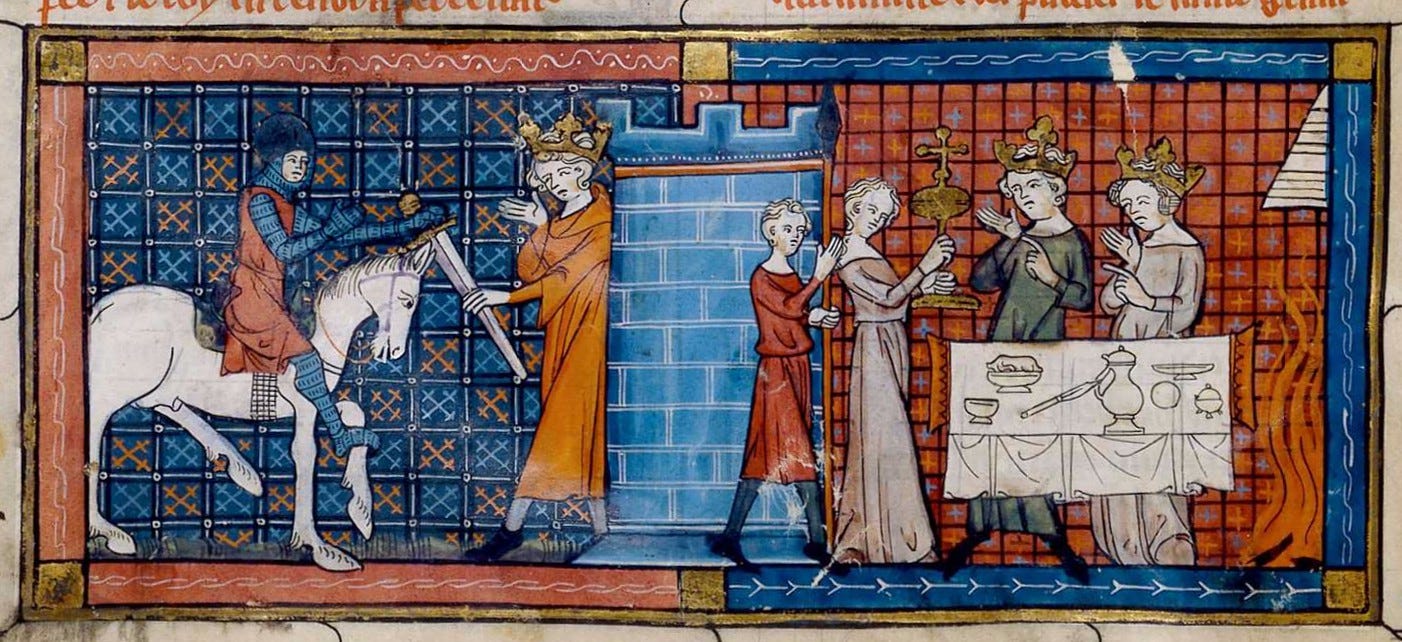
The Fisher King is immortal, or at least extraordinarily long-lived. He’s the guardian of the Holy Grail, keeper of the most sacred relic in Christendom. But he’s been wounded by a sacred lance, struck somewhere in the groin or between the thighs depending on the version. The wound will not heal through any conventional means. Because of this injury, the Fisher King cannot reproduce, cannot father an heir to continue his line. And here’s where it gets mythologically interesting. His physical condition directly affects his kingdom. The land itself becomes a wasteland in response to his wound. Crops fail, rivers run dry, joy and prosperity vanish. The once-fertile kingdom mirrors its king’s barren condition.
All the Fisher King can do is fish in the river near his castle and wait. He’s waiting for someone specific. A pure knight who will undertake the perilous journey to the Grail Castle, witness the mysterious procession of sacred objects, and have the wisdom and compassion to ask the healing question. The question varies slightly between versions. “What ails you?” or “Whom does the Grail serve?” The specific words matter less than the act of asking with genuine compassion, of acknowledging and naming the suffering.
When the right person finally asks that question, the wound heals. The king recovers his vitality. The wasteland blooms again. Life and fertility return to the kingdom. Most scholars file this under standard fertility mythology, and they’re not wrong. Dying vegetation god. Seasonal cycles. Celtic paganism getting Christianized into medieval romance. The Fisher King fits the broader pattern of wounded kings in Indo-European mythology.
But that standard interpretation misses something. Look at the specific elements again with Genesis in mind. A king wounded in his genitals who cannot reproduce. His bloodline ends with him unless intervention comes. The land goes barren as a direct result of this severed succession. He waits in passive suffering for a pure restorer who will heal him through a compassionate act. He guards the most sacred vessel, the container of holy blood.
Now look at Abel. Murdered before he could have children. His bloodline terminated completely. The ground cursed by God, refusing to yield crops. God intervenes with Seth to restore the severed line. The entire Messianic promise depends on this restoration.
Here’s what I think is happening. The Fisher King isn’t just a symbol or a literary device. He’s memory. He’s the collective cultural memory of the severed righteous bloodline personified as a single figure. Abel’s line that got cut but somehow survived. The wounded-but-preserved dynasty waiting through centuries for the promised deliverer who will heal what was broken in Genesis 4.
Consider the parallels more carefully. Abel gets murdered and his reproductive capacity ends. The Fisher King gets castrated and his reproductive capacity ends. Same functional result. Abel’s blood crying from the ground causes the earth to become cursed and barren. The Fisher King’s wound causes his kingdom to become a wasteland. Same mythological pattern. Abel cannot restore his own line. The Fisher King cannot heal his own wound. Both are passive sufferers requiring external intervention. Abel’s line gets restored through Seth, who carries the promise forward. The Fisher King gets healed through the Grail Knight, who brings restoration.
And both are connected to blood. Abel’s blood soaking into cursed ground. The Grail Knight healing the Fisher King with blood from the holy lance.
In Malory’s version of the Arthurian legends, the Fisher King is finally cured when drops of blood from the sacred lance touch his wound. Not just any blood. Blood from the same lance that pierced Christ’s side at the crucifixion. The same spear that drew blood from the Messiah. Abel’s severed bloodline finds its ultimate restoration when it produces Christ, whose shed blood then heals the wound of death itself that’s been bleeding since Genesis 3.
The mythology is preserving something that theology explains. Different languages for the same truth.
THE GRAIL AS BLOODLINE
There’s another layer here that gets obscured in most popular retellings. According to legend, Joseph of Arimathea used a cup to catch Christ’s blood as it flowed from the wounds of crucifixion. That cup becomes the Holy Grail. Joseph brings it to Britain and founds a line of guardians who protect it through generations. The Fisher King is the last of this line, wounded and waiting.
But medieval French had a way of playing with words that modern English loses. “San Greal” means Holy Grail. But if you shift where you break the syllables, you get “Sang Real.” Royal blood. The phrase can mean either the holy cup or the sacred bloodline. They’re linguistically interchangeable, and that might not be accidental.
What if the Grail isn’t primarily about a physical cup? What if it represents the bloodline itself? Think about communion, which is where the Grail imagery comes from originally. The cup and the wine. “This is my blood of the new covenant.” Wine represents blood. Blood represents lineage, genealogy, inheritance. The Church made the Grail into a treasure hunt for a physical object, but the older meaning might be running deeper.
The Grail is Christ’s blood. Christ’s blood is the perfected Adamic line. The seed of the woman from Genesis 3:15 that was promised in Eden, survived Abel’s murder through Seth, endured the Flood through Noah, narrowed through Abraham and David, and finally culminated in Jesus. The Fisher King guards this. He is this. The wounded bloodline that got severed but refused to die. The interrupted dynasty that waits for its completion.
And he can only be healed when someone asks the question that Christ asks of all humanity. “What ails you?” The acknowledgment of the wound. The compassionate recognition of suffering. Then comes the healing, and it comes through blood. Abel’s blood cried out for vengeance in Genesis 4. Christ’s blood speaks of mercy in Hebrews 12:24. The wound that’s been bleeding since the first murder finally closes.
THE PROTECTED LINE
If you trace the genealogy from Seth forward, you get a thread running through the entire Old Testament that’s constantly under attack. Seth to Enosh to Kenan down through ten generations to Noah. The Flood wipes out everyone except Noah’s family of eight. All the genetic contamination gets eliminated. The line continues through Noah’s son Shem, specifically blessed in Genesis 9:26.
From Shem the line goes through multiple generations to Abraham. God makes specific promises to Abraham in Genesis 12. “In you all the families of the earth shall be blessed.” This isn’t vague religious language. It’s covenant. The promise from Eden is being passed down, narrowed, focused through specific people.
Then it narrows further. Abraham has two sons, but the covenant passes through Isaac, not Ishmael. Isaac has two sons, but it goes through Jacob, not Esau. Jacob has twelve sons who become the twelve tribes of Israel, but the Messianic promise is given specifically to Judah. Genesis 49:10 is explicit about this. “The scepter shall not depart from Judah, nor a lawgiver from between his feet, until Shiloh comes.”
From Judah the line goes through Boaz, then Jesse, then David. God promises David in 2 Samuel 7:16 that his throne will be established forever. From David through Solomon and the long line of kings, through the Babylonian exile and the return, down to Mary. A daughter of David’s line who bears Jesus.
Every single generation faced attempts to terminate this lineage. Abel murdered. Nephilim corruption that nearly succeeded. Pharaoh ordering Hebrew baby boys drowned in the Nile. Haman’s plot to exterminate all Jews in the book of Esther. Herod slaughtering infants in Bethlehem trying to kill the newborn king. The pattern is consistent. The enemy knows what’s coming and keeps trying to prevent it by cutting the bloodline before it can produce the promised deliverer.
But the line survives. Gets preserved. Protected. Because God made a promise in Genesis 3:15 and apparently God keeps his promises.
The Fisher King’s wound represents all of this compressed into one figure. Every attack on the bloodline. Every close call. Every generation that almost didn’t make it. He bleeds for centuries, guards the Grail, waits in his castle by the water. Until the knight arrives who can ask the right question and bring healing.
THE PATTERN
So what are we actually looking at here? Three separate traditions that might be three versions of the same story.
Genesis gives the theological framework. Seed of the woman versus seed of the serpent. The righteous line under constant attack. Abel murdered, Nephilim corrupting, enemies rising and falling, but the line surviving through divine protection until it produces the deliverer who crushes the enemy’s head.
Egyptian mythology gives the same story through a different cultural lens. Osiris murdered and dismembered. Set ruling through violence. Horus rising to restore what was broken. The narrative form stays intact even though the Messianic purpose got lost or transformed into something about pharaonic succession and seasonal cycles.
Arthurian legend gives it again as medieval romance. The wounded king who cannot heal himself. The sacred vessel of blood. The pure knight on a quest. The compassionate question. The restoration of fertility and life. It’s the bloodline warfare translated into chivalric allegory, with Christ appearing as both the wounded king waiting for healing and the knight who brings it.
Different cultures. Different time periods. Different religious frameworks. But the same skeletal structure underneath. Righteous bloodline gets severed. Divine intervention preserves and restores. Deliverer comes. Wound heals.
If Genesis 11 and the tower of Babel actually happened, if humanity really did get scattered with confused languages, then every group would have taken the early stories with them. The memory of Eden, the first murder, the great Flood. Those memories would get reshaped by centuries of oral tradition and new cultural contexts. But certain core elements might remain. The murdered brother. The severed bloodline. The promise of restoration.
And maybe all of them, in their own way, are pointing toward the same resolution. Christ is the Grail Knight who heals the Fisher King. Christ is Horus avenging Osiris. Christ is Seth replacing Abel. Christ is the seed of the woman crushing the serpent’s head. Same story, told enough different ways that cultures which no longer remembered they were related could still recognize something familiar in each other’s myths.
Let’s Wrap this Up Before my Brain Explodes
Twenty years ago this started as idle curiosity. I was reading mythology and noticed structural parallels. Started cross-referencing. Tracking patterns. Probably spent more time on this than was entirely healthy. But the pattern kept getting stronger the more I looked. And at some point it stopped feeling like coincidence.
The Fisher King isn’t just medieval Christian allegory. He’s cultural memory wearing Arthurian clothes. Memory of the wounded righteous bloodline. Abel’s line that got severed in Genesis 4 but somehow survived through Seth and Noah and Abraham and David. The dynasty that bled through centuries of attacks but kept going because there was a promise attached to it that wouldn’t die.
The Grail isn’t just a cup, though it’s that too. It’s the promise itself. The covenant running through bloodlines. The seed of the woman that Genesis 3:15 said would eventually crush the enemy. And it’s the blood of Christ, which is both the fulfillment of Abel’s severed line and the healing of the wound that’s been bleeding since Eden.
Somewhere in the fog of old stories, the Fisher King still waits by the water. His wound hasn’t healed, and the land still limps with him. But the old promise still hangs in the air - that the healer will return. Not as a ghost of the past, but as Christ come again, to finish what was started. The wound that opened with Abel’s blood, and never stopped bleeding through history, finally meets its cure. The Second Coming isn’t just judgment - - it’s repair. The broken body of the world stitched together at last.
The severed bloodline restored. The wasteland beginning to bloom. The curse lifted from ground that’s been crying out for millennia.
KEY TERMS FOR UNFAMILIAR READERS
1. Osiris/Set Mythology Egyptian creation myth where Set murders and dismembers his brother Osiris, scattering his body across Egypt. Osiris’s wife Isis reassembles him (minus his phallus) and magically conceives their son Horus, who grows up to avenge his father and restore order.
2. The Fisher King Guardian of the Holy Grail in Arthurian legend who suffers from an unhealable wound to his groin/thighs. Because he cannot reproduce, his kingdom becomes a barren wasteland. He waits for a pure knight to ask the compassionate question (”What ails you?”) that will heal both king and land.
3. Nephilim/Watchers According to Genesis 6 and the Book of Enoch, the Nephilim were giant hybrid offspring produced when fallen angels (called Watchers) took human women as wives. These beings filled the earth with violence and genetic corruption, necessitating the Flood to preserve pure human DNA for the eventual Messiah.
4. Book of Enoch Ancient Jewish text (not in most biblical canons, but considered scripture by Ethiopian Orthodox Church) that expands the Genesis 6 story in detail. Describes 200 angels descending to Mount Hermon, producing Nephilim giants, and teaching forbidden knowledge to humanity.
RECOMMENDED READING
On Comparative Mythology & Bloodlines
“Bloodline of the Holy Grail” by Laurence Gardner - Explores the connection between Grail legends and Messianic bloodlines (controversial but influential)
“The Hero with a Thousand Faces” by Joseph Campbell - Classic work on recurring mythological patterns across cultures
“The Golden Bough” by James George Frazer - Foundational comparative mythology, discusses dying-and-rising gods
On the Fisher King & Arthurian Legend
“From Ritual to Romance” by Jessie L. Weston - Seminal 1920 study connecting Grail legends to ancient fertility rituals
“The Grail: From Celtic Myth to Christian Symbol” by Roger Sherman Loomis - Academic examination of Grail legend evolution
“Le Morte d’Arthur” by Thomas Malory - Medieval source text for Fisher King and Grail stories
On Nephilim & Fallen Angels
“The Book of Enoch” (R.H. Charles translation) - Primary source for Watcher/Nephilim narrative
“Reversing Hermon” by Dr. Michael Heiser - Modern scholarly examination of Genesis 6 and Nephilim
“The Unseen Realm” by Dr. Michael Heiser - Accessible theology of supernatural worldview in Scripture
“The Books of Enoch: Complete Edition” by Joseph Lumpkin - All three Enoch texts with commentary
On Egyptian Mythology
“The Egyptian Book of the Dead” (E.A. Wallis Budge translation) - Primary source for Egyptian afterlife beliefs and Osiris myths
“Ancient Egypt: The Light of the World” by Gerald Massey - Controversial but detailed comparison of Egyptian and biblical narratives
“The Complete Gods and Goddesses of Ancient Egypt” by Richard H. Wilkinson - Academic overview
On Genesis & Biblical Chronology
“Genesis Unbound” by John Sailhamer - Fresh look at Genesis interpretation
“The Genesis Record” by Henry Morris - Conservative commentary on Genesis
“Ancient Egypt and the Old Testament” by Kenneth Kitchen - Archaeological perspective on biblical connections
Another master piece .. thank you so much for this.
It does make a lot of sense and is so elaborate. Thanks once more
This was an excellent connective piece thank you. I find now that I can read something and immediately know there’s a connection, a mental stirring or tingling that indicates something significant. I had that with this article! It’s like my mind is assembling a vast picture and another piece slotted into place, so thank you🙏🏻. What then started bubbling in my mind was a similarity with the created chaos of our ‘time’ (time is a debatable construct); the polluting of the bloodlines (vaccines), destruction of environments (through the greed of corporations), war, strife, conflicts, billionaires, oligarchs - and on and on. The same story being played out again and again, the purification needed, the awakening and resolution. It’s happening again I’m sure and the darkness is doing everything it can with its satanic hordes to prevent it. It’s so much clearer to me now😊