


The Wise Wolf messaged me recently with an opportunity I couldn’t refuse. He’d been reading my newsletter for the past few months, liked what he saw, and decided to give me a shot at telling his readers what the prison system is really like. Not the rehabilitative program it claims to be, the one supposedly designed to get people on their feet so they don’t have to commit crimes to survive. In reality it’s a system built to keep the poor, the mentally ill, the addicted, and the real criminals who DESERVE to be there all lumped together in one monetization scheme. A scheme that hands good jobs to districts that lost their manufacturing infrastructure to China and puts money into the pockets of the senators, congressmen, and judges who invest in the companies running these prisons and their aftercare programs. It’s a self-eating snake designed for one purpose: getting YOUR tax money into the pockets of the people making the laws and running the shitshow.
This is my story.
When I hear “prison is a complete waste of time,” I’m talking about what I watched day in and day out. Men sitting on racks, staring at concrete walls and bars surrounded by chaos, waiting on count and chow and mail that never comes. Guys doing bullshit “anger management” or “thinking errors” classes run by people who don’t give a damn, then walking back to the dorm to see the same violence, the same K-2 smoke (Lily Editor’s Note: K-2 is synthetic marijuana used in prisons), the same corrupt staff. Nothing changes except the scars. We serve the time. The time doesn’t serve us.
I went in at twenty-one years old, facing a life sentence, and ended up serving a ten-year mandatory sentence in the Florida Department of Corrections.
“Corrections,” yeah right, give me a break…
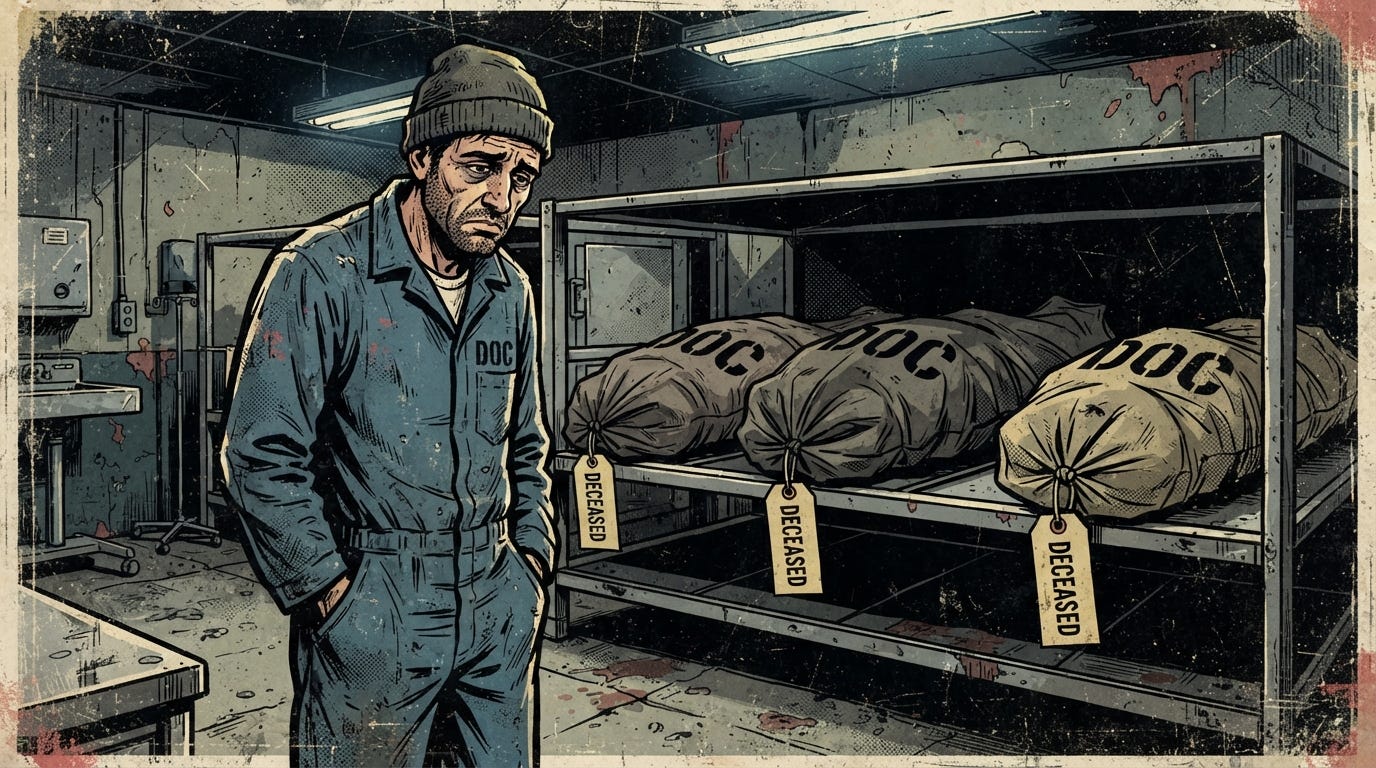
I worked in the hospital at the infamous Lake Butler Reception and Medical Center, tucked within a region littered with prisons in Northeast Florida. One of the first bodies I wrapped was a man so messed up inside, wracked with depression and an extreme level of psychosis, he ripped his own toenail off and hacked the veins in his elbow until he bled to death. The smell of that congealed, coagulated blood doesn’t leave your nostrils; oh no, it remains even after years and years of therapy. Taking men down after they hang themselves in confinement, freeing them loose, untying the knots, lifting them onto a gurney, rolling them in plastic, applying their toe tag, placing them into a morgue freezer, fractures something deep within your psyche. I watched a stupid, old, outdated VHS video and learned how to wrap men up like giant tootsie rolls. I was “educated” on the proper technique and the required etiquette to tag a big toe; well actually, I damn sure wasn’t. An inmate taught me that in the heat of the moment, while a lifeless corpse stared back at me. “Watch and learn.” Talk about a thousand-yard stare. I soaked it all the way up. I learned how to close a steel door on another soul and then walk away like it wasn’t shit. That was my freshman year at crime college.
Death is constant and deliberate. I thought prison’s where inmates do their time, learn a valuable lesson about life, and then go the hell home. It’s not. It’s where people die on whims. Officers place hits on your head because they think you offended their girlfriend nurse or disrespected her in some infinitesimal way. Inmates die over jealousy and greed. Over their egos and bullshit. Inmates are killed because a guard wants to send a direct message. Sometimes they get another inmate to perform the hit, like an officer tried to get me to do, because he didn’t like that another inmate might be getting out, was actually innocent, and had a lover coming to support him every weekend.
That officer asked me to do it while I was at the canteen window, just wishing to be back at my bunk reading a damn book, but no, this guy wants me to kill dude when I had less than three years remaining on my sentence, meanwhile he’s eating honeybuns and drinking Mountain Dew as he casually asks me to kill someone.
Murders get written up as suicides and “medical incidents” because DOC investigates itself. Talk about some shit that needs to get hit with the RICO Act. Inside, there’s no checks-and-balances system. It’s the sly fox guarding the vulnerable henhouse and writing the damn incident report when it’s really the fox that’s killing all the hens.
At Suwannee CI Annex they stuck me in confinement and made sure I knew I was nothing. Screamed at me and told me to kill myself at the confinement window, blowing a damn whistle the entire time. They laughed while they put me on a seventy-two-hour property strip. No mattress, definitely not any clothes. Just freezing cold air, more concrete, boxer shorts, a steel sink, and a steel toilet. You try sleeping in that environment and tell me how that works out for you. They tortured me. They sprayed me with their chemical agent of choice. They call it “Black Jesus” because they love laughing about how, after they spray a “Black boy” with it, it makes him holler for Jesus. What in the heck is that. That’s not correction. That’s racist chemical lynching with falsified paperwork that allows them to continue indefinitely.
I’ve seen a man struggle to breathe after inhaling chemical agents. Eh, well, that’s just another day at school. That’s one level of the college’s true horror. Hearing him struggle to breathe is one thing, but then watching him lifted and slammed full force onto a steel-grate walkway, on the second tier of my confinement wing, right outside my cell door, hearing the sound of his windpipe crushing, well, that’s another level entirely.
The breathing turns to gargles and then there’s nothing, because he’s dead. Knowing officers did the killing changes everything about what prison really is. This school is death. Pure and simple. It stalks you constantly. It whispers in your ear. It waits in the shadow at the edge of your vision. DOC wants you dead, one way or another, inside those walls or after you walk outside through those huge, scary, razor-wire fences.
Guess that was my sophomore year.
Prison is a crime college because it forces you into the ugliest curriculum just to stay alive. Orientation is confinement. No books. As the officers are prone to say, “Use your damn imagination, boy.” Watching yourself stare back at you from a tiny, faded, scratched metal mirror inside the cell, going bonkers. I’d count ten thousand steps back and forth across the cold hard floor and lose the number at six thousand, start over, and do it again. I’d listen to suicide, echoing down the wing when a man hangs himself as his feet bang against his bunk. That copper smell stinks when someone opens their arms with a razorblade. That dreadful metallic smell hits hard and makes every sense in my body light the hell up. Guards and their damn obnoxious whistle blowing, playing their terrible “Night Games,” dousing you with the orange mist of Black Jesus, banging on some poor soul’s window, then strolling down the tier to blame another man and set him up with that number-one prolific killer spray, sometimes just laughing and walking away. You’d dunk your only T-shirt in the toilet bowl, wrap it tightly around your face, then scramble and dive under the bunk, taking shallow breaths through your nostrils, only your nostrils, or you might choke to death.
On property strip everything’s taken. Think about the word “everything,” then imagine yourself in a stripped-out, bare closet, alone in white boxer shorts with the AC blasting if you’re lucky enough to find yourself in a climate-controlled institution (kidding), or baking and sweltering in a pool of your own sweat if you aren’t so lucky. You decide which is better.
You’re alone with a cold steel rack without a mattress and a steel toilet. I shivered for three days and learned the only way to sleep was to do a thousand jumping jacks so my blood circulated, then I’d sit on the metal toilet, fold my arms over my chest like I’m jumping out of a helicopter, tuck my head into my knees and steal twenty minutes of sleep before the cold catches me once again.
I’d count myself lucky when I discovered an ant and communicated with her like she was my last friend on Earth, watch her walk circles and squares on the floor, save cornbread crumbs because I knew she was hungry too. I’d headbutt that damn tin or steel mirror that barely reflected my face and tell myself I’m a lion, a warrior, the kind of man who can handle any-damn-thing, that I’ll never break.
Screw this.
Damn these officers.
And anyone who tries to mess with me.
You’ve got to choose who you’re going to be from the jump, or you get swept up into the crime college, and those ethics and that class curriculum only make strong mothers weep more tears.
At Taylor Correctional Institution, crime college turns into advanced seminars. The dorm goes dark at lights out. K-2 smoke hangs in the air. Guys “gook out” (not the racial term from Vietnam - the act of going into a seizure from the K-2 overdose) on spice and think they’re snakes or have conversations with the devil. Men strap up. They tie magazines to their ribs with plastic wrap, wrap their arms with blankets and sheets, lace their shoes tight because there’s nothing worse than being caught in socks when the knives come out and the grip of rubber soles on the floor’s the only chance you have. Swords get bent off cooking racks in the chow hall bathroom, broken back and forth until the metal fractures, smuggled to the dorm and sharpened for hours on concrete, and the back-and-forth grinding sound is the prison’s lullaby. Shanks get carved from fence wire and Plexiglas. Razors handed out for shaving turn into weapons. Locks swing in canteen bags or hang off belts to smash whoever’s in front of you.
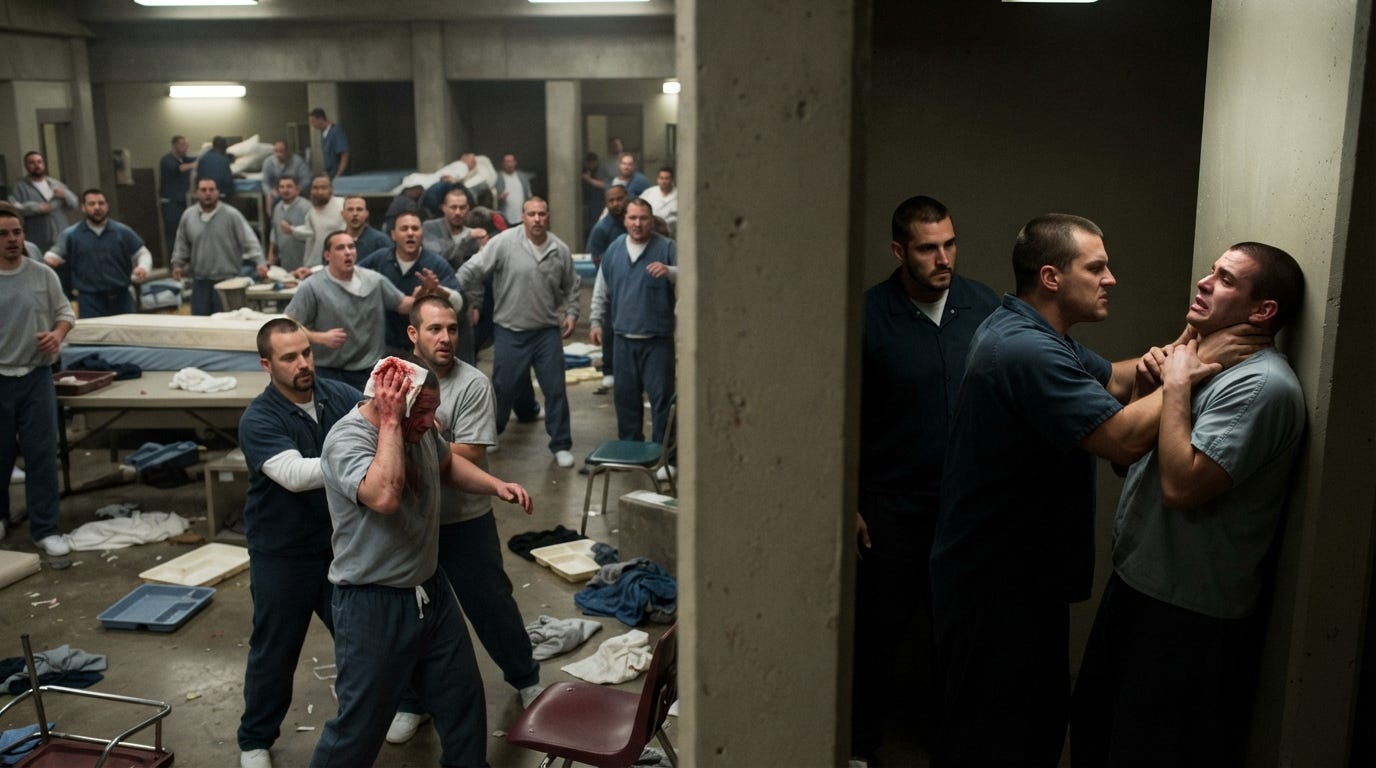
Most dorm riots are more about fear and control than actual murder. Most guys aren’t trained assassins. They’re scared men trying not to die. To kill somebody, you’ve got to be fully committed. Most aren’t. That’s why I saw more blood and stitches than toe tags during riots. But one-on-one, when there’s real beef or a guard wants someone gone, the danger spikes and the curriculum gets further advanced.
Every time a dorm erupts the lights flip on and off, the intercom screams “back to your bunks,” and suddenly everybody’s scrambling to hide weapons in vents and walls, washing blood that’s stuck under fingernails with bottled water, strapping on that clueless, lifeless mask for the goon search teams when they enter the dorm. I stood naked on slippery wet tile while officers barked their orders. Arms up. Mouth open. Tongue out. Turn around. Spread your ass cheeks, boy. Squat and cough. One foot up. Other foot. Then, ushered and herded into a hot dayroom with a hundred and twenty other men, pressed against the wall, wondering if the knife hidden over my bunk by my gang-member bunkee is about to get held up in my face with a sergeant demanding to know if I’m in a gang.
Yeah, that happened.
That’s what most people call “doing time.” A ten-year sentence of advanced riot practice, knife practice, survival practice, and sitting on bunks watching TV. Nobody’s talking about real mental health care. Nobody’s talking about house arrest with structure. It’s ten years of chaos and then, if you’re lucky, a bus ride home with a head full of shit you’ve never processed.
Some of my professors at crime college were inmates. Some were officers.
At Lake Butler the walls in the hospital used to say, “Browns Stick Together,” a reminder that brown-shirt officers protect each other first and last. Their oath doesn’t even mention prisoners. It pledges to guard fellow officers’ honor and life as their own, to be loyal to superiors and the institution, to do only those things that bring honor upon fellow officers and the institution. The people they’re supposed to correct don’t exist anywhere in it. That’s who holds the grades and uses their wooden pointer, or ruler, striking all who misbehave.
Prison seems hopeless and a complete waste of time if correction is the true aim. You walk out more wrecked than you went in. And don’t get me started on the monotony and the waiting around to see what pops off next. Half the time there’s literally nothing to do. It’s all on you to decide who you want to be and what you’re about. Where’s the real guidance.
Junior year.
Florida DOC’s slogan is “We Never Walk Alone.” On the outside it sounds like teamwork. Inside it’s gang writing. It means the most powerful crew in the system doesn’t wear colors. They wear badges.
It means when a guard beats you, sprays you, kills you, writes you up, ships you across the state, hides you in confinement, there’s a good-old-boy network standing behind him smoothing paperwork and closing ranks, moving up the ranks in fact. A few years back three Florida prison guards were arrested as active, card-carrying members of the Ku Klux Klan for plotting to murder a formerly incarcerated Black man, and I knew one of the officers personally. One way they wanted to do it was shoot him up with insulin and make it look like a medical emergency death and place a fishing pole inside his hands while he was only trying to catch a meal in the beautiful St. Johns River. That plot made the news, yet plenty of plots don’t. The names always change, but the culture stays the same, unwavering and very messed up.
There was Officer Red, weather-beaten, pushing fifty, with the murderous intelligence of a kid burning ants with a magnifying glass. He’d line us up and ask, “Who’s a pedophile on this wing?” Whoever got pointed out had to say the age of his victim. Under twelve. Under six. That’s more than enough. Redk’s slap would drop the first man, piss running down his pants, blood coming out his mouth and ears.
Then Officer M, known for killing people with his open palm once he slipped on black leather gloves, would go looking for a second “class project.” I’d see him slap a person so hard I just knew the administration was going to have to make up a real good story, like an English assignment at school.
First the seizure, then the fall. Anything but the truth. Inside Lake Butler and other camps, inmates are in gangs, but so are certain officers, and their gang has all the real power.
Senior year.
Then there was Officer Colon. Puerto Rican. Skinny. Rat-faced. Thought every woman on the compound wanted him. The type who likes to have an inmate cuffed behind his back before he starts punching, who loves spraying defenseless men with chemicals, setting up guys he doesn’t like with knives or drugs, getting off on watching people suffer. He had a girlfriend, Miss Piggy, who ratted out my friend Kennedy’s relationship with Nurse Marie. Kennedy wasn’t hustling Marie. It was mutual respect and love. The one thing prison’s supposed to erase. Piggy’s jealousy got Kennedy fired and beaten. After that Colon turned his eyes on me. Flaco brought the message. “You’re dead, Tatter.”
When guys on the pound told me Colon had put a contract hit on me, two ounces and a phone on my life, they said no. In a place where people will kill you for less, turning down that kind of payment is love. It doesn’t change the math. “Just because we didn’t take it,” they said, “doesn’t mean another dude won’t.” What a math lesson this school’s providing.
I made a Plexiglas knife, taped it to my leg under my blues, weighed down by it like I had Frodo’s ring, walked into the psych ward ready to make it him or me. My mom already knew the plan. If I hadn’t called by six-thirty, she’d be calling administration, calling Tallahassee, doing anything she could to stop the coverup. Colon sat in his chair, boots on the desk, three officers around him, tapping a pen like he was controlling the room with sound while my fingers inched toward the knife. After the speech I’d prepared, he dropped his chair with a bang, slammed the pen down and said, “Okay, Tatter. It’s dead. Don’t you ever walk down that hall while she’s working unless you’re escorted by another officer.” Hit canceled. Knife unused, thank freaking God. Just another day at work.
That’s what mercy looks like in this college.
For almost everybody around me, prison was just that: a complete waste of time. For me, it became a war zone I chose to turn into a classroom. Inside that crime college I started the very first inmate-led yoga program in the Florida DOC. I designed classes so men could overcome trauma and heal their bodies and souls. I studied Spanish and practiced skits with friends. I read every book I could get my hands on and used those books as mentors, leaning on them for support and inspiration. If they were going to cage my body, I was going to free my mind.
Arturo Pérez-Reverte’s books gave me history and honor codes, values, and morals to stand upon. David Benioff’s City of Thieves showed me how bad things can really get and still leave room for humor and humanity. Unbroken gave me courage when I felt literally broken from food poisoning, forced to spend hour after hour in confinement while officers decided whether I was faking or high on K-2 as fluids drained out of every part of me, and they still wanted me working the next day at the front gate. “This too shall pass” became my mantra.
I adopted survival as a mission. Live. Make it back home to my family and loved ones. Our families serve hard time too. They’re hostages of DOC right alongside us. Every missed birthday. Every canceled visit. Every phone call that costs way too much. My mom drove to see me, sent books, showed up for me the day I got out, and fought for me when my brain broke.
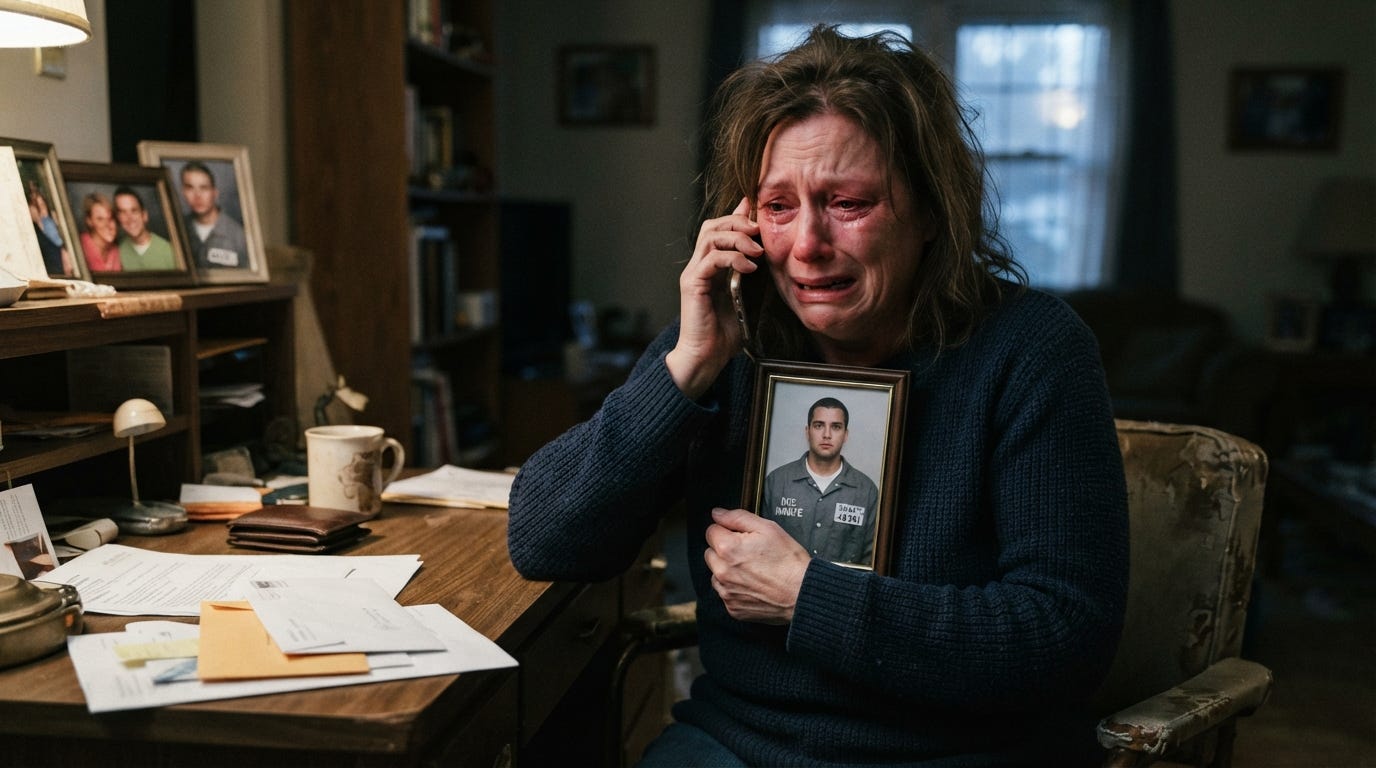
When we talk about “public safety” and “correction,” we never factor in the mothers, fathers, kids, lovers chained to those prison timelines. They’re paying for this crime college just as much as we are.
And this college is expensive… and YOU are the one paying for it with YOUR tax dollars.
All this might be okay if prison actually provided rehabilitation and help afterward. It doesn’t. Prison doesn’t heal trauma. It multiplies it by magnitudes. It does nothing to fix behavior that community alternatives and mental health care couldn’t handle more humanely, more safely, and far cheaper. It’s a big, expensive revolving door of recidivism, and then they want to point at that revolving door as an excuse to build more prisons.
I went for another degree after graduation.
My brain finally short-circuited in January 2021, after being released back to society in August 2018. I wasn’t on drugs. I was on years of institutional warfare.
The truth is simple. A year of mental health care or structured house arrest does what steel doors, concrete walls, and razor fences never will. My real rehabilitation didn’t happen within the belly of the beast. It happened because the minute I bonded out, I had my mom drive me straight to Epic Behavioral Healthcare in St. Augustine. I showed up every week, sometimes twice a week, for two years. Got properly diagnosed with complex PTSD. Learned how to breathe again, started my yoga practice again, and finished my memoir, Count Time. After a brutal year fighting for my freedom, the court gave me six months of house arrest and five years of probation with a mountain of fees waiting to bleed my wallet dry. Those six months of house arrest, tied with Epic Behavioral Healthcare and actual structure, did more for public safety than ten years inside ever did. I was with my family and loved ones, I knew I’d messed up, and even way back then I wanted something different from the life I was living. I wasn’t happy. I was lost. As I focused on self-improvement, my determination continued to grow. I promised myself I’d commit to changing my life and do whatever necessary to make myself and my family proud.
None of that came from DOC.
Please call prison what it really is: state-sponsored human trafficking and a mass-incarceration nightmare. Every contract’s built on our bodies and a massive amount of sweat equity. The phones, emails, video visits, money transfers, commissary, food, medical, laundry, PRIDE labor, private prisons. Every time a family sends a dollar, a company gets rich. Every time a man picks up trash on the side of the road, or sews a uniform, somebody sells that product at full price while he earns pennies or nothing.
In Florida we earned zilch unless you were fortunate enough to land a job at PRIDE. Follow the money from every prison contract, every JPay transaction, every commissary markup, every food invoice, every medical payment, every phone fee, every money transfer cut, every bond that builds a new facility, every dollar of inmate labor that goes into a product, and you end up in one place, the state capital.
The people who’d have to authorize a real investigation are the same people whose names are already on the contracts. The mob would be impressed. I know they are. The paperwork, the silence, the insulation from accountability. It’s a rigged network engineered to be untouchable.
Even letters are part of the warehouse scam now. Physical mail’s banned. Every birthday card, kid’s drawing, family photo gets intercepted, scanned by a for-profit contractor, delivered as a digital file on a tablet, and families can’t even send stamps anymore, which was a form of currency and a way to write about what really happens inside prison walls between a daughter and a dad, a son and a mom, grandparents, aunties and uncles, friends, and lovers. They say it’s “contraband reduction,” but states that tried the same thing saw overdoses go up, not down. Cutting off real mail isn’t about safety, hell no, it’s strictly about control and erasure. It’s about making a person disappear while he’s still breathing and charging enormous fees every step of the way, and it makes me sick.
Go watch The Alabama Solution on HBO Max or rent it on Apple TV and sit with it. That’s really freaking happening in prisons. I know it is in Florida, too. All the killing and corruption, and all the human farming. Alabama, Florida, all the states are generating tons of cash by trapping people, renting out their labor, skimming their wages or not paying them at all, and calling it, ta-da, “justice.”
Florida’s the worst system I know, but these stories aren’t unique. They move across states like franchises with different logos but the same lucrative business model.
Grrrrrrr.
Inside Taylor CI, I watched a man die, struck with locks again and again by four guys while two more stabbed him. He dropped not even twenty-five yards beyond the dorm. I watched young guys like Sam come in with thirteen months and turn into targets. Sam looked white but was Latino. A predator with life was already sizing him up. Then at master count an officer walked in calling count time and stopped at Sam’s bunk, and made poor Sam walk the dorm, sashaying his hips, flicking his wrist, saying “Whoops, did I do that” around the perimeter of the dorm like freaking Urkel until count cleared. If Sam wasn’t a target before, he was after that shit.
School’s in session.
Another day a sergeant thought an inmate told on her, and she walked that man into every dorm on the compound, more than a thousand men, and announced he was a snitch and a “chump-bitch.” That’s a conscripted death sentence. The man was beaten so badly you couldn’t recognize him. That’s crime college. That’s our lesson from the judicial system. I learned what one sentence from a guard can do to my life, and it was a real eye-opener.
I’m not pretending everyone’s innocent. I know dudes who’d literally eat your face and then eat the fruit cocktail at chow (cafeteria) and not think twice about any of it. Flesh eaters exist. Child rapists exist. Predators exist. But most of us aren’t that. Most people inside made a series of terrible choices inside systems of poverty, racism, hate, addiction, and a legal structure where a halfway decent defense costs more than a family will ever be able to afford.
Plenty of people caught in the jaws of the legal world get a choice: let the judge decide your fate (while the District Attorney hangs a crazy amount of time over you) or plead guilty and pray the man or woman on the bench won’t railroad you, backtrack the real offer, and send you into a den of thieves, rapists, liars, and killers, with real predators residing inside a predatory, deranged system, ready to lock you up, throw away the key, and use our bodies as punching bags.
Chief Judge Pamela L. North told me that if I’d caught these charges in Maryland, I never would have served a ten-year mandatory sentence. That shook me. What is justice? Who is it truly for? What does it really mean when the same crime in a different zip code doesn’t bury a young man for a decade. It isn’t some clean, universal idea. It’s a map of power and politics and profit. And I was stuck on the wrong part of the crumpled-up map.
Dr. Kelly Vannan’s trash-can slide during a Lifelong Learning Institute lecture I helped co-lecture at Flagler College says it all. She told a room that’s what society thinks of us, that we’re trash. She said once we’re sent to prison and the doors slam behind us, nobody thinks about the trash once it’s thrown out. When I spoke, I put that trash can back up on the screen and said this: “The mob looked at trash and turned it into a multibillion-dollar business. That’s exactly what our government, the DOC, corporate shareholders, and executives think about. They look at the incarcerated and see money. They’re banking on the public not thinking about any of us because silence breeds profit. Mass incarceration’s a for-profit epidemic. It’s a corporate warehouse program where private contracts, bed quotas, and slave labor are dressed up as public safety. From Jim Crow attitudes in administration to modern slave labor on production lines, the incentives to lock us away, sign more contracts, extract a shitload more cash.”
I guess now I’m part of the Lifelong Learning Institute college program after the education prison taught me.
I’m not the only one saying this shit. The Marshall Project ran Joey Heilman’s essay, “I Spent 78 Days in a Violent Youth Jail. I Have PTSD For Life.” Seventy-eight days. Barely three damn months, and I’m not taking that away from him in the least. Twenty-two years later he’s still screaming in his car, still snapping back to beatdowns in the dark, still feeling his nervous system flip into survival mode at his kid’s school picnic. Less than one summer in a juvenile cage and his mind’s wired for flashbacks, fright, and panic.
So, what do you think a ten-year mandatory sentence in maximum-security adult complexes does? What about twenty years and thirty, or, like Joey, seventy-eight days? What do you think wrapping bodies does? What do you think dodging hits and watching officers kill people causes? It’s sure not about “correction.”
It’s damn structural damage, programming people like robots to mess up.
Without real help, all most people ever really do is stare at walls and bars surrounded by wild shit and call that “doing time.” What guidance is there in that? You’re stripped bare of identity and reduced to a number, an inmate, and a body in a crummy, uncomfortable bed. It takes a real solid mind and a shit-ton of stubbornness not to get swept up into the shitstorm of DOC, into the boredom, the violence, the dehumanization, the slow grind that eats your soul.
When you walk out, your sentence isn’t over. Every flashback adds more time. Every panic attack’s another few minutes lengthening your stay in college. Rehabilitation after prison should be the system’s priority. It isn’t.
The Department of Corrections isn’t trying to heal anybody. They want you as broken as you can get, and as desensitized and scared as you can possibly be. They want all your mess-ups to spike the recidivism tally and give them another excuse to play “Captain America,” posing like heroes in front of a razor-wire backdrop, all while cashing in their dirty prison poker chips for cold hard cash.
Courtrooms aren’t built to find truth. They’re stages where conflicting stories compete. Real defense costs a fortune, and innocent people go down every day just to fit a prosecutor’s narrative. People get sentenced to death who are completely innocent. In this setup it isn’t about what happened, oh no, it’s about what you can prove, and whichever story wins becomes the decree. If you can’t afford a story that beats the state, you lose your life. That’s the game, and that’s crime college inside, story war outside, and warehouse profit on top.
Here’s the part DOC never wants you to see. Former criminal defense attorney and retired Chief Circuit Court Judge Pamela L. North read my memoir Count Time and provided this blurb: “No more proof is needed that behind prison walls lies abundant untapped talent than this riveting account of prison life by Emmett Tatter. Far from portraying himself as a saint, Tatter provides us with a truthful description of his time inside, revealing questionable morality at times, also known as human behavior. All told in the most colorful and graphic manner.”
That’s a judge who’s seen thousands of cases, telling you straight that behind prison walls lies “abundant” untapped talent. We aren’t trash, nor villains, and not all of us are beastly monsters. We are human beings, screwed up and flawed, with questionable morality like every person walking the streets, but capable of telling the truth in living color and changing our lives. That’s the heart of this. DOC isn’t a superhero. It’s not the brave guardian in some comic book. It’s a worldwide syndicate in a flashy costume sporting a damn cape. It warehouses human beings, erases their gifts, bleeds them out of everything, and then sells you the story that it’s saving the day.
What a hero.
Learning this is how you truly graduate from the prison system’s colleges.
Not everyone outside’s blind. PEN America believes in incarcerated writers and lets us put our stories on paper. Reginald Dwayne Betts went from solitary to Yale Law and builds Freedom Libraries because he knows books save lives. Shaka Senghor, Ian Manuel, Keri Blakinger, and a whole army of people turned years inside into work that helps instead of destroys. My life’s part of that same ecosystem. Les Standiford, a New York Times bestselling author and founding director of the Florida International University Creative Writing Program, called Count Time searing and unforgettable. Dr. Baz Dreisinger, author of Incarceration Nations, a justice worker and professor at John Jay College who founded the Prison-to-College Pipeline, said my voice is a warning the world needs to heed “now more than ever.” John DeDakis, an award-winning journalist, former senior copy editor on CNN’s The Situation Room with Wolf Blitzer, and mystery-suspense novelist, called my story a raw, wrenching argument for prison reform and self-reform. Professors who support my work, Kelly Vannan, Kim Bradley, Mandy Miller, Allan Marcil, all saw the same thing: behind the mugshot and DOC number, there’s a real face staring back at you.
And it’s me looking at you, you looking back at me, at eye level.
My life proves the stigma’s bullshit. The only things that ever changed anyone I knew inside were the things the state tried to keep out. Books. Education. Yoga. Real mental health care. Real connection. My first love was reading and books mentored me when nothing else could. That’s why Freedom Libraries matter. That’s why PEN America matters. That’s why inmate-led yoga classes matter. Real journalism matters. On one rec yard we stood on prison grass and learned how to breathe together, and it helped. It changed our bodies and minds. It gave men something besides violence to show up for. It instilled freaking passion. Passion to be better and become resilient to the clutches of the DOC dream snatcher.
We don’t need more prisons. We need community mental health clinics on the front end of crime. We need house arrest and ankle monitors tied to therapy, classes, and work instead of warehousing people in concrete boxes. We need Freedom Libraries and PEN America style writing programs in every jail and prison so once a person falls in love with alphabetical letters and the books he or she has read, there’s another way to live, with a real chance in the free world. A chance to dream. We need inmate-built yoga and trauma recovery in every dorm, not just on the one yard, a couple of classrooms, where some crazy convict (me) decided to teach downward dog. We need real reentry on the back end. Housing. Jobs. Union-backed training. Ongoing therapy. Mentors. Someone who believes in you, the shit the system pretends is only optional. We also need to take the first step and choose to be different. We must decide to change, and with real programs and someone telling you you’re something other than a piece-of-shit convict, it makes your chances a hell of a lot better.
You build that and prison stops being the first answer. The crime college closes. Warehouse programs shrink, people heal instead of rot, and the state stops using bodies as sweat equity and starts treating them like actual human beings. It stops killing us and making our loved ones cry. Then, you finally start living in a country where “public safety” means safety, not profit.
The Wise Wolf gave me the chance to tell you what prison is really like, a crime college for some and a complete waste of time for others, doing nothing that a year of mental health care or house arrest couldn’t accomplish better. This is it. For most men I lived with, prison was ten years of staring at walls and learning how to survive violence. For me, it was redemption, and I refused to let hell own my story. I turned that college into my classroom for revolution. Yoga classes. Spanish skits in the dorm. Books stacked on the bunk. Therapy when I got out. I’m living proof that if we give people real tools instead of crap, they can make their time count instead of letting the big house count them as trash.
Until that happens, prison keeps winning. Look at recidivism and look at all the death counts inside the almost 1,700 prisons, and that’s just prisons, not our county jails. Look at overdose and suicide after release. Vegas doesn’t have shit on DOC. You walk into prison and the odds are stacked against your soul. You walk out and DOC’s standing there with open jaws, waiting for you to stumble so it can swallow you whole again.
Do this.
Watch The Alabama Solution. Let the killing and corruption and slave labor sink in. Then look back at everything I’ve told you here about Florida’s prisons, about crime college, about the warehouse program, about untapped talent wasting away behind a system that doesn’t give a damn.
Now be honest and ask yourself one final question.
The superhero with state-sponsored crime colleges popping up all over this country like poisonous mushrooms isn’t saving us.
So, who are the real gangsters?
And who the hell’s paying their salary.
Maybe the superhero you’ve been cheering for is just the gangster in costume, or suit.
Help keep the Wise Wolf howling.

Thank you for helping to open up this conversation @🐺The Wise Wolf up ✨✨✨ shine light down upon the DOC! It COUNTS 🌹🐦🔥
Emmitt you are loved