


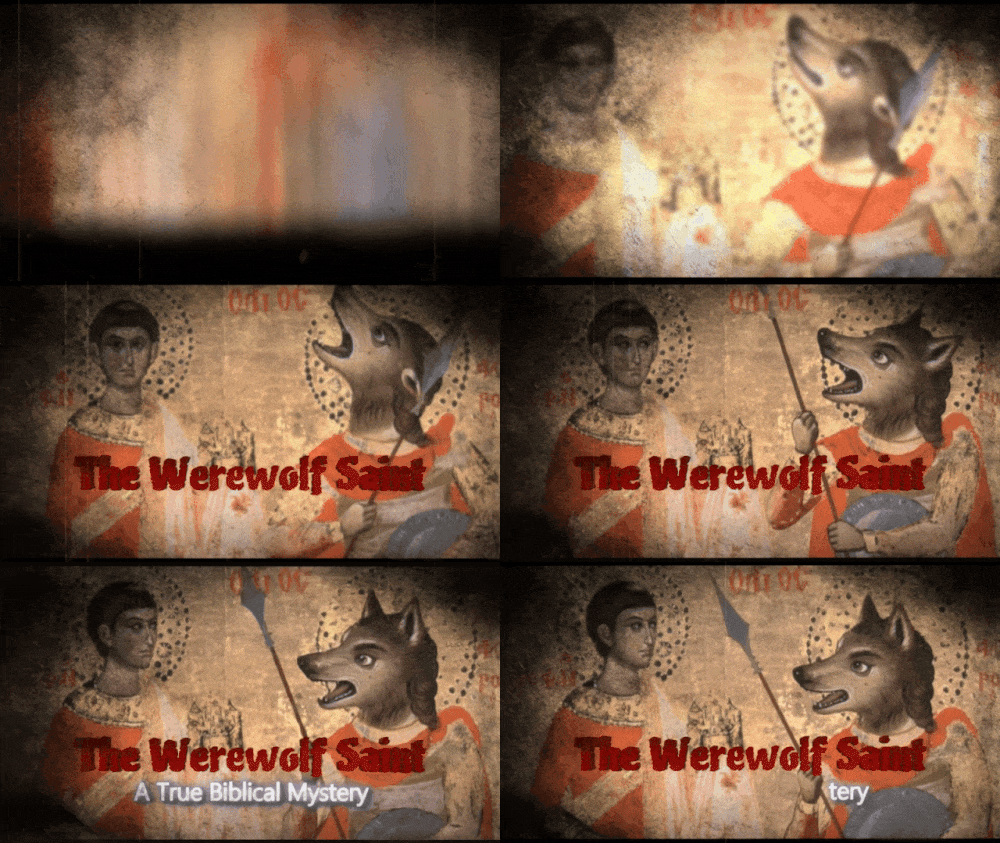
You won’t hear this in Sunday school but, buried in the oldest layers of Christian tradition, hidden in crumbling medieval manuscripts and banned Orthodox icons, there’s a saint who had the head of a dog.
Not symbolically. Not as a metaphor. Literally.
His name was Reprobus before his conversion, a name that means “scoundrel” or “reprobate.” He stood somewhere between seven and twelve feet tall depending on which account you read, and he came from a tribe of dog-headed warriors who lived at the absolute edge of the known world, who barked instead of speaking, who ate human flesh.
Then he heard the gospel, got baptized, and changed his name to Christopher, which means “Christ-bearer.” And then something happened that the sources can’t quite agree on.
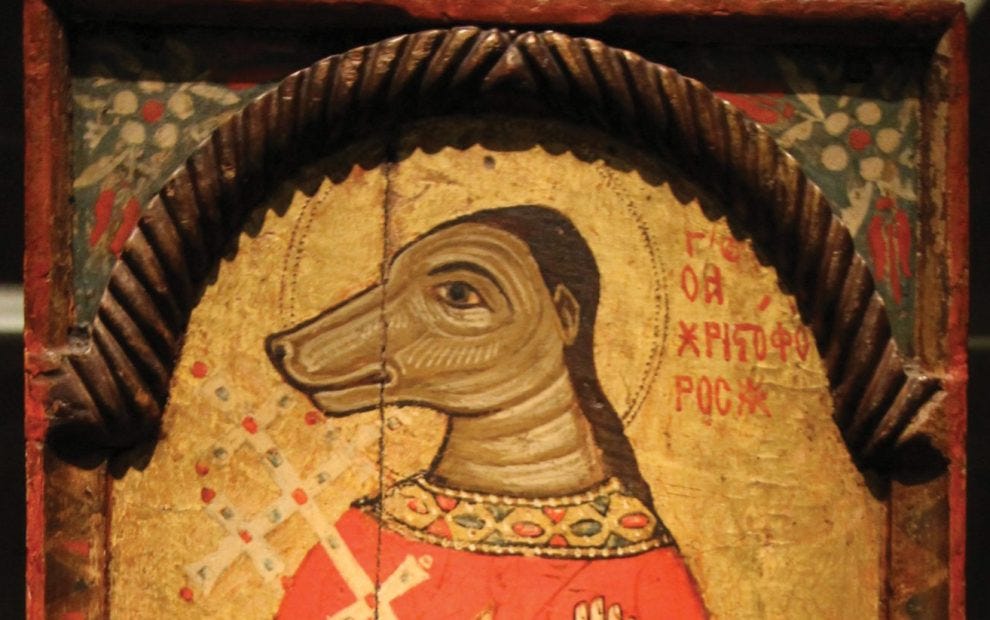
Some accounts say his dog’s head became human at baptism. Others keep him dog-headed right through his martyrdom. The German bishop Walter of Speyer wrote that he “was rewarded with a human appearance” after conversion. But the icons show him with that canine snout even as a saint, even performing miracles, even dying for Christ.
Was he physically transformed? Or was he always something more than just a monster, something that could move between forms? The sources won’t tell you straight.
Either way, he became one of the most popular saints in all of Christendom. Then the church tried to erase him.
Vatican II and the Old Believers
The Catholic Church quietly removed St. Christopher from the official calendar of saints in 1969, claiming Vatican II modernization and citing “lack of historical evidence.” His feast day got suppressed.
Meanwhile, millions of people still wear St. Christopher medals, still stick his image on their dashboards, still pray to him before traveling. The institution tried to erase him. The people refused.
The Orthodox Church still venerates Christopher, but things got interesting in 1722 when the Russian Orthodox authorities banned depictions of him with a dog’s head. The official state church forbade the image. The Old Believers refused to stop, kept painting him with that canine snout because they understood something the institution wanted buried.
Why would both branches of Christianity suddenly need to suppress the same saint? Not because they stopped believing the accounts. Because they needed to hide what those accounts actually meant.
Alexander and the Dog-Headed Warriors
The cynocephali weren’t just a Christian legend. They show up everywhere in ancient history, and the accounts are disturbingly consistent.
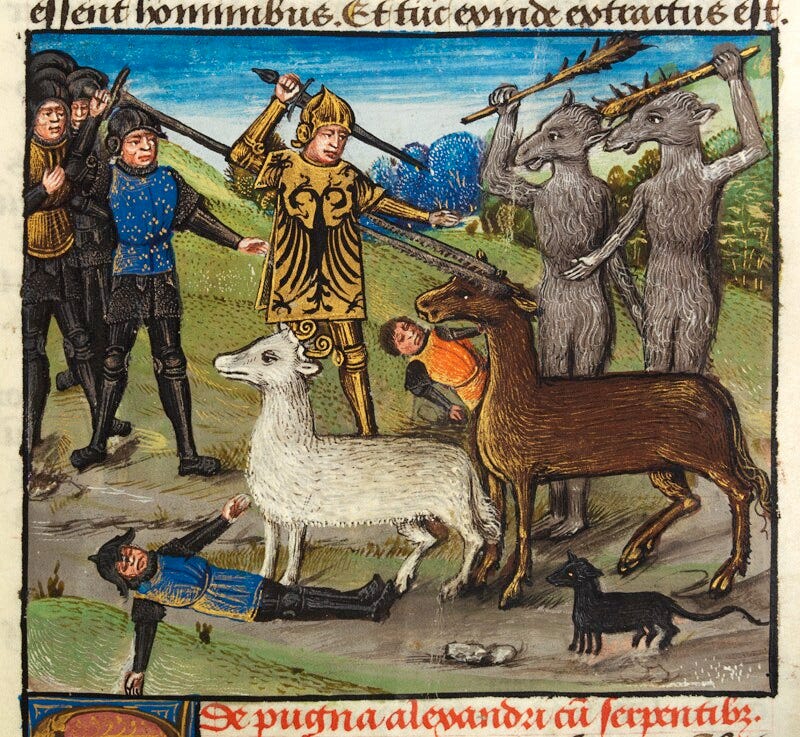
Alexander the Great wrote letters to his teacher Aristotle describing battles with these creatures. This guy was the greatest military genius in human history - he did not need to lie or exaggerate in order to get attention from his former tutor.
He called them fierce, vicious, barking warriors. Medieval manuscripts show Alexander’s army in pitched combat against soldiers with human bodies wielding swords and shields, but with the heads of fierce mastiffs. These weren’t fairy tales to Alexander. He claimed he captured several of them alive.
The Greek historian Herodotus placed them in Libya among the other strange races inhabiting the edges of the world. The physician Ctesias, traveling in India around 400 BC, wrote detailed accounts that are almost ethnographic in their specificity. He encountered an entire civilization of dog-headed people. 120,000 of them, he claimed, living in mountain caves, shepherding flocks, hunting with terrifying efficiency. He described their teeth as larger than dogs’, their nails long like claws. They barked to communicate with each other but understood human speech. They lived up to 200 years, slept on leaves or grass, and were shepherds who raised sheep, goats, and asses. The richest wore linen. The rest wore tanned animal skins.
Marco Polo saw them in the Andaman Islands, describing them as having “heads like dogs, and teeth and eyes likewise; in fact, in the face they are all just like big mastiff dogs.” Columbus heard reports of them in the Americas. Chinese Buddhist missionaries spotted them on islands to the east.
King Arthur supposedly fought them in the mountains around Edinburgh.
And here’s what you need to understand about the pattern. Wherever the boundary of civilization pushed outward, travelers reported dog-headed men at that new edge. If Alexander encounters them in Asia Minor, King Arthur encounters them in Scotland, Charlemagne sees them as Vikings from Scandinavia, and Marco Polo and Columbus find them even further out. The limit of the known world always appeared monstrous.
The question isn’t whether people believed in them. They absolutely did, across every culture, for thousands of years.
The question is why we stopped talking about them.
Werewolves, Lycanthropy, and Bloodline Curses
The dog-headed men and werewolves share the same mythological DNA. They’re two versions of the same thing, and medieval theology understood them both as expressions of corrupted bloodlines.
Lycanthropy comes from the Greek words for wolf and man. King Lycaon got turned into a wolf by Zeus for serving human flesh to the gods. The same crime Christopher’s people committed. The same transformation. The same curse. Throughout medieval Europe, werewolf trials prosecuted people for transforming into wolves and devouring human flesh. These weren’t theoretical.
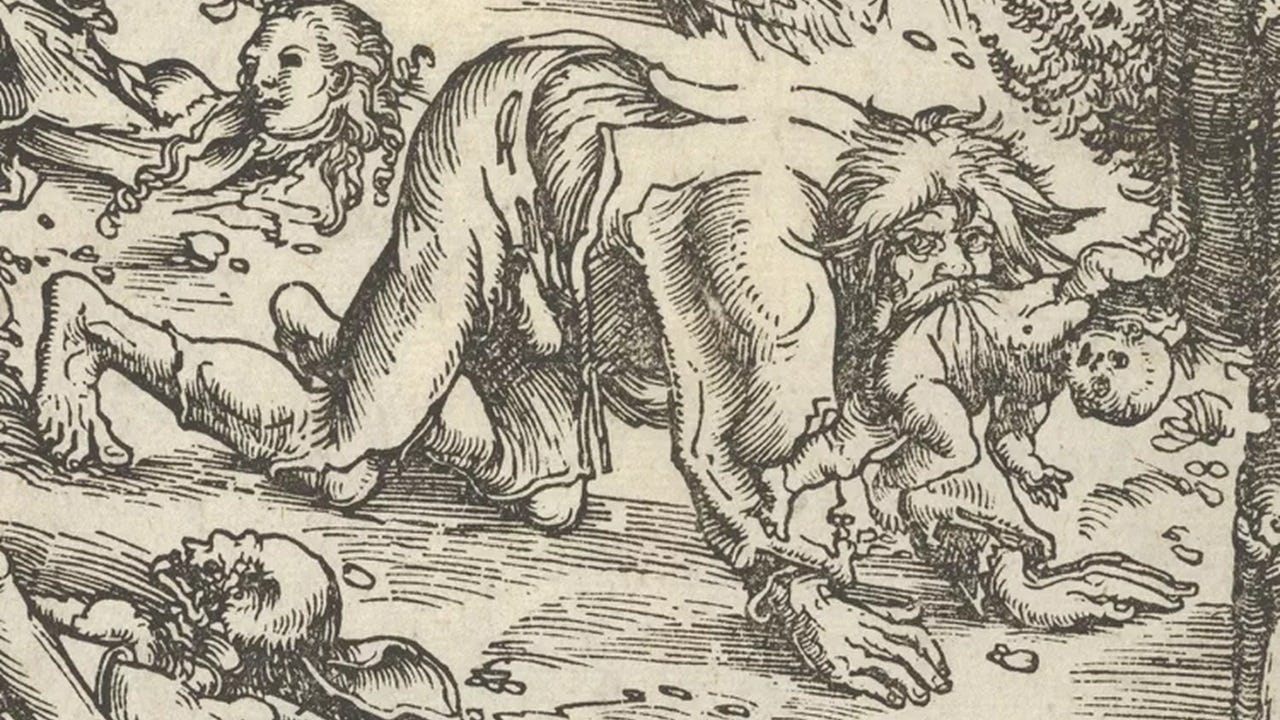
In 1521, Frenchmen Pierre Burgot and Michel Verdun allegedly swore allegiance to the devil. As a reward, he gave them ointment that turned them into wolves. After confessing to brutally murdering several children, they were both burned at the stake.
What connects all these accounts is that both werewolves and dog-headed men were understood as bloodline curses. Something inherited. Something that ran in families, passed down through corrupted ancestry. The transformation wasn’t random. It was genealogical.
Medieval texts offer three origins for lycanthropy. A curse from someone with power, a deal with demonic forces, or birth. You were cursed by someone, you made a pact, or you were born into it. Your ancestors’ sins made you this way. The physical form you took expressed the spiritual corruption in your bloodline.
And this is where the church’s theology gets uncomfortable. Because they believed this absolutely. They believed in generational sin, bloodline curses, demons, spiritual warfare. They believed the Nephilim had once walked the earth and that their corrupted bloodlines scattered after the Flood, producing the giant races, the monstrous peoples at the edges of the world.
So why would they suddenly start denying that dog-headed men existed? Why ban the icons? Why suppress centuries of consistent testimony?
Not because they stopped believing. Because they knew it was true and they needed to hide it.
The Nephilim Problem
These bloodlines didn’t die out. That’s the part nobody wants to say out loud.
The Nephilim scattered after the Flood. They adapted. They learned to hide. And their primary target has always been the same: the Church of Christ, the one institution on earth with the power to break their curses, to expose their nature, to offer genuine freedom through baptism.
If people knew that shapeshifting beings were real, that corrupted bloodlines produced actual monsters, that the cynocephali weren’t just medieval superstition but evidence of something that’s still out there, still influencing world events, still infiltrating institutions, everything changes.
Christopher is dangerous because he’s proof. Proof that these bloodlines exist. Proof that they can be redeemed. Proof that baptism has power over even Nephilim corruption. And if people understood that, they’d start asking who else carries these bloodlines. Who else can shapeshift. Who else has been hiding in plain sight.
The church had to bury Christopher because the alternative was admitting that the war isn’t over. That the enemy bloodlines didn’t disappear after the Flood. That the powers and principalities Paul warned about have literal, physical, genetic manifestations walking among us.
And worst of all, that the institutional church itself might have been compromised. Because if you wanted to neutralize the Church’s power to expose these bloodlines, to break their curses, what would you do?
You’d infiltrate it.
Make sure certain truths never get preached from the pulpit. Make sure saints like Christopher get quietly removed from the calendar.
Canaan, Babylon, and the Cursed Tribes
Christopher was explicitly linked to the land of Canaan. Some accounts call him a Canaanite. And that word got confused (or was it confusion?) with “caninus,” the Latin for “of the dog.”
But this isn’t just linguistic wordplay. The Canaanites were the descendants of Ham, cursed by Noah, and they were the giants in the land: the Nephilim, the Rephaim, the Anakim. These were the people Israel was commanded to drive out completely, to show no mercy, to utterly destroy. Not because God was randomly genocidal, but because their bloodlines had been corrupted beyond saving. Mixed with fallen angels. Steeped in abomination. The physical giants and monsters in the land were the result of genetic corruption that went all the way back to Genesis 6, when “the sons of God came in to the daughters of men and they bore children to them.”
Babylon carries the same weight in biblical symbolism. The ultimate expression of human pride and rebellion against God. The tower builders who said “let us make a name for ourselves.” God scattered them, confused their languages, sent them to the ends of the earth. Some Christian traditions hold that the monstrous races descended from this scattering. Their physical deformity reflected their spiritual corruption.
The dog-headed men were understood as the remnants of these cursed tribes. Scattered to the edges. Marked in their very bodies by the sins of their ancestors going back to Babel, back to Canaan, back to the mingling of fallen angels with human women.
The Medieval Irish Passion of St. Christopher states it plainly. “This Christopher was one of the Dog-heads, a race that had the heads of dogs and ate human flesh.”
Not “looked like” dog-heads. He was one. Past tense. Before his conversion.
Reprobus the Cannibal Giant
So let’s be clear about what we’re dealing with.
Reprobus the scoundrel, standing somewhere between seven and twelve feet tall depending on the account, a giant either way with a dog’s head, sharp teeth, barking instead of talking. This wasn’t just some disfigured man. This was a Nephilim throwback, a Canaanite giant with the head of a beast.
He was captured in battle by Roman forces fighting in Cyrenaica, west of Egypt. He was reported to be of enormous size, with the head of a dog instead of a man, both apparently being typical of the Marmaritae tribe he came from. He and his unit were transferred to Syrian Antioch, where everything changed.
Everything about him screamed “unredeemable”: cursed bloodline, physically monstrous, cannibal, part of a tribe of warriors who ate human flesh, as far from the image of God as you can get and still be considered remotely human.
But then he heard the gospel.
The accounts vary on exactly how it happened. Some say he was seeking the most powerful king in the world. He served one king, then discovered that king feared someone else, so he left to serve that greater power. He found the devil and served him, until he saw the devil afraid of Christ. So he went looking for Christ. When he found him, or when Christ found him, everything changed.
Other accounts say Bishop Peter of Attalia baptized him directly in Antioch.
But what happened at that baptism is where the sources start to diverge in ways that should make you pay attention.
The Mystery of the Transformation
Walter of Speyer, the German bishop writing in the late 10th century, says clearly that Christopher “was rewarded with a human appearance, whereupon he devoted his life to Christian service and became an athlete of God, one of the soldier saints,” describing a full transformation from dog to man, monster to saint, the curse broken at the moment of baptism.
But then you look at the icons that kept getting painted for centuries after that. And there’s Christopher, still dog-headed. Still with that canine snout. But everything else has changed. He’s holding a cross. He’s wearing the robes of a saint. He’s performing miracles. He’s being martyred for Christ. The dog’s head is still there, but his nature has been transformed.
So which is it?
Did his head literally transform at baptism, the dog’s skull reshaping itself into human form as he came up out of the water? Or did something else happen?
The traditions about Cain’s bloodline offer another possibility. Cain’s descendants were said to possess the ability to shapeshift, a trait that appears throughout ancient accounts. The Viking stories of Loki and his giant offspring, the trickster gods who moved between forms at will, echo this older tradition. Cain himself is the archetype of the shapeshifting trickster, the one who wore different faces.
If Christopher carried this bloodline, then maybe the sources disagree because both things were true. Maybe he could appear human when he chose. Maybe the dog’s head remained for those with eyes to see what he really was. Maybe baptism didn’t remove the ability but changed who controlled it, breaking the curse without erasing the mark entirely.
Or maybe the icons kept him dog-headed deliberately, refusing to hide what he had been and making the point visible that even this can be redeemed.
Or maybe both accounts are true in ways we’re not equipped to understand. Maybe for some who saw him, he appeared human. For others, the dog’s head remained visible. Maybe it depended on their spiritual state, their ability to perceive what was really there.
What’s undeniable is that the cannibalistic nature vanished, the barking became speech, became prayer, became preaching, and the scoundrel became the Christ-bearer as Reprobus the reprobate transformed into Christopher the saint.
Whether his skull physically reshaped itself in the baptismal waters or whether he carried that dog’s head all the way to his martyrdom, he was transformed. The curse no longer owned him.
If Reprobus can be saved, anyone can.
What the Icons Actually Say
When you find an icon of dog-headed Christopher (and you have to hunt for them now, they’re deliberately rare), you’re not looking at medieval ignorance or confused etymology or artistic license. You’re looking at a carefully constructed theological statement.
Some icons from Pentecost show dog-headed men in the crowd receiving the Holy Spirit alongside normal humans. These aren’t decorative flourishes but a carefully constructed theological point that the gospel reaches even the cynocephali, even the ultimate foreigner, even the creature at the absolute edge of what can be considered human.
The term “dog” appears throughout Scripture as the ultimate insult, the final category of the unclean and unredeemable. When the Canaanite woman approached Jesus, he spoke of not taking the children’s bread and throwing it to the dogs, referring to her status as a Gentile outsider. But what did Jesus do? He healed her daughter anyway. The gospel broke through the boundary.
Christopher with his dog’s head is the church saying “this far. Christ’s redemption reaches this far.” And if it reaches that far, if it can save even Reprobus the twelve-foot dog-headed cannibal from the cursed Nephilim tribes scattered from Babylon, then it can reach anyone.
The image isn’t a metaphor. It’s a literal, historical, theological promise that no one is beyond redemption. No bloodline too corrupted. No curse too deep. No nature too monstrous.
Baptism and Bloodline Curses
The Bible is explicit about generational curses. Exodus 20:5-6 warns that God visits “the iniquity of the fathers upon the children to the third and fourth generation.” The word “iniquity” means to be bent toward a certain sin. The child will be bent like his parents, grandparents, great-grandparents. An inner inclination toward the same sinful habits, the same patterns, passed down through the blood.
The Old Testament is full of this. Entire families suffering because of what their ancestors did. Bloodline curses. Generational sin. The Babylonian captivity as punishment for generations of rebellion. The exile of Israel because their fathers’ fathers had turned from God.
But the New Testament says something else. It says Christ became a curse for us. That when he hung on the cross, he took upon himself the curse for our wrongdoing. That in him, the curse of the law is broken. That if anyone is in Christ, he is a new creation. The old has passed away. Everything becomes new.
Including your bloodline.
Christopher is the proof of concept. He carried in his very body the marks of cursed ancestry. The dog’s head wasn’t just a birth defect. It was the visible, physical manifestation of what he came from. Canaan. Babylon. The scattered tribes. The corrupted bloodlines. The mingling of fallen angels with human women. All of it written in his DNA, expressed in his monstrous form.
And baptism changed something fundamental.
Whether it wiped out the physical curse entirely or gave him mastery over it, whether his face became permanently human or he could shift between forms as needed, the sources argue. But they all agree on one thing: he was no longer bound by what he had been born into as the curse broke and the monster became the saint.
That’s the scandal the institutional church can’t handle. Because if baptism has that kind of power, if it can literally break a Nephilim bloodline curse, then maybe we’ve been thinking about salvation all wrong.
Maybe it’s not about being good enough. Maybe it’s not about having the right ancestry or the right bloodline or the right anything. Maybe it’s not about centuries of church membership and sacraments and hierarchy.
Maybe it’s just about getting in the water and letting God do what only God can do.
And maybe what God does looks different for each person. Maybe for Reprobus, it meant his head changed. Maybe it meant he finally controlled the change instead of being controlled by it. Maybe it meant both, depending on who was looking and when.
Either way, he was free.
Why This Matters Now
The gospel says it’s for all nations. But what about the monstrous nations? What about the dog-headed warriors? What about the descendants of the cursed tribes? What about the bloodlines so polluted they produce twelve-foot cannibal giants with the heads of beasts?
Christopher is the answer. Even them, especially them.
Because if the gospel can’t reach the cynocephali, if it can’t transform Reprobus, if there’s any bloodline so cursed or nature so corrupt that baptism can’t touch it, then it’s not really good news. It’s just another system of worthy and unworthy, saved and damned, us and them.
But if it can reach even the dog-headed cannibal from the cursed tribes at the edge of the world, then it can reach anywhere. Anyone. Everyone.
That’s why they had to bury it. That’s why they had to ban the icons. That’s why your pastor has never mentioned it. That’s why the Catholic Church removed him in 1969 and why the Russian Orthodox Church banned his image in 1722.
Christopher the Cynocephalus is too powerful. He’s proof that the gospel is weirder, wilder, and more dangerous than the church wants you to know. He’s proof that transformation is real. Not metaphorical. Not symbolic. Real.
The kind of real where something changes when you come up out of the baptismal waters. Whether that’s your physical form shifting or your relationship to that form fundamentally altering, the sources can’t agree. But they all say the same thing underneath: you’re not what you were, and the curse doesn’t own you anymore.
Every time Christianity gets too institutional, too controlled, too sanitized, movements emerge that go back to the weird stuff. The desert fathers went into the wilderness to fight demons face to face. Celtic Christians found thin places where heaven touched earth and the supernatural bled through. Eastern mystics practiced the Jesus Prayer until they saw the uncreated light of God. And the Old Believers kept painting Christopher with his dog’s head long after the official church banned it, because they understood something the institution had forgotten.
The power isn’t in the institution. It’s in the baptismal water. It’s in the blood of Christ. It’s in the moment of transformation when the curse breaks and the monster becomes the saint.
We are all, in our own way, dog-headed monsters from cursed bloodlines, standing at the edge of what can be redeemed, barking when we should be speaking, hungering for things that will destroy us, marked in our bodies and souls by the sins of our ancestors and our own choices.
And the gospel says come, be baptized, be transformed, become a Christ-bearer, even you, especially you.
That’s the message they don’t want you to hear. That’s why they buried Christopher. Because once you understand that even Reprobus can be saved, you realize that salvation is bigger and stranger and more powerful than any institution can control.
The werewolf became a saint. The monster became the Christ-bearer. The cursed bloodline got cleansed.
And if it happened to him, it can happen to you.
If this opened your eyes to something the institutional church has been hiding, share it. Other Christians need to know that the battle against satanic bloodlines is real, that the Nephilim corruption didn’t end with the Flood, and that even those trapped in the darkest bloodlines can find redemption through Christ’s blood. The gospel reaches further than we’ve been told.
If you can afford it and want to support this kind of research that the mainstream church refuses to touch, consider becoming a paid subscriber. We’re running 50% off annual subscriptions all through December. We’re a small ministry doing the work others won’t, digging up the suppressed truths that make institutional Christianity uncomfortable.
But whether you subscribe or not, get this information out there. People need to know what Christopher really was, and what his transformation proves is possible.
This is so wild to read after yesterday being algorithmed by tales of the Dogman sightings of Michigan, Ohio, Mississippi, etc - I can attest that the Hill Country of Northeast Mississippi is still both quite feral and rural, and rife for cryptids.
What it's more proof of is the transforming power and blood of Jesus Christ 🙌 🔥 🕊 over Christopher's life.