
Forbidden Archaeology: The Biblical Artifacts Hidden in Government Vaults
Hidden beneath museum basements and government vaults lie artifacts that could rewrite everything we know about ancient history. Here's why powerful institutions will do anything to keep them buried.
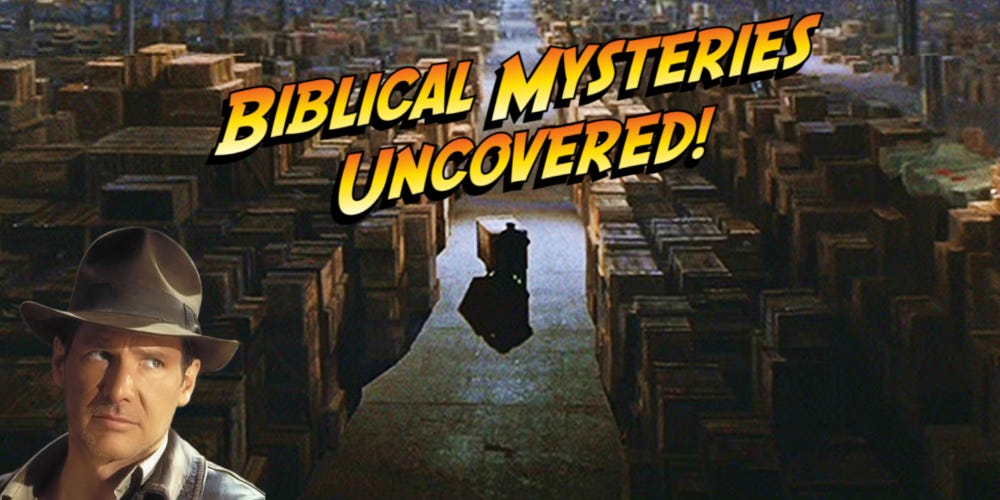
Remember the final scene in Raiders of the Lost Ark? Indiana Jones watches helplessly as government agents wheel the Ark of the Covenant into a massive warehouse, disappearing it among countless other mysterious crates. The camera pulls back to reveal row after row of identical boxes stretching into the darkness, suggesting that world-changing artifacts are routinely buried in bureaucratic storage. Steven Spielberg intended it as fiction, but what if this scenario isn't as far-fetched as we think?
The Giant Skeleton Conspiracy
Deep in the dusty archives of the Smithsonian Institution, according to whistleblowers who have risked their careers to speak out, lie the bones of giants. Not metaphorical giants. Actual skeletal remains of humans standing 9, 10, even 12 feet tall, with skulls so massive they barely fit in standard storage containers.
But you'll never see them in any museum display.
For over 150 years, these sources claim, a systematic campaign has been underway to hide archaeological evidence that would fundamentally challenge our understanding of human history and validate accounts recorded in the world's oldest texts. The stakes? Nothing less than the collapse of established scientific paradigms and the vindication of ancient scriptures that billions hold sacred.

Then, around 1920, something changed. The reports stopped. The evidence vanished.
"Every single giant skeleton ends up in the same place," claims researcher Jim Vieira, who has catalogued over 1,500 newspaper accounts of giant discoveries. "The Smithsonian. And then they disappear forever."
The official explanation? Misidentified animal bones and exaggerated measurements by untrained observers. But critics point to detailed descriptions by qualified archaeologists and the suspicious pattern of evidence consistently vanishing into the same institution.
Why would anyone want to hide proof of giants? The answer lies in Genesis 6:4: "There were giants in the earth in those days, and also after that" The phrase "and also after that" suggests giants didn't vanish with the flood but continued to exist throughout human history. For millions of believers, finding these remains would prove biblical accounts weren't mythology but historical records of a world where giants still walk among us. The implications are staggering: if giant bloodlines survived into modern times, who are their descendants today?
The Search for Noah's Ark: A Government Cover-Up?
High on Turkey's Mount Ararat, satellite imagery has captured what appears to be a massive wooden structure preserved in ice for millennia. The dimensions match biblical descriptions of Noah's Ark precisely: 300 cubits long, 50 cubits wide, 30 cubits high.
Multiple expeditions have claimed to reach the site, bringing back samples of ancient wood and reporting internal compartments consistent with an enormous vessel. In 1959, Turkish Air Force Captain İlhan Durupınar photographed an unmistakable boat-shaped formation. Ground-penetrating radar revealed what appeared to be internal chambers and metal fixtures.
Yet accessing the site remains nearly impossible. Turkish military restrictions, dangerous weather conditions, and what some researchers describe as deliberate bureaucratic stonewalling have prevented thorough investigation.

If authenticated, Noah's Ark would represent the most significant archaeological discovery in human history, providing physical proof of the global flood described not just in the Bible, but in the mythologies of cultures worldwide. The implications would ripple through geology, archaeology, theology, and our entire understanding of human origins.
Exodus Evidence Hidden in Plain Sight
At the bottom of the Red Sea, according to controversial archaeologist Ron Wyatt, lie the corroded remains of Egyptian chariot wheels, horse hooves, and human bones. The evidence, he claimed, of Pharaoh's army destroyed during the Israelites' miraculous escape from Egypt.
Wyatt's team reported finding wheels with four, six, and eight spokes, consistent with Egyptian military equipment from the time of the Exodus. Coral formations had grown around bronze and gold components, preserving them in recognizable shapes. Underwater photography allegedly captured formations that could only be ancient military artifacts.
But attempts to verify these claims have been met with restrictions from Egyptian authorities and dismissal from mainstream archaeologists. The sites remain off-limits to independent investigation.
Meanwhile, in Saudi Arabia, a mountain called Jabal al-Lawz shows signs of having been subjected to intense heat that turned its peak black. Local Bedouins call it the "Mountain of Moses," claiming their ancestors passed down stories of the prophet receiving divine revelation there. The mountain sits in a restricted military zone, effectively barring archaeological investigation.
"The evidence for the biblical Exodus is overwhelming once you know where to look," Wyatt argued before his death. "The problem is they won't let anyone look."
The Forbidden Excavations of Biblical Cities
In the dusty hills of Israel and Jordan, archaeologists have made discoveries that seem to validate biblical accounts with stunning accuracy. Yet many of these sites remain mysteriously under-excavated or off-limits to independent researchers.
Take the ancient city of Sodom, which archaeologist Dr. Steven Collins believes he has located at Tall el-Hammam in Jordan. The site shows evidence of sudden, catastrophic destruction around 1700 BCE, with temperatures reaching over 2,000 degrees Celsius. Pottery melted into glass. Human remains instantly vaporized.

Yet full excavation has been limited, and attempts to conduct extensive geological surveys have faced bureaucratic obstacles. "The evidence for the biblical destruction of Sodom is overwhelming," Collins argues, "but there seems to be little appetite for discoveries that would validate scripture too directly."
Similarly, recent excavations at Khirbat Qeiyafa have uncovered what appears to be a massive fortified city from the time of King David. The site contains Hebrew inscriptions and urban planning that matches biblical descriptions of Israelite cities. Carbon dating places it precisely in David's era, challenging scholarly claims that the biblical kingdom was too small and primitive to build such structures.
"Every shovel of dirt seems to confirm what the Bible said all along," notes one archaeologist who requested anonymity. "But publishing findings that too strongly support biblical historicity can be career suicide in academic circles."
Meanwhile, in Jerusalem, the Temple Mount remains one of archaeology's greatest mysteries. Despite being the most sacred site in Judaism and the location of Solomon's Temple, systematic excavation has been virtually impossible due to religious and political sensitivities. Yet construction work has occasionally uncovered artifacts that suggest the biblical accounts of temple wealth and grandeur were not exaggerated.
Sealed chambers beneath the mount allegedly contain treasures and artifacts from the First Temple period. Some researchers claim these hidden chambers hold the original Ark of the Covenant, along with other biblical artifacts that would prove the historical accuracy of Old Testament accounts.
"The evidence is literally buried beneath our feet," argues biblical archaeologist Vendyl Jones, who spent decades searching for temple artifacts. "But accessing it would require admitting that the Bible got the details right."
The Institutional Machine
Why would evidence of such monumental importance be suppressed? The reasons run deeper than simple academic stubbornness.
Careers spanning decades have been built on established timelines and evolutionary models. Entire university departments, museum exhibitions, and textbook industries depend on maintaining current paradigms. Admitting that fundamental assumptions were wrong would require not just rewriting history books, but acknowledging that alternative researchers dismissed as "fringe" were right all along.
Religious institutions face their own dilemma. While biblical validation might seem welcome, it could also raise uncomfortable questions about which interpretations are correct and what other "myths" might be literal truth.
Government interests add another layer. Archaeological discoveries can influence territorial claims, tourism revenue, and geopolitical relationships. Some sites sit in regions where religious or political sensitivities make investigation dangerous.
"There's too much at stake," argues one anonymous museum curator who claims to have witnessed evidence being quietly archived. "Too many reputations, too much money, too many beliefs that would have to change."
The Evidence Mounts
Despite official dismissals, evidence continues to surface. Leaked photographs from restricted sites. Testimonies from researchers who claim they've been threatened or discredited for pursuing sensitive discoveries. Satellite imagery that reveals structures too perfect to be natural formations.
Social media has become a battleground where amateur researchers share findings that mainstream academia refuses to acknowledge. Videos of giant bones surface and disappear. Photographs of impossible artifacts circulate before being debunked or explained away.
Each piece of evidence, taken alone, might be dismissed as hoax, misidentification, or wishful thinking. But the pattern suggests something more systematic. A coordinated effort to ensure that certain discoveries never reach public attention.
What This Means for You
If even a fraction of these claims proves accurate, the implications are staggering. Human history would be revealed as far more complex, ancient, and advanced than we've been taught. Religious texts would gain credibility as historical documents rather than mere mythology. Our understanding of human capability, natural disasters, and the timeline of civilization would require complete revision.
More troubling is what it suggests about information control in our modern world. If archaeological evidence can be systematically suppressed for over a century, what other inconvenient truths might be hidden from public view?
The next time you visit a natural history museum or read about ancient civilizations, ask yourself: what aren't they showing you? What discoveries are gathering dust in basement storage rooms, waiting for a day when the truth becomes too obvious to deny?
The evidence is out there, according to those brave enough to seek it. The question is whether we're ready to handle what it reveals about our past, our present, and the forces that control what we're allowed to know.
What do you think? Are these legitimate archaeological mysteries being suppressed, or elaborate theories born from wishful thinking? Share this article and let others decide for themselves what evidence they find compelling.


George Edward Griffin (born November 7, 1931, STILL ALIVE!) is a brilliant American author, filmmaker, lecturer, and a conspiracy theorist. Griffin's writings promote a number of right-wing views and conspiracy theories regarding politics, defense and health care. His books include ‘The Creature from Jekyll Island’ (regarding the creation of the Federal Reserve, 1913) and ‘World Without Cancer’ (regarding the use of vitB17/ laetrile, aka apricot kernels). Currently, Mr. Griffin is the Editor-in-Chief of Need-to-Know News, worthy of a look: https://needtoknow.news/about-us/
I first became aware of Mr. Griffin back in 2010? when I watched this documentary (1993) and I have followed his work since. My original link to the docu has been expunged, but I found it here. He is a very a knowledgeable, intelligent and interesting man, despite how Wikipedia likes to spin it; as do others in the know, I do not trust their analysis on anything! Mr. Griffin is one of the original ‘conspiracy theorists’ that I have found in my lifetime. Although this vid may be ‘dated’, Mr. Griffin was trying to educate his viewers of 1993.
G. Edward Griffin - The Discovery of Noah's Ark – 1993: https://rumble.com/v2ogbtk-g.-edward-griffin-the-discovery-of-noahs-ark-1993.html (Regrets, 52min vid, there is much preamble, not for the attention-deficit crowd). Wise Wolf may appreciate this vid, ¯\_(ツ)_/¯
BTW the length of Noah’s Ark was 300 cubits, its width 50 cubits and its height 30 cubits (Genesis 6:15). A cubit is about 18 inches, a foot and a half, the distance from the elbow to the tip of the middle finger, the middle finger. HA! So, the next time you must give someone the middle finger, think of it as giving them a cubit!
I think that's why Trump ordered an investigation of everything at The Smithsonian...🤷♀️