


I grew up in a trailer across the road from a mansion. The mansion belonged to my grandparents, who were oil money. The trailer belonged to us, who were not. This is the first thing you need to understand about my education in manhood, that I could see wealth from my porch and could not touch it (I still can’t), which is a useful thing for a boy to learn early because it is also true of most things.
My father dropped out of high school at sixteen to join a biker gang, which tells you the trajectory. Regardless, he was a hardworking man (in the sense that my grandfather got him a cushy job as a well tender, which meant sitting in a garage all day, because modern oil wells run on time clocks and rarely need a human to do anything at all). He was never a parent, and that and the job sat side by side in him without ever once shaking hands. The lessons he passed down were not lessons. They were usually beatings, or the constant verbal abuse that filled the spaces between them. The one genuine skill he gave me was how to handle a rifle, drop a deer, and dress it in the field, and that one he made sure of. It was the single thing he sat me down and taught on purpose, and I do not hold the hunting against him, because a man who can feed himself from the woods has been given something real. So I am fully prepared for the collapse of civilization. It is the years before the collapse, the ones with the taxes and the women and the eye contact, that nobody bothered to walk me through.
The only actual wisdom of my childhood came from my grandfather, who had worked two full-time jobs his whole life (which was how he bought the oil leases) and was never home for his own four sons, one of whom became my father, and the rest wrote itself. He was always a good man. I just didn’t get to see much of him until I was ten, when he retired, and after that I spent every day with him I possibly could, because he was the finest person I knew and the exact opposite of my father in every way that counted. I thank God for him, because if it had not been for my grandfather I would almost certainly have grown up to be the same miserable man my father is. He told me one thing that took me about three decades to understand. He said you make your own luck.
I didn’t believe him, because my father and my uncles had spent my whole childhood explaining that the old man hadn’t made anything. The way they told it, my grandfather had simply been handed the land and the oil wells, lucked into all of it, and owed his sons a cut. So when the wells started running dry, they blamed him for that too, for the money draining out from under the silver spoons they’d been raised sucking on. None of them ever did a hard day’s work for anyone but themselves, and when the inheritance they’d expected to be handed turned out to be smaller than their appetites, they decided the man who earned it was the villain. That lie rolled downhill and landed on me. It took me years to understand that my grandfather got where he was by working himself half to death, and that the only luck in the story was the kind he’d made.
So I did what any young man raised without a single page of the instructions does. I fumbled. I spent the early 2000s with no real idea what a man was supposed to do, failing my way through it, and then somewhere in there I happened onto two men who would finally teach me the skills to drag myself up out of the gutter. Not into the good life. Into another gutter. Eventually I clawed my way up far enough to land a real corporate job once, six figures, insurance, a 401k, the whole thing, and then got myself fired from it for refusing to help the owner cheat his own customers, which dropped me right back down the ladder I had just spent years climbing. So, another gutter. And then another after that. But I kept climbing, one filthy rung at a time, until one day I looked down and noticed I was no longer covered in the particular kind of filth that crushing poverty leaves on a man.
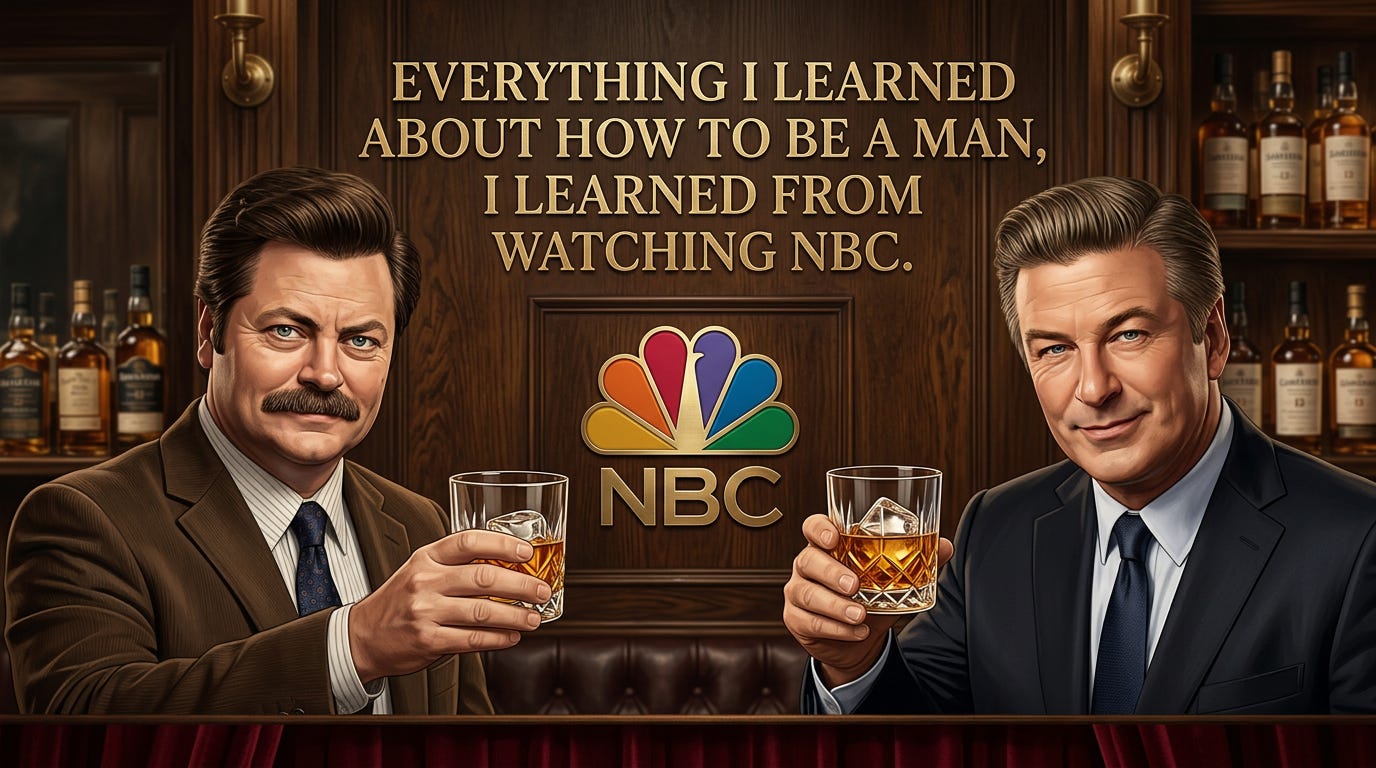
I did not climb out alone. Somewhere in the middle of all that filth I found two teachers, and the strange part, the part I have made peace with, is that neither one of them was a real person. They were characters on the National Broadcasting Company. The men were not real but the lessons were. And those lessons taught me more about being a man than any man who actually drew breath ever bothered to.
Their names are Ron Swanson and Jack Donaghy. Ron was the deadpan libertarian heart of Parks and Recreation, which ran on NBC from 2009 to 2015, and Jack was the apex-predator network executive of 30 Rock, which ran on NBC from 2006 to 2013.
Lesson one. A man handles his own pain.
Ron Swanson: “I would rather bleed out than sit here and talk about my feelings for ten minutes.”
Jack Donaghy: “I believe that when you have a problem, you talk it over with your priest, or your tailor, or the mute elevator porter at your men’s club. Then you take that problem and you crush it with your mind vice. But for lesser beings, like curly haired men and people who need glasses, therapy can help.”
A man metabolizes his own suffering. He does not hand it to a stranger with a notepad and ask to have it carried for him. Learn this one first, because everything else is built on top of it.
Lesson two. Keep your mouth shut more than you open it.
Ron Swanson: “When people get a little too chummy with me, I like to call them by the wrong name to let them know I don’t really care about them.”
Jack Donaghy: “There are no bad ideas, Lemon. Only good ideas that go horribly wrong.” He says it to shut down a conversation, not to open one.
A man does not fill silence to be comfortable, and he does not say a thing just because he thought it. He holds his counsel, lets other people show their hand first, and speaks when he has something worth the air. Ron treats his own words like they cost money. Jack uses his like a scalpel. Neither one runs his mouth to be liked, and neither has ever once talked himself into a corner he could have stayed out of by saying nothing.
Lesson three. Say what needs said and do not sand it down.
Leslie: “Why would anybody ever eat anything besides breakfast food?” Ron Swanson: “People are idiots, Leslie.”
Jack Donaghy: “I didn’t lie, Kenneth. I massaged the truth.”
Ron was not being cruel to Leslie. He was being accurate, and to Ron accuracy is a courtesy. A hard truth makes some people uncomfortable, and that discomfort changes nothing about whether the thing is true, so Ron does not cater to anyone’s ego on the way to saying it. He calls the kettle black and keeps walking. Jack will edge a thing for strategy, but the man otherwise says exactly what he means and wastes no breath softening it for the listener. Bluntness, from these two, is a form of respect, because it assumes you are strong enough to hear reality without a cushion taped to it. And notice that neither man ever doubles back. They say the true thing, they let it land, and they move forward. Always forward, never backward, never circling the runway hoping you liked it.
Lesson four. You make your own luck and nobody hands you the throne.
Ron Swanson: “Give a man a fish and feed him for a day. Don’t teach a man to fish, and feed yourself. He’s a grown man. And fishing’s not that hard.”
Jack Donaghy, on learning Liz keeps her savings in a checking account: “Where do you invest your money, Lemon?... Are you an immigrant?”
Both of these men started with nothing. Jack clawed his way up from a poor Boston childhood to the fifty-second floor, and Ron built his entire life with his own two hands. You earn it or you do without it. That was my grandfather’s whole sermon, the same “you make your own luck” I could never hear coming from him, and it wasn’t until two television characters said the identical thing back to me that something finally clicked. My grandfather had been right the entire time. He actually knew a thing or two about life and how to live it. And the reason I couldn’t see it was that my father had spent my whole childhood lying to me about the man, dressing a self-made father up as a lucky one so the lie would cover his own failures. It took Ron and Jack to show me the truth my grandfather had been handing me free of charge for years.
Lesson five. Whole-ass one thing.
Ron Swanson: “Never half-ass two things. Whole-ass one thing.”
Jack Donaghy: “Ambition is the willingness to kill the things you love and eat them in order to survive.”
Total focus, total commitment, none of the spreading yourself thin across a dozen half-efforts so you look busy at a meeting. A man finishes what he starts, all the way, or he does not start it at all.
Lesson six. You take care of people by making them stronger, never by announcing that you care.
Ron Swanson: “The less I know about other people’s affairs, the happier I am. I’m not interested in caring about people. I once worked with a guy for three years and never learned his name. Best friend I ever had.”
Jack Donaghy: “Lemon, I would like to teach you something. I would like to be Michelle Pfeiffer to your angry black kid who learns that poetry is just another way to rap.”
Both men say things like that and then spend years doing the exact opposite. Ron quietly turned April, Andy, and Leslie into stronger, more capable people while loudly insisting he didn’t care about anyone. Jack mentored Liz Lemon for the better part of a decade and dressed every bit of it up as corporate strategy. They love through making you more capable, never through saying so. The gruffness is not the absence of the affection. The gruffness is how the affection gets delivered.
Lesson seven. How you carry yourself is your calling card, so treat it like one.
Liz: “Why are you wearing a tux?” Jack Donaghy: “It’s after six. What am I, a farmer?” He also maintains that “your hair is your head suit.”
Ron Swanson: “There are three acceptable haircuts: high and tight, crew cut, buzz cut.”
Make no mistake, both of these men are exacting about how they look. Jack is in a tailored suit or a tux nearly every minute of the series. Ron got the same haircut from the same barber every month for decades and would sooner shut down the parks department than turn up looking like a slob. This is not vanity and it is not fashion, two things both men would find equally contemptible. It is the standard ordinary men used to hold, the one a working man in the 1930s carried without thinking about it, that you wore a real suit, kept a clean and correct haircut, did not go out looking sloppy, and did not chase whatever was trendy. How you appeared was your calling card, the thing you handed the world before you ever opened your mouth, and it said you were a man who had himself in order. Both of them settled their answer long ago and never wavered from it. That is the discipline, and the care behind it is so total it reads as effortless.
Lesson eight. A man who knows what he wants cannot be bought.
Ann: “You’re stranded on a desert island, what is the one thing that you bring with you?” Ron Swanson: “Silence.”
Jack Donaghy: “Lemon, money can’t buy happiness. Money is happiness.”
Both men are chasing their own version of happiness, and both know exactly what it looks like. Ron’s is food, drink, woodworking, and a rotating cast of women named Tammy. Jack’s is money, but here is the distinction that matters: the man is obsessed with it without ever being greedy for it. He is simply the best there is at what he does, and he makes his money because he earns it and deserves it, not because he is grasping. That is the difference between a man like Jack Donaghy and a man like Bill Gates. Strip them both of every dollar and every ounce of power, and Jack is still a man, capable, certain, able to build it all back. Bill is still just Bill. A man who knows what he wants and earns it cannot be bought, because there is nothing you can offer him that he could not get for himself. The sin was never wanting much or wanting little. The sin is not knowing which, and leaving the answer for other people to fill in.
Lesson nine. Be the most capable man in the room, and be ready to be capable in any room.
Ron Swanson: “Literally everything is a weapon, son. That folder, in my hands, is far deadlier than this bow in yours.”
Jack Donaghy: “In a post-apocalyptic society, what possible use would they have for you?”
Both men worship competence, and the point is not that Ron is good with his hands while Jack is good in a boardroom. Either one of them, dropped cold into the other’s arena, would master it, because mastery is not a set of tricks, it is a way of meeting a problem. Put Ron in the suit and he reads the room, runs the table, and owns the building, because the man who can field-dress a deer can field-dress a negotiation. Put Jack in the woods and he works out the fire, the shelter, and which berry not to eat, because the mind that conquered a corporation does not go stupid because the carpet ran out. A man does not have one arena. He walks into whatever room he is standing in, takes its measure, and becomes the most capable person in it. He adapts. He leads. He is never the helpless one waiting for someone else to handle it, no matter where you drop him.
Lesson ten. Pick your kingdom on purpose and rule it without apology.
Jack Donaghy: “I didn’t get a bathroom door that looks like a wall by not being good at business.”
Ron Swanson: “I’m a simple man. I like pretty, dark-haired women and breakfast food.”
Jack built an empire and Ron built a workshop, and the men who understand neither one assume Jack is the winner and Ron is the guy who couldn’t cut it. They have it exactly backwards. Ron could have had Jack’s life any time he wanted it, the brains and the spine and the bearing are all there, and a Ron Swanson dropped onto the fifty-second floor runs the building inside a year. He did not end up in a small good life because the empire was beyond him. He looked the empire dead in the eye and turned it down. Both men were fully capable of the other’s throne, both chose their own on purpose and built it with their own hands, and neither one spends a single second envying the other. A man does not drift into his life and he does not let the world hand him one. He picks the kingdom, claims it, and never apologizes for the choosing. The empire and the workshop are the same victory. The only loss is the man who never decided, and let the current pick for him.
Lesson eleven. Women come to a man who is already whole, not to one who is auditioning.
Jack Donaghy: “I’m in love. And it feels terrible, but also great. It feels terrate.”
Ron Swanson, on his ex-wife Tammy: “When I’m done with her, I always feel terrible. It’s like the flu. But for your heart and your genitals.”
Both men were catnip to women, and neither one chased. Jack moved through a parade of brilliant, formidable women. Ron, a divorced man whose two ex-wives were both named Tammy and both certifiable, never had trouble finding the next one. Women were drawn to them for the exact reason this whole article is about. A man who is settled in himself, who handles his own pain, who wants nothing he hasn’t earned and apologizes to no one, is magnetic. A man who performs, who pleads, who narrates his feelings hoping to be rescued, is not. They were ladies’ men because they were men first. The order matters. You do not become a man by chasing women. You become a man, and then you stop having to.
It took me decades to learn any of this. Decades of spinning my wheels, of letting people walk across me, of waiting for somebody to hand me a life. Then two men who were not real taught me to handle my own pain, earn my own keep, want nothing I had not built, and grab the throat of the thing when the moment called for it. I got there eventually. That is the man these two made out of the boy in the trailer across from the mansion.
Bonus Lesson. Whiskey is the meeting a man takes with himself.
Jack Donaghy: “I promise you this weekend will be filled with looking out windows while holding a glass of scotch.”
Ron Swanson: “Never been hungover. After I’ve had too much whiskey, I cook myself a large flank steak, pan-fried in salted butter. I eat that, put on a pair of wet socks, and go to sleep.”
For hundreds of years this was simply how men dealt with the relentless bullshit of being alive. They poured a stiff one, stared out a window or worked the wood until their hands were busy and their mouth was shut, and they handled it. Jack does it in a glass tower with a tumbler of scotch. Ron does it with a glass of Lagavulin and a lathe. Neither of them would ever call it coping, because to them it is not a crutch, it is the quiet room where a man does his thinking. I am not going to stand here and tell you it is the healthy way, and the surgeon general did not co-author this article. I am telling you it is the men’s way, the one that ran for centuries on a stiff drink, a closed mouth, and a finished day’s work, and the men who ran on it built the country you are currently complaining about from inside a heated building.
A necessary aside, because a real man knows this and will tell you whether you asked or not. Whisky without an “e” is Scotland and Canada. Whiskey with an “e” is Ireland and America. Ron drinks Lagavulin, a Scotch, so Ron is a no-e man. Jack is Irish Catholic out of working-class Boston, so Jack and I are with-an-e men. Same brotherhood, different vowel. You cannot claim the lineage if you do not know your own spelling.
All of which brings me to the counselor. A few years back I got arrested for “trespassing” while gathering evidence on the murder of a teenage girl, the kind of murder the local cops had quietly buried to protect a real estate deal. The fallout included a court-ordered counselor, who listened to me mention that I had a glass or two of whiskey at night to settle my nerves and wrote down, with great gravity, that I was an alcoholic.
I asked if he drank. He said, “On weekends.” By his own standard, then, he was an alcoholic too, and I watched that land on his face. Then I told him a doctor forbidding an Irishman his whiskey is like telling a black man to go swimming in bleach. He had a degree, a notepad, and a rule. Across the desk sat a man who had a drink at night, handled his own life, and required none of the three. The credentialed expert got me wrong. The two fictional men got me right.
That is the brotherhood. A stiff drink, a closed mouth, a finished day’s work, and the company of men who do not need it explained. Two of mine happened to live inside a television, on the same network that aired the empty hours of my childhood. They poured the drink, stared out the window, said the true thing, and raised me anyway.
Pour one out, in silence, and remember how it was done.
That said, running a Substack is so profoundly stressful that there are afternoons I look back on quitting and wonder if I have made a grave tactical error. So before you fill my comments to remind me that God does not want me drinking, please recall that the first thing His son did at a party was turn six jugs of water into wine, and not the cheap stuff either. I am simply following the example.
Help keep the Wise Wolf howling.
Excellent, WW.
Old school is the best school. And old school is returning with a vengeance right now among Zoomer men. One of the most cunning lies ever devised, feminism, won't survive what's coming.
There are silver linings to the storm clouds.
Sooner or later, you figure it all out yourself despite not having downloaded the manual... or you die trying.