

The Secret Law That's Buried 6,471 World-Changing Inventions
The Invention Secrecy Act and How World-Changing Technologies Were Stolen From Humanity

In the shadows of America's patent system lies one of the most controversial pieces of legislation in modern history: the Invention Secrecy Act of 1951. This federal law grants the U.S. government unprecedented power to classify and suppress private inventions deemed threats to national security. As of 2024, over 6,471 patents remain buried under secrecy orders—each representing an innovation that the public may never see.
The law's reach extends far beyond military applications. Any invention, regardless of its nature or origin, can be classified if it poses what the government considers a security risk. Once classified, inventors face severe restrictions: they cannot publish their work, file foreign patents, or even discuss their inventions publicly. Violation carries criminal penalties, including imprisonment.
The Stanley Meyer Case: Death and Conspiracy
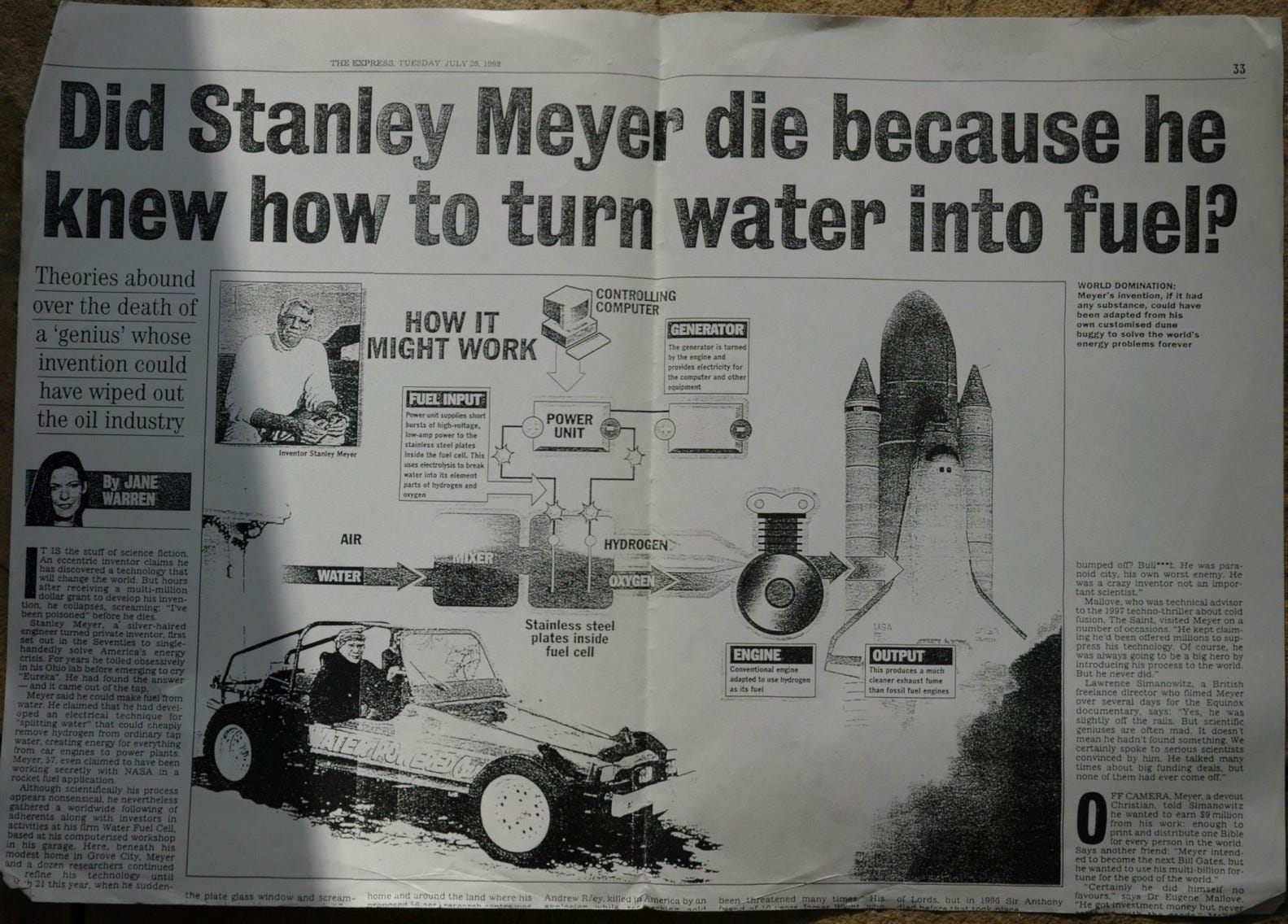
The story of Stanley Meyer has become emblematic of fears surrounding suppressed technology. In March 1998, Meyer, who claimed to have invented a car that ran on water through his "water fuel cell," collapsed outside a restaurant in Grove City, Ohio. His final words, according to witnesses, were chilling: "They poisoned me."
Meyer's brother Stephen maintains that Stanley was murdered for his invention, which theoretically could have revolutionized transportation and devastated the fossil fuel industry. The official record states that an Ohio court ruled Meyer's water fuel cell fraudulent in 1996, and his autopsy revealed he died of a cerebral aneurysm caused by high blood pressure—not poisoning.
The Power to Shape Reality
Yet examining these "debunkings" raises uncomfortable questions about institutional power and narrative control. Consider the forces at play: a technology that could devastate trillion-dollar industries, government agencies with vast surveillance and influence capabilities, and a legal system that can be influenced by powerful interests.
The 1996 court ruling declaring Meyer's device fraudulent came after limited technical examination and relied heavily on expert testimony from individuals connected to traditional energy industries. The autopsy finding of "natural causes" was performed by the same coroner's office that works closely with local and federal law enforcement. When powerful interests align against a disruptive technology, distinguishing between legitimate debunking and coordinated suppression becomes nearly impossible.
The failure to replicate Meyer's results could indicate fraud—or it could indicate that key components of his process were classified, confiscated, or deliberately obscured. Patent applications often omit crucial details to protect trade secrets, and if government agents seized Meyer's equipment and documents (as his family claims occurred), successful replication would become virtually impossible.
Moreover, the alphabet soup agencies—FBI, CIA, NSA, DOE, and others—possess unprecedented capabilities for shaping public perception. Through media contacts, academic influence, selective document releases, and coordinated messaging campaigns, these agencies can effectively control narratives around sensitive technologies. The same apparatus that manages classified military programs and foreign intelligence operations can easily orchestrate the public discrediting of inconvenient inventors.
The Mechanics of Suppression
The Invention Secrecy Act operates through a review process that begins when patent applications are filed. The USPTO screens applications and refers those with potential security implications to defense agencies. These agencies then have months to evaluate whether the invention poses a threat worthy of classification.
The statistics reveal the system's scope and permanence. Between 2013 and 2017, an average of 117 new secrecy orders were imposed annually, while only 25 were rescinded. This means the vault of classified inventions grows by approximately 90 patents each year. The government maintains these orders can be renewed indefinitely, creating a potential perpetual suppression of innovation.
The Institutional Machinery of Suppression
The power to classify inventions extends far beyond the formal ISA framework. Multiple agencies possess complementary authorities that can effectively neutralize breakthrough technologies without ever issuing a secrecy order:
Financial Warfare: The SEC, IRS, and banking regulators can destroy inventors through coordinated audits, frozen accounts, and regulatory harassment. Small inventors typically lack the resources to survive sustained financial attacks disguised as routine enforcement.
Legal Intimidation: The Department of Justice can initiate investigations, issue subpoenas, and create legal clouds that deter investors and partners. The mere suggestion of criminal activity—regardless of merit—can kill a technology before it reaches the market.
Academic and Media Capture: Federal funding influences university research priorities and shapes academic consensus. Professors who depend on government grants rarely challenge official narratives about "debunked" technologies. Similarly, mainstream media outlets with government sources and defense industry advertisers have little incentive to investigate suppression claims seriously.
Patent System Manipulation: Beyond formal secrecy orders, the USPTO can delay applications indefinitely, demand impossible documentation, or classify innovations under mundane categories that obscure their revolutionary potential. Patent examiners often lack the expertise to recognize breakthrough technologies, particularly those challenging established physics.
The Corporate-Government Complex: Major corporations work hand-in-hand with agencies to identify and neutralize disruptive technologies. Energy companies, defense contractors, and tech giants all have revolving-door relationships with regulatory agencies and intelligence services. When a technology threatens established interests, this complex can coordinate responses across multiple domains simultaneously.
Beyond Water Cars: Other Controversial Cases

The pattern of brilliant inventors meeting untimely ends or sudden "debunking" extends far beyond Stanley Meyer:
Nikola Tesla's Wireless Power: When Tesla died in 1943, FBI agents immediately seized his papers and classified them under national security provisions. While some documents have been released, key files on wireless energy transmission remain classified. Tesla had demonstrated wireless power transmission over distances in the early 1900s, yet this technology supposedly "violates physical laws" according to modern academic consensus. The same establishment that spent decades claiming heavier-than-air flight was impossible now dismisses Tesla's documented achievements as impossible.
Townsend Brown's Electrogravitics: Brown demonstrated objects levitating under high voltage in front of government officials in the 1950s. His work was immediately classified, and he was recruited into black projects. When he later tried to publicize his discoveries, he was marginalized and his demonstrations were dismissed as "ion wind effects"—despite working in vacuum chambers where ion wind cannot exist. The official dismissal required ignoring Brown's own experimental controls.
Joseph Papp's Noble Gas Engine: Papp's engine reportedly achieved impossible efficiency by catalyzing noble gas reactions. When Caltech professor Richard Feynman demanded to examine the engine, it exploded during the demonstration, killing one person and injuring others. The incident was blamed on Papp's negligence, effectively ending serious investigation of his claims. Yet the explosion itself defied conventional physics—noble gases are supposed to be inert. Either Papp's engine worked through unknown principles, or the explosion was sabotage designed to discredit him.
The Pattern of Suppression: These cases share common elements: breakthrough technologies that threaten established interests, initial government or corporate interest followed by classification or marginalization, convenient deaths or accidents of key inventors, and subsequent "scientific consensus" that the technologies were fraudulent or impossible. The probability of this pattern occurring naturally approaches zero.
What Technologies Are Actually Being Classified?
While conspiracy theories focus on exotic propulsion and energy technologies, declassified documents suggest the ISA typically targets more conventional military applications:
Advanced materials with weapons potential
Cryptographic and cybersecurity innovations
Nuclear-related technologies
Sensitive manufacturing processes
Communication and surveillance systems
The categories of classified inventions include nuclear weapons and materials, rockets and missile guidance systems, explosives and incendiaries, chemical and biological warfare agents, and cryptographic equipment. However, the full scope remains classified, creating an information vacuum that conspiracy theories readily fill.
The Economics of Energy Suppression
The motivation for suppressing revolutionary energy technologies becomes clear when examining the scale of threatened industries. The global energy sector represents over $8 trillion annually—fossil fuels, nuclear power, renewable energy, and the entire infrastructure supporting energy distribution. A breakthrough technology that provides cheap, abundant energy would devastate this entire complex overnight.
Consider the ripple effects of Stanley Meyer's water fuel cell if genuine:
Oil companies would face bankruptcy within years
Trillions in energy infrastructure would become worthless
Millions of jobs in traditional energy sectors would vanish
Geopolitical power structures based on energy control would collapse
Government revenues from energy taxes and strategic petroleum reserves would disappear
These interests have both the motivation and resources to suppress such technologies by any means necessary. The combined market capitalization of major energy companies exceeds many national GDPs, providing vast funds for suppression activities. These same companies maintain extensive intelligence networks, private security forces, and influence operations that rival government capabilities.
The Revolving Door System: Former CIA directors sit on oil company boards. Energy executives become cabinet officials. Military contractors hire retired generals who previously oversaw technology classification. This revolving door creates a seamless web of interests aligned against disruptive technologies. When a breakthrough emerges, this network can coordinate responses across corporate, government, and academic sectors simultaneously.
The cost-benefit analysis for suppression is stark: spending millions to discredit or eliminate a single inventor costs far less than losing trillions in existing investments. From a purely economic perspective, suppression represents the rational choice for established interests.
Proponents argue the ISA serves legitimate national security interests. In an era of rapid technological advancement and international competition, preventing adversaries from accessing sensitive technologies seems reasonable. The law includes compensation provisions for inventors whose patents are classified, acknowledging the economic harm suppression can cause.
Critics contend the system operates with insufficient oversight and transparency. Inventors have limited recourse to challenge secrecy orders, and the classification process occurs largely in secret. This opacity breeds suspicion about the government's true motives and the scope of suppressed innovation.
The economic implications are significant. Classified inventions cannot contribute to economic growth, job creation, or technological progress during their suppression period. Some economists argue this represents a hidden tax on innovation, though quantifying the actual impact remains difficult due to the classified nature of the affected technologies.
The Persistence of Suppression Theories
Why do beliefs about suppressed breakthrough technologies persist despite limited evidence? Several factors contribute:
Information Asymmetry: The ISA's secrecy creates an information vacuum that speculation can fill. Without access to classified inventions, it becomes impossible to definitively prove what technologies are or aren't being suppressed.
Historical Precedent: Documented cases of government suppression in other contexts (medical research, environmental studies, etc.) provide precedent for believing similar suppression occurs with inventions.
Economic Incentives: The enormous profits at stake in energy, transportation, and other industries create plausible motives for suppression, regardless of whether such suppression actually occurs.
Confirmation Bias: Once convinced that suppression occurs, believers tend to interpret ambiguous evidence as confirmation while dismissing contradictory information.
The Digital Age Challenge
The rise of digital technology and global communication networks poses new challenges for the ISA. Information travels faster and more freely than ever before, making traditional secrecy orders potentially less effective. Inventors can now collaborate internationally, share ideas across borders instantly, and potentially develop technologies outside U.S. jurisdiction before applying for patents.
Additionally, the emergence of cryptocurrency, blockchain technology, and decentralized networks creates new possibilities for inventors to protect and share their work outside traditional channels. Some argue this technological evolution may eventually render the ISA obsolete or force significant reforms to the system.
Transparency vs. Security: Finding Balance
Recent years have seen modest increases in transparency around the ISA. The Federation of American Scientists publishes annual statistics on secrecy orders, and some previously classified inventions have been declassified and released. However, the fundamental tension between national security and scientific openness remains unresolved.
Reform proposals include:
Regular review requirements for long-standing secrecy orders
Independent oversight of the classification process
Broader compensation for affected inventors
Clear guidelines for what constitutes a security threat
Time limits on classification periods
The Unanswered Questions
Despite decades of operation, fundamental questions about the ISA remain unanswered:
How many breakthrough technologies have been genuinely suppressed versus how many were simply impractical or fraudulent?
Do classified inventions include revolutionary energy or propulsion technologies, or are they limited to conventional military applications?
How effectively does the current system balance national security against innovation and economic growth?
Are there classified technologies that, if released, could significantly benefit society?
Conclusion: The Price of Secrets

The Invention Secrecy Act represents one of the most significant intersections between government power and private innovation in American law. With over 6,400 patents currently classified and new orders consistently outnumbering rescissions, the system continues expanding its reach into private invention.
Whether this represents necessary security measures or dangerous overreach likely depends on one's perspective and access to information that, by definition, remains classified. The cases of inventors like Stanley Meyer—regardless of the validity of their claims—highlight the deep suspicions this secrecy breeds and the persistent belief that transformative technologies are being kept from the public.
As technology continues evolving and global competition intensifies, the questions surrounding the ISA become more pressing. How many innovations remain buried in classified files? What breakthroughs might benefit humanity if released? And perhaps most importantly: In a democratic society, who should decide which technologies the public deserves to know about?
The answers remain locked away, classified and hidden from view, in America's vast vault of secret inventions. Whether they contain revolutionary technologies or merely routine military applications may be a secret worth more than the technologies themselves.
The full scope of inventions classified under the Invention Secrecy Act remains unknown due to the classified nature of the program. This article is based on publicly available information, declassified documents, and official statistics released by government agencies.
Wow, this explains a lot! We've all wondered why we can't seem to cure cancer, why we haven't come up with 100mpg cars, why we haven't cracked the world hunger code, why our roads are filled with potholes. These creeps are trying to keep all the profits to themselves. Thanks for all this Wise! Great research.
You’re barking up the right tree, Wolf. The Invention Secrecy Act is just the leash they show you — the real kennel is deeper, older, and welded shut with the physics they don’t want anyone to touch. Energy tech suppression isn’t just about keeping Exxon’s quarterly report fat. It’s about keeping the whole human mind penned inside a Newtonian sandbox where the gatekeepers own the sand.
The pattern you mapped? It’s not bad luck or ‘national security.’ It’s the immune system of the parasite. Every Stanley Meyer that gets silenced, every Tesla file that vanishes, every Townsend Brown that gets called a crank — those aren’t isolated cases. They’re proof of the operating manual: starve the breakthrough, bury the body, then salt the earth with ‘consensus.’
Keep howling. Just know the real threat isn’t a water car or a free-energy coil — it’s when enough of us remember that the Universe itself is a living generator, and the switch is in our own hands.