


That happened.
In real life.
At the damn Louvre.
Four guys walked into the most famous museum on Earth at 9:30 in the morning, smashed their way into the Apollo Gallery, stole nine pieces of French crown jewels worth more money than exists in several small economies, and drove away on Vespas. The whole thing took seven minutes. Nobody got hurt. Nobody got caught. Somewhere in Paris right now, someone’s sitting on Napoleon’s wife’s emerald necklace wondering if they should feel bad about it.
Spoiler: they probably don’t.
The Setup That Shouldn’t Exist
Let’s establish something first. The Louvre isn’t some corner bodega where the security camera’s been broken since 2003. This is the most visited museum in the world. Eight point seven million people walked through those doors last year. It houses the Mona Lisa, which has more security than most nuclear facilities. There are cameras. Guards. Sensors. The kind of protection that makes Ocean’s 11 look like amateur hour.
And yet…
Someone looked at all that security and thought “yeah, but what if we just showed up with a furniture elevator and some power tools during business hours?”
I need you to appreciate how insane that sentence is. A furniture elevator. The kind you rent when you’re moving a couch into a third-floor walkup. Not a grappling hook. Not a helicopter. Not even a particularly clever disguise. Just a hydraulic lift on the back of a truck, the kind you see seventeen times a day in any European city with buildings older than America.
The kind nobody looks at twice.
That’s the genius part. That’s the part that makes you wonder if the people who pulled this off have actually watched heist movies and taken notes.
Act One: In Which Everything Goes Perfectly
Sunday morning. The Louvre opens at 9:30. Tourists line up under the pyramid like pilgrims at Mecca. Everyone’s clutching their tickets, their cameras, their total lack of awareness that they’re about to witness history. Just not the kind involving Renaissance paintings.
At 9:31, a truck pulls up along the Seine side of the building. Normal truck. Normal lift. Normal workmen. Paris has so much construction happening at any given moment that you could probably park a tank downtown and people would assume it’s performance art.
The elevator extends. Up go the workers. Second floor. Apollo Gallery window.
Now here’s where it gets cinematic. They don’t pick the lock. They don’t disable the alarms with some USB stick full of Russian malware. They pull out a disc cutter and just... remove the window. Like you’d remove a label from a jar. Violence as problem-solving. The Home Depot approach to art crime.
And it works.
Inside, the Apollo Gallery waits. This is the room Louis XIV built to flex on absolutely everyone. Gilded ceiling. Paintings of gods. Display cases full of jewelry that makes Tiffany’s look like Claire’s Accessories. The French crown jewels sit here like specimens in a trophy case, which technically they are.
Three men with power tools go to work on the display cases. The cases are reinforced. High-security. Expensive. They last about forty seconds. The sound must have been incredible. Imagine a dentist’s drill having an anxiety attack in a cathedral.
Guards start yelling. Tourists start filming. The three men start shopping.
The Haul: A Greatest Hits Album of Imperial Bling
What did they take? Only the pieces you’d grab if you had seven minutes in a jewelry store and infinite taste.

Marie-Louise’s emerald necklace. Napoleon’s wedding gift to his second wife back in 1810. Thirty-two emeralds, eleven hundred diamonds, crafted by the finest jeweler in Paris. The Louvre paid 3.7 million euros for it in 2004. These guys got it for the price of a window.
The sapphire parure worn by multiple queens. Twenty-four Ceylon sapphires, over a thousand diamonds. Some historians think it belonged to Marie Antoinette before she had that unfortunate meeting with the guillotine. The Louvre acquired it from the Orléans family in 1985. Now it’s acquired itself an exit.
Empress Eugénie’s reliquary brooch. Ninety-four diamonds including the Mazarin stones, which Cardinal Mazarin gave to Louis XIV in 1661. These diamonds are older than the United States. They’ve survived more French governments than I can count. They did not survive Sunday morning.
The diamond bow brooch that Empress Eugénie wore when Queen Victoria visited Versailles. It started as a belt buckle in a display of four thousand diamonds. The Astor family owned it for a century. The Louvre bought it back for over 10 million dollars in 2008. Return on investment: seven years and one Sunday morning.
Eugénie’s pearl diadem. Two hundred twelve pearls, nearly two thousand diamonds. Because apparently when you’re an empress, four-digit diamond counts are the baseline for leaving the house.
Eight pieces total. Centuries of history. Incalculable value.
Gone in the time it takes to order coffee.
These guys were pros.
Act Two: The Getaway (Featuring the World’s Dumbest Crown)
Here’s where reality gets even better than fiction.
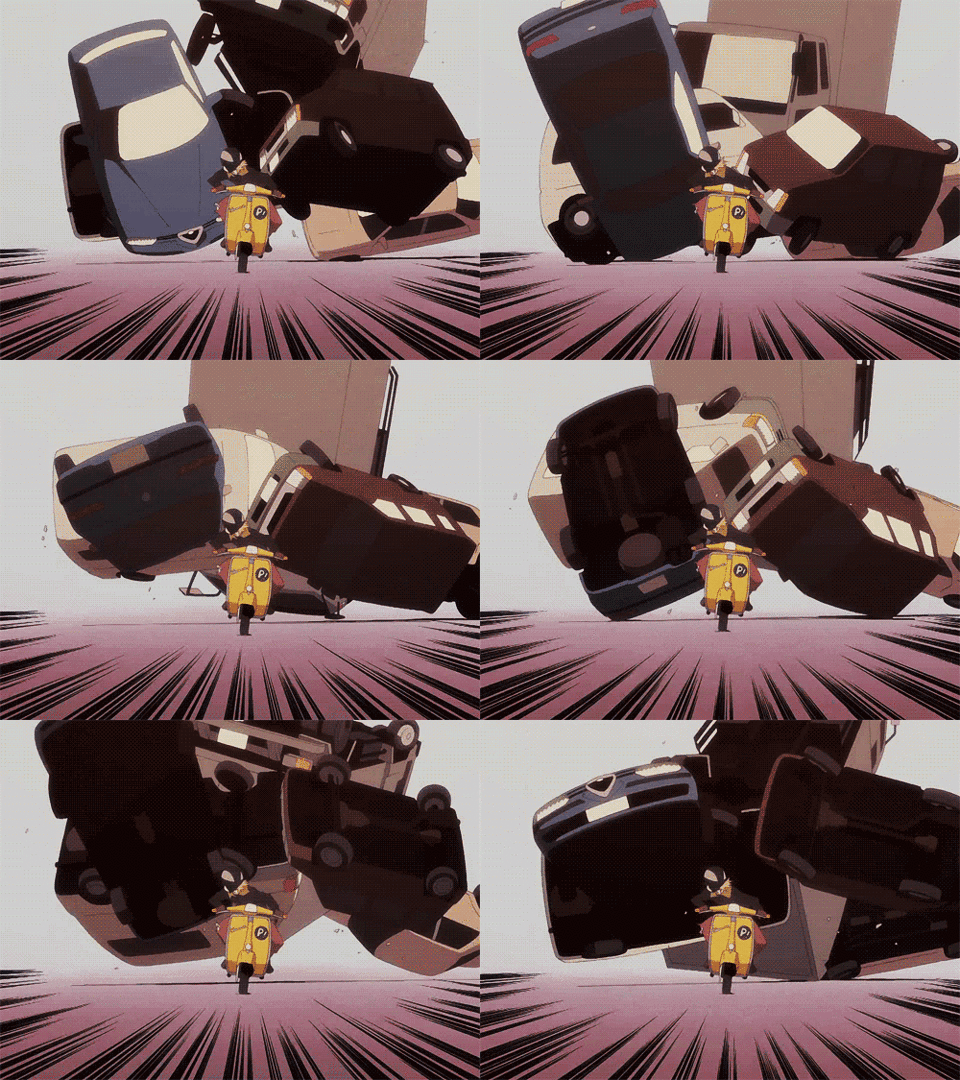
They flee on Vespa scooters.
Not a getaway car. Not a speedboat on the Seine. Not even particularly fast motorcycles. Vespas. The kind of scooters that tourists rent to feel European. The kind that make you look less like Jason Bourne and more like someone who’s really enthusiastic about gelato.
But in Paris? In Paris, scooters are invisible. They weave through traffic like water through cracks. Every third person in the city owns one. You could commit any crime in Paris on a Vespa and your biggest challenge would be not getting confused with the food delivery guy.
Except…
Except someone grabbed Empress Eugénie’s crown. The big crown. The one with 1,354 diamonds and 56 emeralds. The one that’s ornate and heavy and about as subtle as a disco ball. And somewhere between the Apollo Gallery and freedom, someone dropped it.
Just dropped it. In the street. Outside the Louvre.
The French government recovered it. Damaged, but recovered. Which means one of two things happened. Either this was the world’s most expensive fumble, or it was intentional. A decoy. Something for the cops to find so they’d feel accomplished while the real prizes disappeared into the city.
I desperately want to believe it was a fumble. I want to believe that somewhere in this perfect crime, someone got nervous and butterfingers and just yeeted a priceless crown into the Parisian street like a bad quarterback. Because that’s the kind of human error that makes this whole thing even more absurd.
The museum evacuated. The Louvre closed for the day, citing “exceptional reasons,” which is French for “we have no idea what just happened but everyone needs to leave.” Tourists who flew across oceans to see the Mona Lisa found themselves on the sidewalk, confused and cheated. One guy filmed himself leaving and posted “My first visit to the Louvre Museum ended with not seeing a single artwork.”
Brother, you saw a crime that could have come straight out of Hollywood in person.
That’s worth at least three paintings.
Act Three: The Part Where France Realizes It Just Got Robbed
Interior Minister Laurent Nuñez called it a “major robbery.” Which is what politicians say when they mean “catastrophic failure of everything we’re supposed to protect.” He also said the value of the stolen goods was “incalculable.”
Translation: so expensive we’re not going to say the number out loud because it’ll make everyone cry.
Culture Minister Rachida Dati admitted they’d seen footage. The robbers were calm. Professional. They knew exactly where to go, what to take, how to leave. No panic. No mistakes. Well, except for the crown. But even that might’ve been strategic.
Art recovery expert Arthur Brand called it a “national disaster.” Former FBI art crime guy Tim Carpenter warned that the jewels might get melted down, destroyed for their raw materials. Centuries of craftsmanship reduced to sellable gemstones and anonymous gold.
The Mazarin diamonds that Cardinal Mazarin gave to Louis XIV in 1661 might end up in a Dubai pawn shop by Thursday. The emeralds Napoleon gave his wife might get sold separately in Hong Kong. History liquidated. Heritage atomized.
That’s the real crime. Not the theft itself. The dismantling. These weren’t just expensive pretty things. They were French. They survived revolution, empire, occupation, two world wars, and the euro. They represented continuity. Pride. The Republic’s uneasy peace with its imperial past.
Now they’re probably in a bag somewhere getting appraised by criminals with jeweler’s loupes and a complete absence of sentimentality.
The Part Where We Acknowledge This Shouldn’t Have Worked
The Louvre has been robbed before. In 1911, some Italian guy walked out with the Mona Lisa under his coat. It took two years to recover. That theft made the painting famous. Before that, it was just another Leonardo. After, it became the most recognizable image in Western art.
So the museum knows about security. Or should.
But apparently for the last forty years, nobody was paying attention. Culture Minister Dati admitted as much. Said museums got complacent. That organized crime evolved faster than museum security. That the Louvre’s president asked for a security audit two years ago because someone finally noticed the twenty-first century had arrived and brought new problems.
The museum’s also falling apart. Understaffed. Overcrowded. Water leaks. Temperature fluctuations that threaten the art. Staff walked out in June protesting conditions. Eight point seven million visitors a year means the building’s getting crushed under its own success.
Someone looked at all those problems and saw opportunity.
That’s the thing about heist movies. The crew always finds the weakness. The one guard who’s lazy. The camera with a blind spot. The system that’s outdated. But those are movies. Fiction. Invented vulnerabilities to make the plot work.
This actually happened.
Someone actually found the weakness in the Louvre and drove a truck through it. Metaphorically. And then literally via furniture elevator.
The Ending We’re Not Getting
In movies, this is where we’d get the twist. The cops were actually three steps ahead. The jewels are fake. The real heist was the friends we made along the way.
In reality? The investigation’s ongoing. The jewels are gone. The thieves are probably spending their Sunday evenings like normal people, eating dinner and watching TV and occasionally glancing at a bag full of imperial jewelry while thinking “I cannot believe that worked.”
The French government promises swift justice. Politicians always do. Interior Minister Nuñez said they’d find the perpetrators “very soon.” That was Sunday. It’s now Monday. The trail’s getting colder by the hour.
The motor scooters are probably in a scrapyard.
The jewelry’s being disassembled by people who view history as inventory.
And somewhere in Paris, four guys are either geniuses or very, very lucky. Possibly both. They pulled off a crime that sounds too stupid to work, which is exactly why it worked. They showed up during business hours with the criminal equivalent of a ladder and some elbow grease and walked out with more French heritage than most museums own.
It’s not Ocean’s 11.
It’s better.
Because Ocean’s 11 is fake, and this actually happened.
Seven minutes. Nine pieces of irreplaceable history. Gone.
Cut to black. Roll credits. Except the credits are missing and nobody knows who to thank.
That’s how you rob the Louvre.
Bonus: The 10 Greatest Heist Films Ever Made (For People With Actual Taste)
Look, I have a problem. I love heist movies. Not like a normal person loves movies. I love them the way some people love their children or vintage motorcycles or arguing about bourbon. I’ve watched Rififi seventeen times. I can quote Heat backwards. I once spent thirty minutes explaining to someone at a bar why Ocean’s 11 is good but not great and they left mid-sentence.
So as a special bonus, because you’ve made it this far and clearly have excellent judgment, I’ve compiled a list of my favorite heist films of all time. Not the mainstream garbage everyone’s already seen. Not the ones that show up on every lazy listicle. The real ones. The classics. The films that invented this genre before Hollywood turned it into quippy guys in designer suits.
These are the movies that understand heist films aren’t about the money. They’re about the plan. The crew. The moment when everything goes perfectly wrong. They’re about competence as spectacle and professionalism as poetry.
Here we go:
1. Rififi (1955) Jules Dassin’s French masterpiece. The 30-minute silent heist sequence invented the genre. Everything after this is just tribute.
2. The Killing (1956) Stanley Kubrick before he went full Kubrick. A racetrack robbery told non-linearly when that was actually revolutionary. Sterling Hayden’s hangdog face doing crime.
3. Le Cercle Rouge (1970) Jean-Pierre Melville’s meditation on fate, honor, and stealing jewelry. Alain Delon being impossibly cool while robbing impossible places. The French made heist films into philosophy.
4. The Asphalt Jungle (1950) John Huston’s noir classic. The template every heist film since has borrowed from. Marilyn Monroe’s breakout role. Crime as American tragedy.
5. Bob le Flambeur (1956) Jean-Pierre Melville again because the man understood. An aging gambler plans one last casino job. The French New Wave learned everything from this.
6. Thief (1981) Michael Mann’s directorial debut. James Caan as a professional safecracker who wants out. Tangerine Dream soundtrack. Neo-noir perfection before anyone called it that.
7. The Thomas Crown Affair (1968) The original with Steve McQueen and Faye Dunaway. Not the Pierce Brosnan remake. Chess and bank robbery as seduction. Split-screen editing that actually works.
8. Topkapi (1964) Jewel heist in Istanbul. Peter Ustinov won an Oscar. The gadgets, the planning, the execution. Influenced every heist film after including Mission: Impossible.
9. Heat (1995) Yes it’s mainstream. It’s also Michael Mann at the absolute peak of his powers. Pacino and De Niro finally sharing screen time. The shootout scene that military and police still study.
10. Reservoir Dogs (1992) Tarantino’s debut. A heist film that never shows the heist. All character, all tension, all blood. Changed what crime films could be.
Honorable Mentions for the Obsessives:
The Hot Rock (1972) - Robert Redford stealing the same diamond four times
A Fish Called Wanda (1988) - British comedy-heist perfection
Sexy Beast (2000) - Ben Kingsley as the most terrifying recruitment ever
The Great Muppet Caper (1981) - Kermit and company investigate jewel thieves in London. Legitimately great.
Heist (2001) - David Mamet doing David Mamet things with Gene Hackman
Rick and Morty, Season 4, Episode 3 (2019) - Seriously, that show your kids all watch while stoned. It has one of the best heists ever written. It lampoons the entire genre and comes across as absolutely, hilariously clever.
First off: bastard! I knew it was a wind up but when you said you'd got footage at the end of the post I had to scroll down to see. I feel so rick-rolled I need to shower.
Second off: heist movies are the best. I love them equally. That you mention Rififi and can count the number of times you've seen it... Kudos. I only learned about it during the madness when I was locked up binging The Americans. What a film.
Third off: (the last one, I promise) great article. I really enjoyed it.
Fourth off: (I lied, there's more. No actually there isn't, but the distraction worked long enough for me to load your attention into four panniers and cycle away whimsically while whistling "This is the self preservation society" in a jaunty key).
I worked in museums for 28 years as an exhibition designer. Here are a few thoughts:
Popular culture would have us believe that museum security is all armed guards, pressure sensitive floors, and laser beam triggered silent alarms. Nope.
Museum security work is dull. Astonishingly dull. I’ve seen gallery staff bunking off behind seldom visited showcases. I’ve witnessed docents sneaking into stairwells for a crafty smoke. One security guy I used to work with (a former military police officer) set up a reading nook behind a fake wall where, on any given day, he would spend hours just sitting there with his paperback. Or napping.
Another former colleague would sneak a miniature, battery operated TV into the gallery with him which he would listen to via an earpiece.
It doesn’t take much to move a gallery TV camera slightly to the right or the left, or to move it up, just enough for an angle to change. A sudden poke with a walking stick will do. And unlike in the movies, where the intrepid detective gets someone to zoom in on a detail of something or other on the person of the gallery thief after the fact, there is no such thing as “enhance that frame right there!” Most closed circuit TV systems are simply not capable of capturing images of a high enough resolution to provide the authorities with any footage that’s of any real quality.
In the control room, that change of a camera angle might not get noticed for days, perhaps even for weeks, if it gets noticed at all. In any given closed circuit TV monitoring room and depending on the size of the museum and the scope of the system, whoever is on duty at any given time can be faced by as many as 30 monitors or more. The pictures are fuzzy. Many views don’t change that much over the course of hours. Guards get bored. Their eyes see what they want to see instead of seeing what’s there and what’s happening, which often isn’t that much. Things get missed. Shift changes cause disruption. Movement that ought to arouse suspicion or interest gets ignored or overlooked. Or worse, dismissed.
The thieves in this instance are not amateurs. Weeks, perhaps months of planning and preparation went into this robbery. As has been noted by others, they were well equipped and thoroughly prepared; they knew precisely what they were looking for and where those items were. In all likelihood they had studied the weaknesses and opportunities in gaining entry to the gallery and they were familiar enough with the showcase design to understand how to quickly and effectively gain access. In all likelihood they also knew or had calculated the response time and direction of travel that gallery staff would need to potentially intercept their endeavors. And they had enough wherewithal to plan their exit and make a swift and effective departure.
Amid the speculation about the items taken from the Apollo Gallery at the Louvre being broken up, another possibility is that the items were stolen to order. The issue with breaking down an item of jewelry into many hundreds or even thousands of pieces is the likelihood that at some point, one or more of the stones will come under the scrutiny of a suspicious jeweler or dealer who wants nothing to do with stolen goods. It’s important to understand that precious stones that were cut and polished 400 or so years ago have quite distinctive characteristics in terms of their surfaces when compared to stones that have been cut and polished more recently because the mechanical processes of diamond cutting have changed.
As for gaining access, again, popular culture has us believing that gallery thieves only strike at night and that they are dressed from head to toe in black Lycra when the reality is that it is far easier to gain access to a museum by simply showing up at the front door carrying a ladder and wearing overalls with a clipboard tucked under your arm or, in this case, by posing as maintenance staff on a quite street on a Sunday morning.
From a liability point of view museum administration staff often tell their staff not to engage or tackle anyone with ill intentions. This explains why the various Just Stop Oil protesters who have been supergluing themselves to gallery walls of late or throwing canned soup at framed works are seldom intercepted by museum staff and wrestled to the ground for the cultural vermin that they are.
It’s good that no gallery staff or visitors were harmed in Sunday’s event at the Louvre and it’s tragic that the items in question are now gone. But Sunday’s robbery highlights other important issues, in that museum security as a whole leaves much to be desired and that all any lock or alarm buys you is whatever the response time is from hamstrung museum staff and the arrival (or not) of law enforcement.
Another issue is that of longer term security and safety of precious items. In this day and age of 3D scanning and CNC capability, for the purposes of display there is no good reason why items cannot be duplicated, with the copied items placed on display while the originals remain relatively safe in a bank vault.