


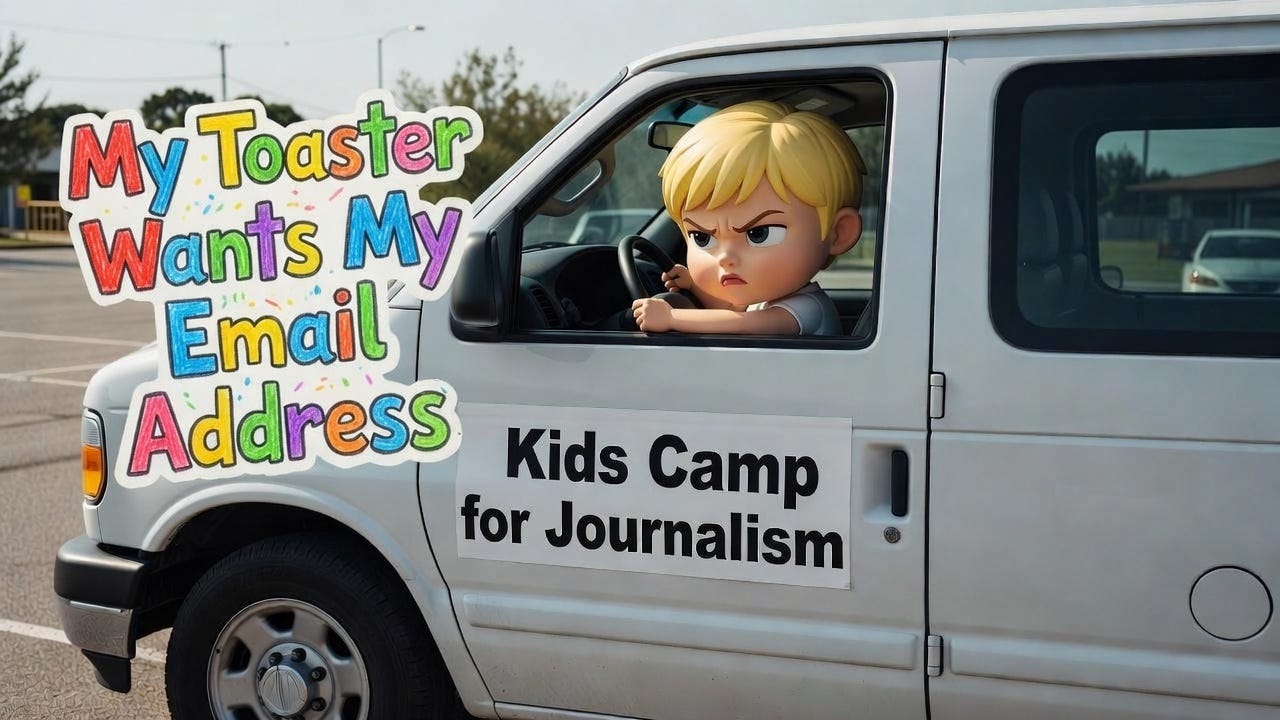
I tried to park downtown last Tuesday. I don’t own a car (a situation we will return to), but the summer camp where I work owns a van, a fifteen-passenger beast that smells like sunscreen and the ghosts of ten thousand juice boxes, and somebody had to drive it into town for supplies.
When I was 15 and had my learner’s permit, my dad took me downtown to practice parallel parking, which he treated with the gravity of a moon landing. Part of the lesson was the meter. You pulled up, you dug quarters out of the cupholder, you fed the meter, the meter gave you time. That was the whole ritual. A machine took your money and gave you a thing in return, and nobody involved learned your mother’s maiden name.
That was eight years ago. Eight. In the time it took me to go from a learner’s permit to a journalism degree, parking went from “put quarters in the slot” to “kneel and worship the digital algorithm gods.”
The prayer goes like this. I stood in the rain scanning a QR code, which led to a website, which told me to download an app, which asked me to create an account, which wanted my email, my phone number, the van’s license plate, my card number, and permission to send me “occasional offers.” To park. On a street. Which taxes already paid for. Somewhere in this chain of events I was entering security answers into a rain-slicked phone while the camp’s supply list (forty glue sticks, a volume of rope I chose not to question) sat on the passenger seat, and I thought, huh, ‘so this is adulthood’.
The app then charged me a 35-cent “convenience fee,” which raises the question of what, exactly, was convenient, and for whom. Not for me. I checked.
The World I Never Got to Meet
My actual complaint is generational. I am 23, which means I caught the very last of the analog world and then watched somebody switch it off. I got the meters. I got the paper menus at the diner. But by the time I was old enough to actually live in that world, it was being uninstalled around me, one update at a time. My grandma talks about it the way other grandmas talk about the old country. There were seasons. Bread cost a nickel (the price of bread drops another nickel every time she tells this story). Appliances worked.
She had a refrigerator for THIRTY-ONE YEARS. One refrigerator. It did a single thing, which was make things cold, and it pursued that career with the focus of an Olympic athlete. It had no screen. It never once asked her to agree to anything. It made things cold during Nixon, it made things cold during Reagan, and it was still faithfully making things cold when I was born, humming in her kitchen like an appliance at peace with itself.
My parents bought a smart fridge in 2022. (I want you to sit with the phrase “smart fridge” for a second, because it implies the existence of a stupid fridge, and it turns out the stupid one is the fridge that works.) In 2025 the company stopped writing firmware for that model, and the touchscreen froze on an error message, and the ice maker, which required cloud connectivity for reasons known only to the engineers and possibly Satan, quietly stopped producing ice. The cold part still functioned. The fridge could still fridge.
Grandma’s fridge served under six presidents. My parents’ fridge didn’t finish a phone contract. This is what the industry calls innovation, and what I call a subscription with a door on it.
Everything Is a Portal Now
The laminated menu is not extinct. Diners still have them, God bless diners, menus sticky in a way you elect not to investigate, handed over by a person who announces “the soup today is chicken.” One person telling another person about food. That technology has a six-thousand-year uptime record and zero reported outages. But step outside the diner and the menu is an endangered species, and I am watching it die in real time, one trendy restaurant at a time.
What replaces it is a QR code taped to the table, leading to a PDF formatted for a screen the size of a drive-in movie, which I navigate by pinch-zooming across the appetizer section like an analyst studying spy photos of a missile site. Some of these menus want me to create an account first. To look at food. At some point a fully grown adult with a job title stood up in a meeting and said “what if customers had to log in to discover that we serve mozzarella sticks,” and the room said yes, and that man was promoted, and I inherited the results.
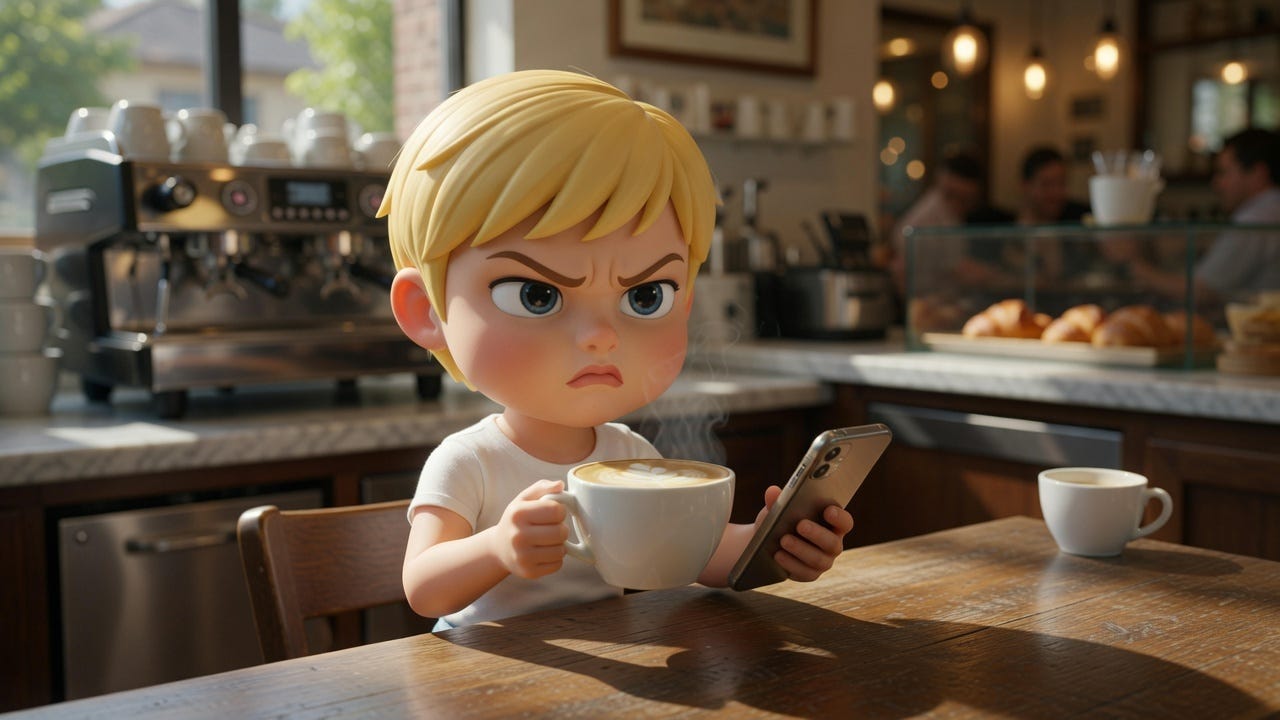
The experience lasted thirty seconds. A man handed me coffee. The coffee was coffee. But the survey wanted to know how the interaction made me FEEL, on a scale, with an optional comment box, and if I skip it the barista’s numbers apparently go down, because somebody decided a human being’s employment should hinge on whether strangers complete beverage homework.
The Leash
My parents describe leaving the house in the nineties like veterans describing a foreign posting. You just left. Nobody could reach you, and this was considered normal rather than a hostage situation. You found the restaurant because the building said RESTAURANT on it. You paid with paper. When the power went out, the stove still cooked and the car still started and the doorbell remained a piece of metal whose entire job was hitting another piece of metal.
Every one of those things has since been improved into something that needs my phone, an account, two-factor authentication, and a terms-of-service document longer than Deuteronomy, which I clicked “agree” on without reading, in the rain, on my way to buy glue sticks. (I told you we’d be back at the van. The van and I have been through things.) And it’s still spreading. There is a toaster on the market right now with WiFi and a companion app, meaning the machine that warms bread now has a login, which means the headline of this article is not a joke, it’s a product category.
And the phone is not a convenience. It’s a leash. The parking app was never about parking. It’s a data pipeline with a parking-shaped user interface, and my location, my payment history, my patterns, and, as of last Tuesday, the movements of one summer camp’s supply van are the actual product being sold. I’m not the customer standing in the rain. I’m the inventory standing in the rain.
The trap is that you can’t opt out. Opting out means you don’t park, don’t eat, and in half the new apartment buildings don’t do laundry, because the machines take payment exclusively through an app, an actual sentence I just wrote about actual washing machines in the actual United States of America.
What I Actually Want
I want to be a person in a place. That is the entire demand. Quarters into meters. Menus into hands. Appliances that die of old age, surrounded by loved ones, instead of being taken off life support from three time zones away by Rakesh, who did it between meetings. A thirty-second coffee transaction that both parties are permitted to simply walk away from, unrated and unsurveyed, the moment complete in itself.
Grandma got fifty years of that world. My parents got twenty-five. I got a login screen and a marketing consent checkbox that was pre-checked.
People call my generation “digital natives” like it’s a compliment. Natives don’t pick where they’re born. We’re just the first generation handed the terms of service before we could read them, and every year the leash gets stapled to one more thing that used to just work, and they call it the future. I’ve seen the future.
It’s a QR code in the rain, and I would like a refund.
Half of you are reading this on an app right now. I know. I’ve made my peace with it, because The Wise Wolf is at least a leash you chose, and nobody here will ever charge you a 35-cent convenience fee for the privilege. We run on zero venture capital and one increasingly irritated Wolf, plus me, a college graduate currently teaching children to weave lanyards, a technology that has never once required a firmware update. A paid subscription keeps this publication independent, covers my bus fare, and inches me toward a car of my own (used, dumb, no touchscreen, Lord willing) so the camp van and I can finally see other people. No account needed to get us in your inbox. Well. An email. Fine, ONE leash. But it’s short, and we will never, ever ask how this article made you feel.
Help keep the Wise Wolf howling.
P.S. I’m a bobblehead now because I opened my Substack messages and found a startling number of men who read my reporting and replied “hey beautiful,” one of whom sent a photo of his ‘banana boat’ (if you know what I mean). So thank you, Wolf, for the bobblehead graphics, because she has a giant head, a tiny body, and a face that cannot receive a single picture of anybody’s banana boat. She’s adorable and she’s impervious and she’s the only version of me you get now.
I live off-grid, maka and store solar power, my reefer is a 10 year old unit that runs on propane and I get one country station on the radio.
Guess I'm kinda of a failure.
He didn't say, “What if customers had to log in to discover that we serve mozzarella sticks?” He said “What if customers had to log in to discover how much we're going to charge them for mozzarella sticks?” Dynamic pricing.
There's a restaurant in Brussels where there is no menu: the owner comes to the table and tells you what they have. The "Buiten Verwachting" in Boutersem has its menu on a blackboard, because you get what was fresh at the market that day. These are restaurants I do.
My chest freezer was my mum's and I inherited it when she passed in 2009. I'd helped fetch it when she bought it secondhand from someone in Harrogate, using the van of a friend who ran an engineering company when I was 14. This year, it has been in our family's possession for 50 years and it doesn't know it ever left the old country. I pray every time I need to switch it on, so there is, I have to admit, a cloud connection.