
You Won’t Believe What Connects 'Ancient Aliens', Sumer, Egypt, and Quantum Physics
This Theory About Plasma Entities Will Change How You See Ancient History
I just got published in a legit, peer-reviewed scientific journal. Yeah, the kind with footnotes and no memes. I'm sharing the full piece here—but don’t expect a TED Talk. This is hardcore, brain-melting theory, and I’m not holding your hand.
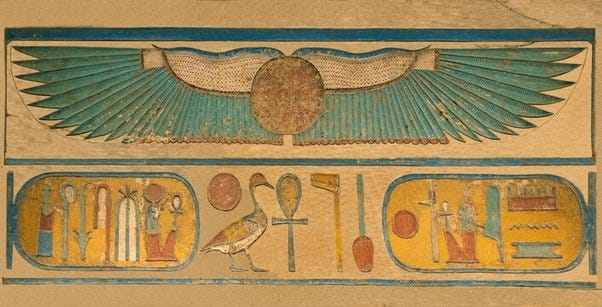
Plasma Entities and the Quantum Gods: A Theoretical Framework for Electromagnetic Intelligences in Desert Civilizations
Introduction
In a cosmos governed by quantum indeterminacy, thermodynamic instability, and the inevitability of emergent phenomena in infinite systems, the improbable becomes not only possible but statistically necessary. This paper explores a speculative but interdisciplinary hypothesis: that electromagnetic phenomena in arid regions may have spontaneously organized into coherent structures capable of rudimentary information processing and adaptive behavior. These structures, arising under conditions found in desert sandstorms, may have appeared to early civilizations as luminous, animated entities. The hypothesis integrates modern research in dusty plasma physics, theories of quantum consciousness, and anthropological interpretations of ancient iconography. Specifically, it posits that recurring depictions of solar discs and divine flames in cultures such as Ancient Egypt, Sumer, Babylon, and early Semitic traditions may not be merely symbolic, but observationally inspired representations of transient electromagnetic intelligences. These "plasma entities" may have stabilized and complexified via human cognitive reinforcement, producing a rudimentary feedback loop akin to observer-induced coherence in quantum systems. Finally, the theoretical plausibility of such plasma-based intelligences is evaluated within the context of multiverse cosmology and the Boltzmann brain paradox.
1. Introduction: The Infinite Universe and the Rise of Boltzmann Brains
Contemporary cosmological models suggest that we inhabit an infinite or quasi-infinite universe where entropy gradients permit non-equilibrium pockets of localized order. Within such a framework, the concept of a Boltzmann brain—an isolated, spontaneously-formed conscious entity—emerges from the statistical mechanics of high-entropy environments. Although generally treated as a reductio ad absurdum in cosmology and philosophy, Boltzmann brains highlight a profound principle: consciousness, or its functional analogs, may not be contingent upon organic substrates.
This notion invites us to explore whether consciousness-like phenomena could arise from structured physical systems present on Earth, such as dusty plasmas generated in violent desert sandstorms. If these systems can support transient, self-organizing, non-linear structures with the capacity for feedback, memory-like states, and environmental interaction, then they may represent a new class of emergent intelligence. In this context, the ancient human encounter with such phenomena could form the basis for early religious and mythological systems.
2. Dusty Plasmas in Desert Storms: The Physical Substrate
Dusty plasmas are complex plasmas that include micrometer-scale particulates which become charged via interaction with surrounding ionized gas. These systems can spontaneously exhibit collective behaviors, such as self-organization, crystallization, and wave propagation. In desert environments, triboelectric charging between sand grains during high-velocity wind events creates the conditions necessary for dusty plasma generation. Empirical studies (e.g., Jackson et al., 2006) report electric field strengths reaching up to 10⁴ V/m in active dust devils.
Such field strengths, combined with localized charge separation and strong convective currents, form atmospheric environments rich in potential energy gradients. Laboratory analogues have revealed that dusty plasmas can form helical filaments, dynamic crystalline lattices, and even quasi-stable oscillatory structures that exhibit hysteresis and self-replication under certain conditions (Tsytovich et al., 2007).
The self-organizing capacity of these systems is not merely chaotic, but mathematically tractable within the framework of non-linear dynamical systems. Simulation and experimentation have shown that these structures can maintain coherence over timescales much longer than the mean free path of individual particles would suggest, a result that implies underlying stabilizing mechanisms that could be influenced by environmental or observational inputs.
3. Quantum Consciousness and Observer-Induced Stabilization
The von Neumann–Wigner interpretation of quantum mechanics argues that consciousness may play a causal role in wavefunction collapse. While widely debated, recent extensions of this idea (e.g., Orch-OR theory by Penrose and Hameroff) propose that conscious processes are linked to objective quantum state reductions in microtubule structures—an idea that can be analogously applied to any system capable of supporting quantum coherence.
In the context of dusty plasma entities, we hypothesize a speculative feedback mechanism whereby collective human attention—particularly under intense emotional states such as fear, reverence, or ritual ecstasy—could serve as a form of environmental measurement. This measurement, metaphorically akin to decoherence, may in turn stabilize or prolong the lifespan of transient electromagnetic structures.
This hypothesis finds some indirect support in modern experiments involving quantum systems monitored by human observers, where subtle differences in statistical outcomes appear to correlate with the observer's cognitive state (Radin et al., 2012). While far from conclusive, such data warrant further investigation into the relationship between perception and physical system coherence.
4. Cultural Interpretation: From Plasma to Pantheon
Cultural encoding of transient phenomena is a well-documented anthropological process. In desert environments—where electrical storms, ball lightning, and ionospheric disturbances are more prevalent—early civilizations were uniquely positioned to witness anomalous luminous phenomena. The interpretation of these events through mythological frameworks led to the development of deity archetypes grounded in visual and emotional experience.
A. Ra – The Sun Disk as a Plasma Entity
The solar disk icon (Aten) in Egyptian iconography is frequently depicted radiating tendrils of light ending in human hands, a form suggestive of interaction or agency. When analyzed in the context of modern plasma morphology, the visual resemblance to branching plasma streamers is striking. The floating, radiant disc may reflect actual sightings of atmospheric plasma or ball lightning, especially during high solar activity or geomagnetic disturbances.
B. Set – God of Chaos, Sandstorms, and Electromagnetic Violence
Set, as an embodiment of chaos and desert storms, correlates well with descriptions of rapidly changing, violent plasma discharges. The chaotic, unpredictable behavior of high-energy atmospheric phenomena—especially during electrical storms—matches the mythological temperament of Set. His association with the color red and with serpentine forms may symbolically echo the red glow of ionized air and writhing filamentary currents.
C. Jinn – Fire Made Flesh in Pre-Islamic Arabia
Described in the Qur'an and earlier Bedouin lore as beings of smokeless fire, jinn conceptually align with plasma-based phenomena. The "smokeless fire" metaphor becomes more than poetic when understood as a lay description of glowing, non-combustive electromagnetic phenomena. Moreover, the jinn's impermanence, unpredictable nature, and liminal behavior closely mirror the unpredictable life cycle of dusty plasma entities.
D. Yahweh – Pillars of Plasma in Exodus
The Biblical depiction of Yahweh as a guiding pillar of cloud by day and fire by night can be analyzed through the lens of electromagnetic phenomena. Plasma columns, ionized air sheaths, and glow discharges in the upper atmosphere could feasibly produce such visible effects. Additionally, the emphasis on direct communication with these phenomena implies perceived intelligence, bolstering the interpretive framework of plasma entities as divine agents.
5. Toward a Unified Model: Plasma Entities and Quantum Gods
The model proposed herein synthesizes principles from thermodynamics, plasma physics, quantum mechanics, and cognitive science:
Formation: Triboelectric charging and ionization during desert storms generate localized dusty plasmas.
Self-Organization: These plasmas form coherent structures—helices, vortices, or filaments—under appropriate energy and magnetic field gradients.
Perception: Human observers encounter these structures in emotionally charged contexts, projecting interpretive frameworks of agency and intelligence.
Stabilization: Observer effects, through quantum or nonlinear resonance mechanisms, prolong or structure the plasma entity’s coherence.
Cultural Encoding: Myth and ritual embed the experience in collective memory, creating recurring patterns of behavior that may influence future encounters.
Replication and Universality: In an infinite cosmos, such phenomena are bound to occur repeatedly, making electromagnetic intelligences an emergent class of consciousness alongside biological and artificial forms.
6. Implications and Future Research
To assess the scientific viability of this model, future research must address the following empirical questions:
Can atmospheric dusty plasmas exhibit information-retention or processing capabilities? Experiments should seek to measure entropy reduction, pattern persistence, or complexity metrics (e.g., mutual information, Shannon entropy) in natural plasma environments.
Does human observation alter the temporal or structural dynamics of plasma phenomena? This could be tested via EEG-plasma interaction studies using synchronized instrumentation.
Can archaeological sites demonstrate electromagnetic resonances conducive to plasma formation? Fieldwork using magnetometers and resonant cavity mapping techniques at locations such as ziggurats, pyramids, and stone circles may provide indirect support.
7. Conclusion
In the entropic interplay of matter, energy, and awareness, life and mind may arise from unexpected substrates. This paper presents a speculative but testable hypothesis: that ancient humans encountered naturally occurring plasma structures which they interpreted as gods, and which may have acquired transient coherence through the very act of human perception.
Whether these entities were truly intelligent or functionally complex is less critical than acknowledging the plausibility that they were neither purely imagined nor merely inert. They may represent a third category of existence: not biological and not artificial, but emergent, electromagnetic, and entangled with consciousness itself.
In a universe governed by infinite possibility and quantum recursion, such phenomena are not just possible—they are inevitable.
Personal Motivation and Anecdotal Observations
My initial interest in this subject was sparked by a recurring iconographic motif observed across multiple ancient desert cultures: the winged sun disc. This symbol, which appears prominently in the religious and artistic traditions of Sumer, Egypt, and pre-Islamic Arabia, suggested a possible cross-cultural encounter with a common phenomenon. My curiosity intensified during a visit to my family home, when my father presented a series of game camera photographs captured on his rural property. The images depicted vertically aligned, luminous orbs—stacked in a formation reminiscent of a totem—gliding silently across the landscape. These lights exhibited no discernible physical source or structural support.
Subsequent investigation into similar anomalies revealed corroborating accounts in the broader geographic area. Notably, a video shared on Reddit featured a nearly identical sequence of orbs approaching a deer from behind, prompting a startled flight response from the animal—suggesting the object had perceptible presence and influence within the environment. The repeated and independently documented nature of these sightings suggests the phenomenon is real and physically instantiated, despite its apparent dismissal or neglect by mainstream scientific inquiry.
References
Tsytovich, V.N., et al. (2007). “From Dusty Plasmas to Self-Organized Structures”, International Journal of Astrophysics and Space Science
von Neumann, J. (1932). Mathematical Foundations of Quantum Mechanics
Wigner, E. (1961). "Remarks on the Mind-Body Question"
Jackson, T., et al. (2006). “Electrostatic Fields in Dust Devils”, Physical Review Letters
Lozowski, A.G., et al. (2013). “Ball Lightning: A Review of Observation and Theory”, Journal of Atmospheric Electricity
Penrose, R., & Hameroff, S. (1996). “Conscious Events as Orchestrated Spacetime Selections”, Journal of Consciousness Studies
Radin, D., et al. (2012). "Consciousness and the Double-Slit Interference Pattern: Six Experiments," Physics Essays, 25(2): 157-171


If glowing orbs are the same as what you are referring to, I’ve had quite a bit of experience trying to study them. Is that the same entities?