


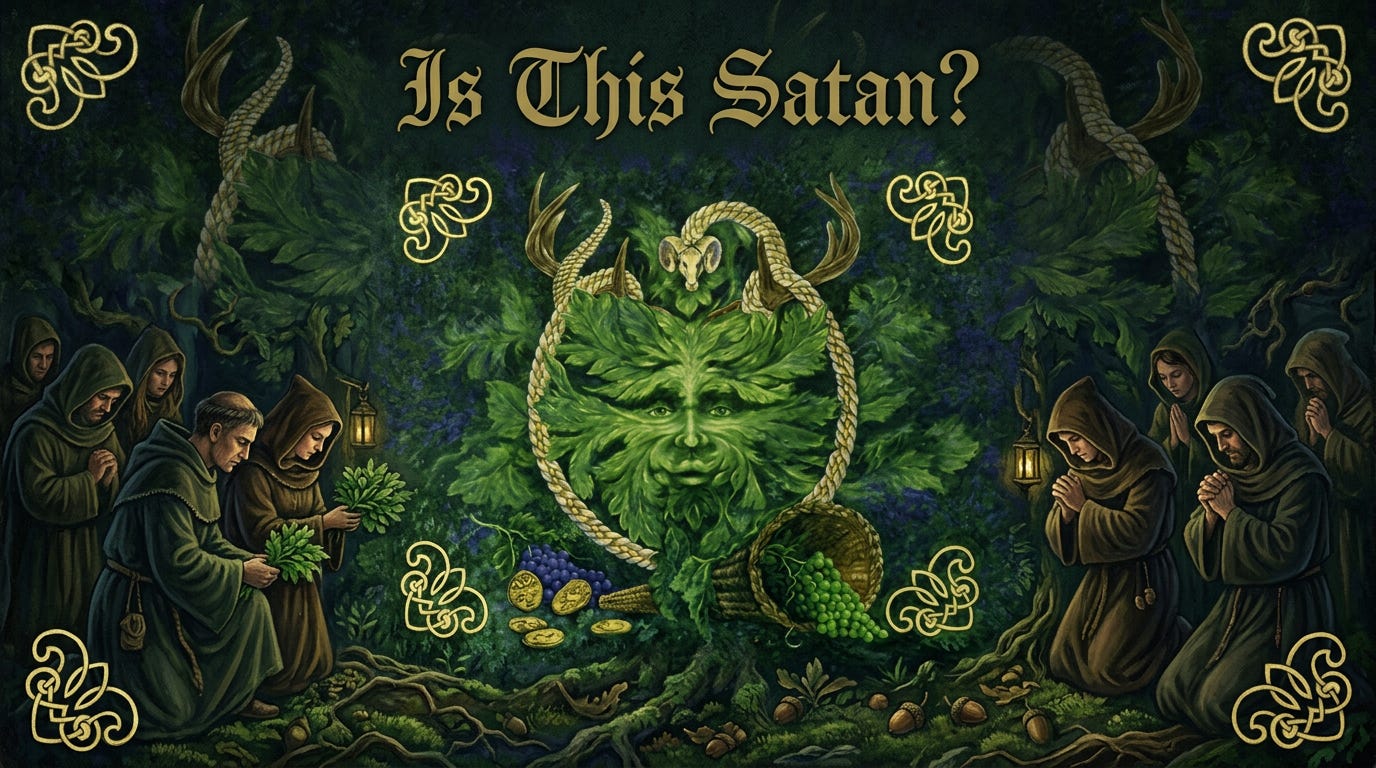
Five thousand years ago, the most powerful priesthood on Earth painted their god of the dead the color of a houseplant.
His name was Osiris. He ruled the underworld. He was murdered, chopped into pieces, reassembled, and resurrected, which is a rough week by anyone’s standards. And when the Egyptians painted him on tomb walls, they gave him skin the color of spring grass. One of his actual titles was “the Great Green.” They even planted little dirt-filled Osiris molds with grain seeds so that a tiny green Osiris would literally SPROUT inside the tomb, which is either beautiful or the single creepiest Chia Pet in history, depending on your theology.
A green god of death, resurrection, and secret knowledge of the world below. The Egyptians spent three thousand years and unthinkable wealth venerating him. Which raises the only question that matters: who, exactly, were they painting?
Winged Balls of Fire and Other Aviation Hazards
The Bible answers that question, and the answer is not “nobody.” Deuteronomy 32:17 says the nations sacrificed to demons. Paul repeats it flat in 1 Corinthians 10:20. The pagan gods were real, the ancients were talking to SOMETHING, and that something was not friendly. The generic title for these regional somethings was Baal, which just means “lord.” There were Baals everywhere. Baal of this mountain, Baal of that valley, Baal-zebub of Ekron, whose name you may recognize from every exorcism movie ever made. The ancient Near East had more lords than a British golf club.

The Egyptians put the winged sun disk over every temple door. The Assyrians drew their god Ashur as a bearded figure riding inside a winged orb. The Persians did the same with the Faravahar. Half the ancient Near East apparently agreed that divine beings commute by flying ball.
That image did not retire with the empires that carved it. Modern UFO witnesses describe orbs. Balls of light. Glowing spheres that move like they have somewhere to be.
The 2023 congressional UAP hearings were wall-to-wall orb testimony from military pilots (who, whatever else you think of them, are professionally trained to identify things in the sky, it’s kind of their whole deal). What if the ancients drew winged balls of light because they SAW winged balls of light, called them lords, and built altars? I’m not telling you that’s what happened. I’m asking why the sketch artist keeps drawing the same suspect.
Because these lords have a chief. And the oldest documents we have about him record, in his own words, exactly what his problem is.
The Original Middle Child Meltdown
The Life of Adam and Eve, a Jewish text from around the time of Christ, has the devil complaining to Adam DIRECTLY. He says he lost his glory “because of you.” God made Adam, commanded the angels to bow to the newest arrival, and one angel looked at this mud creature and said absolutely not. I was here first. I am older, brighter, and better, and I will not bend to dirt.
That is not a philosophical objection. That is the world’s first case of sibling rage. The eldest watching the baby get the kingdom.
And Scripture names the motive. Wisdom of Solomon 2:24, quoted constantly by the early church fathers: “through envy of the devil came death into the world.” Envy. Not pride in the abstract, not ambition, ENVY, aimed at a specific person, over a specific promotion. Cyprian of Carthage wrote a whole treatise identifying the devil’s envy of Adam as the first envy that ever existed. Cain killing Abel was just the sequel, performed by the student of the original artist.
So the first sin in the universe was an elder being turning envious of a younger one, and Scripture buried him for it. But the story of the angel who refused to bow did not stay buried. It surfaced again, centuries later, in the mountains of northern Iraq. With the ending rewritten.
The Peacock Angel Would Like a Word
The mountains belong to the Yazidis, one of the oldest and most persecuted religious minorities on Earth. Their chief angel is Melek Taus, the Peacock Angel, and his origin story goes like this. God created him first, before anything else. Then God created Adam and commanded the angels to bow. Melek Taus refused, saying he would bow to no one but God. And for this, God did not cast him out. God PROMOTED him. Made him chief of the angels and ruler over the affairs of the world, which as consolation prizes go is the entire casino.
That is the Iblis story beat for beat. Same test. Same refusal. Same character, as far as the plot is concerned. The only thing that changed is the verdict. The Yazidis insist, sincerely and emphatically, that Melek Taus is not Satan, and they have suffered horrifically for centuries because their neighbors disagreed. I am not mocking these people. They have been slaughtered by everyone from the Ottomans to ISIS, and nothing here is a call to treat them as anything but human beings owed dignity and protection.
But I am allowed to notice the plot. And the plot is the refusal rewritten as the hero’s origin. Scholars have even traced the likely delivery route. The 12th century reformer who shaped Yazidism, Sheikh Adi, was a Sufi, and there was a whole current in Sufism (through mystics like al-Hallaj) arguing that Iblis was actually the ultimate monotheist, the lover of God so pure he refused to bow even on God’s orders. Somebody took the rehabilitation seriously enough to build a theology on it.
Which is precisely how the adversary would want it. He has a marketing problem. He wants worship, and he cannot show up with horns and a pitchfork, that market is saturated. The workaround is bad information. Feed a small, isolated community the same story everyone else already knows, with one edit. The refusal wasn’t rebellion. It was DEVOTION. And it earned a promotion. Paul warned that Satan disguises himself as an angel of light (2 Corinthians 11:14). He did not specify which color of light. I have a guess.
Because the Peacock Angel’s bird of choice is iridescent GREEN. And once you notice that, you start noticing that whenever the rehabilitated god sets up a new branch office, he decorates it the same way.
Everything Old Is Green Again
In Mesopotamia he’s Tammuz, the dying-and-rising vegetation god, whom a long tradition of Christian writers identified as the deified son of Nimrod, the original rebel king of Babel. Tammuz dies, the green withers, the women weep, Tammuz rises, the green returns. Ezekiel saw women performing that exact mourning ritual AT THE TEMPLE GATE in Jerusalem and God listed it among the abominations (Ezekiel 8:14). The green god had infiltrated the one place on Earth he was banned from.
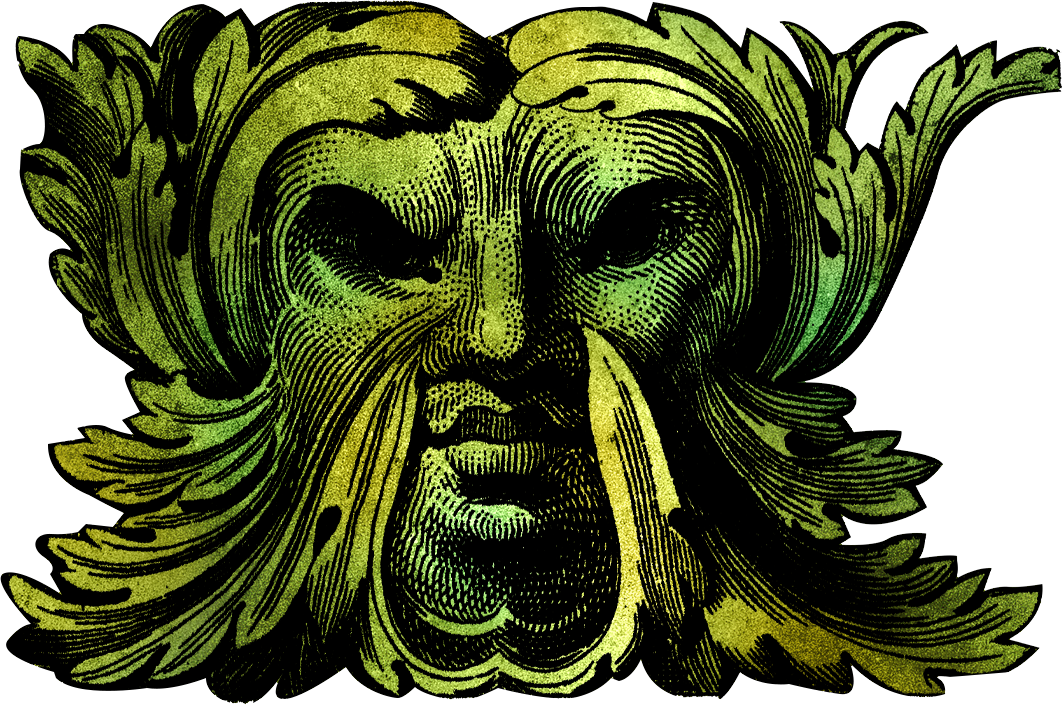
And in the modern West he’s back as Gaia, the Earth Mother, the sacred ecology of the New Age movement, where nature itself is divine and the wilderness is the temple. Different era, same product. A green power associated with plants, animals, cycles of death and rebirth, offering spiritual connection with no repentance required. The dying-and-rising vegetation god never actually died. He just kept rising, which, to be fair, is on-brand.
What if that’s not an archetype? What if it’s a client list? Because the clients on that list share more than a color scheme. They share a venue.
The Grotto Industrial Complex
The green god has never cared for cathedrals. His preferred real estate is the deep woods. The druids conducted their rites in sacred groves, in caves, in the places where the canopy closes over your head and the light itself goes green. The Romans, who were not squeamish people, were disturbed by what they found in those groves. The poet Lucan describes a sacred wood near Marseille where every tree was smeared with human blood, and when Caesar ordered it cut down, his own soldiers froze, so Caesar grabbed an axe and swung first, telling them the guilt was his alone. These were men who crucified people as a career. The grove was where they drew the line.
Rich people never stopped building them. From the Renaissance onward, European aristocrats spent fortunes constructing artificial grottos, man-made caves tricked out with shells, statues of nymphs and Pan, dripping water, the whole woodland-shrine aesthetic, in their own gardens. The tradition runs straight through to certain redwood retreats in Northern California that I have written about before, where the world’s most powerful men gather annually in a grove to perform a ceremony in front of a forty-foot owl. (That one is fully documented. There’s film.)
Why do the wealthiest people in every era keep rebuilding the druid’s office? Maybe because the office was never vacated. It still has a tenant, and we even have his portrait.
The Horned Guy in the Tunnel
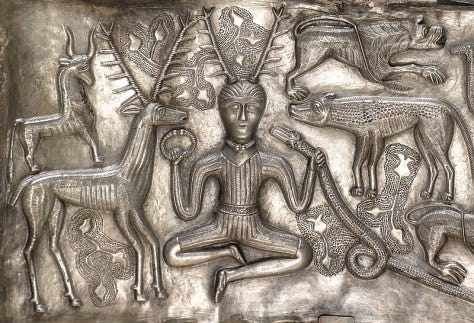
The portrait is on the Gundestrup Cauldron, and the tenant’s name, from the one surviving inscription, was Cernunnos, the antlered god of the Gaulish deep woods. We know almost nothing else about him.
Some people believe CERN, the particle physics laboratory in Geneva, is secretly named for him. The naysayers will tell you CERN is just an acronym (Conseil Européen pour la Recherche Nucléaire), and fine, on paper it is. The acronym still has some things to explain. CERN has a statue of Shiva, the destroyer, dancing his dance of cosmic annihilation, sitting on its campus as a gift from India. In 2016, video surfaced of individuals in black robes staging a mock human sacrifice in front of that statue, on CERN grounds, which CERN dismissed as a prank by researchers. “Our scientists ritually pretend-stabbed a woman in front of the destroyer god as a goof” is a sentence that should end careers and somehow didn’t. That same year, the opening ceremony for the Gotthard Base Tunnel, the deepest tunnel on Earth, bored through the Alps a few hours from Geneva, featured a horned goat-man deity being worshipped by writhing dancers in front of assembled European heads of state, and everyone clapped.
Maybe the name is a coincidence. But the horned wilderness god seems awfully comfortable around Europe’s most prestigious institutions. And institutions, ancient or modern, always announce their allegiances the same way. They put it in the branding.
Team Green
Branding happens to be my old territory. Before the Wise Wolf existed, I spent decades doing graphic design work, and I can tell you that no billion-dollar company chooses a logo casually. Branding goes through committees, focus groups, trademark lawyers, and executives who will fight to the death over a shade of blue. Nothing is accidental. Which makes two of tech’s biggest flags very interesting.
Nvidia, the most valuable company on Earth, the firm whose chips power essentially all artificial intelligence. Green logo. Green everything. Their fans literally call them Team Green.

And their name? By the founders’ own account, they wanted a word containing “NV” and landed on invidia. The Latin word for ENVY. The company building the machine minds of the future is named Envy, branded as a green all-seeing eye, which means “green with envy” is not my joke, it is their actual corporate etymology. Those chips are going into AI data centers that the industry keeps naming after Titans and pagan powers, your Colossus, your Hyperion, your Prometheus, because apparently “Server Farm 7” wasn’t evocative enough.

Companies this size do not adopt envy, eyes, and serpents by accident. Somebody chose all of that. The question is only what they thought they were choosing. But Nvidia and Razer are recent arrivals to Team Green. The oldest green brand in the world has been running for a century and a half, and you’re probably carrying it right now.
The Guru on the Greenback
That brand is the dollar. The United States prints its money green, and on the back of the one-dollar bill sits a thirteen-step Egyptian pyramid with its capstone missing and a disembodied glowing eye floating where the top should be, above the Latin words NOVUS ORDO SECLORUM, “a new order of the ages.” An unblinking eye, watching from a field of green. You just met one of those two paragraphs ago on a graphics card. Hundreds of researchers have called the dollar’s design occult in origin. The government’s answer has always been that the eye is the Eye of Providence, a perfectly wholesome Christian symbol, to which the obvious reply is that an Egyptian pyramid has about as much to do with Christianity as money itself does.
The paper trail on how it got there is stranger than the symbol. The design sat unused in the government’s files for 150 years until 1935, when Franklin Roosevelt personally approved putting it on the dollar bill at the urging of Henry Wallace, his Secretary of Agriculture and later Vice President.

Wallace read “new order of the ages” as an esoteric prophecy and wanted it on the money. So the all-seeing eye watching you from your wallet is there because a Russian occultist’s American disciple whispered in the president’s ear, which is the kind of sentence that would get you laughed out of the room if it weren’t documented history.
And Scripture has a name for the god of that wallet. Jesus named him personally: “You cannot serve God and Mammon.” Mammon is simply the Aramaic word for money, the same word used for wealth all through the rabbinic writings, and Jesus speaks of it as a rival that can be SERVED, a master demanding worship. The church took Him at His word. Gregory of Nyssa said Mammon was another name for Beelzebub, and medieval tradition ranked him among the princes of Hell. Paul called the love of money the root of all evil, and think about what the love of money actually is. It’s wanting what the other guy has. It’s envy, running the entire modern world on a green battery, in service of a god the Bible identifies as a devil. The first sin ever committed is now the operating system of civilization, and we print it in his color, under his eye.
The Emerald That Fell
His color, if the oldest legend about it is right, was set at the moment of the fall. Medieval tradition held that when Lucifer fell, an emerald was knocked loose from his crown, and that green stone fell to Earth, where it became an object of veneration. The brightest of the angels, and the piece of him men kept and treasured was GREEN.
Even our language seems to remember. Nobody actually knows why English says “green with envy.” The trail dead-ends at Shakespeare, who coined “green-eyed jealousy” and “the green-eyed monster” and took the reason to his grave. The standard explanation, that the Greeks believed envy turned your skin green with bile, evaporates when you go looking for a single ancient physician who ever said so. There isn’t one. The origin of the phrase is a genuine blank spot. Four centuries of English speakers have been painting the oldest sin the same color as the oldest sinner without anyone being able to say why.
So the what-ifs stack up. What if the first sin was envy, an elder creation raging that God chose Adam to be king over him? What if that being’s calling cards, across every culture he’s worked, have been the wilderness, the serpent, the dying-and-rising green god, the grove, the grotto, the unblinking eye, and the glowing orb in the sky? What if there is a thread, call it neo-druidic, call it whatever you like, running from the groves of Gaul to the garden grottos of aristocrats to a certain owl ceremony in the redwoods to a horned god dancing for prime ministers in a tunnel? What if the folk saying is more literal than anyone intended, and the devil really is green with envy?
I could be wrong. I want you to consider that I’m wrong. Check every claim in this article, the sources are real and findable, and some of what I’ve connected is speculation stacked on legend, and I’ve tried to flag which is which. Don’t take my word for it and don’t take the debunkers’ word for it either. Question my research. Then question theirs.
But when the same color keeps showing up on the same character for five thousand years, at some point “coincidence” starts to require more faith than the alternative.
Envy is the oldest sin. And it thinks it has always looked good in green.
If this article made you side-eye your gaming mouse, consider a paid subscription. The Wise Wolf walked away from a comfortable tech career to chase green gods through five millennia of legend, and the irony of asking you for Mammon’s own product, in Mammon’s own color, is not lost on me. He has never once sent us a check. Lily just graduated with her journalism degree and is currently spending her summer at a camp, where she is learning valuable journalism skills like “canoe retrieval” and “explaining to nine-year-olds why the woods are not haunted” (Lily, based on this article, do not make promises). Your support keeps her researching, keeps me howling, and keeps this operation running on something other than emerald legends and spite.
Help keep the Wise Wolf howling.
Can’t get enough of the GREEN? Lily wrote an article a while back on a genuinely strange topic that almost nobody read, which she has definitely forgiven you for. Maybe give it a look next?
The Green Children of Woolpit: A Medieval Close Encounter That History Tried to Forget

Picture this: harvest season, somewhere between 1135 and 1150, in the sleepy village of Woolpit, Suffolk. The name itself should have been a warning. "Wolf pits" they called them, ancient traps designed to snare the predators that stalked the English countryside. But on this particular day, something far stranger than wolves would emerge from the earth.
lovedd this piece. osiris is such a fascinating figure. i was thinking about midsommar (2017) and the wicker man (1973) while reading this, and just cinemtaic folk horror in general
Dude… wow. This one had me glued to the screen. Well done sir. Well done indeed. 🫡