


Editorial Note: So I’m seeing comments calling me arrogant, which is a fun accusation. An arrogant person would have written that people are stupid and left it at that. An arrogant person wouldn’t have said they themselves were once stupid but did something about it. Read books. Went to college. Learned. Chances are if this article offends you, it’s not because I am arrogant. It’s because you are the person I am talking about.
Yet Another Editorial Note: Apparently a lot of people read this article and missed the point so thoroughly that I have to wonder if they read it at all.
I am not telling you to blindly trust experts. I am not telling you your personal experiences with healthcare are wrong. They are YOUR personal experiences and they do not work for everyone. What I am telling you is that your personal experience is not universal law.
The point of this article is to THINK FOR YOURSELF. Examine evidence from both sides. Make an informed decision. The fact that so many people read that message and concluded I am a paid misinformation agent working for Big Expert is genuinely astonishing to me, and if that is where your head went after reading this, I say this with complete sincerity: put down the meth pipe, drink some water, and read it again.
Earlier today, before I had finished my first cup of coffee, a stranger on the internet informed me that he is an expert on artificial intelligence.
His evidence: thirty years ago, he watched his friend write a program that drove a cartoon car across a computer monitor.
He then explained, in the same breath, that AI is not real, does not exist, and is in fact just autocomplete. This is the kind of logical whiplash that should require a neck brace. The man is simultaneously an expert in a technology that he also believes is fake. He is the human equivalent of a car mechanic who doesn’t believe engines exist but DOES know a lot about engines from watching his friend change a carburetor in 1991.
I want to be clear that I am not cherry-picking one exceptional lunatic here. This man is not unusual. This man is EVERYWHERE now. He multiplied. He found other men exactly like himself and they formed communities on the internet, and those communities now confidently explain virology, nuclear physics, aeronautics, geopolitics, and the inner workings of technologies that entire universities of actual experts have dedicated their careers to studying, and they do all of this from an Obama phone while wearing flip flops.
We have arrived, my friends, at what I am going to call the Golden Age of Confident Stupidity. And it deserves a proper autopsy.
I had originally planned to write today about the dangers of AI data centers, the surveillance architecture, the infrastructure being built around us while everyone argues about chatbots. That article still exists in my notes. It will get written. But this man was SO aggressively, SO committedly, SO LOAD-BEARINGLY stupid that I decided the more pressing danger is not AI data centers. It is stupid people in large masses. The data centers at least require engineers.
The Part Where We Explain Why Stupid People Think They’re Smart (Spoiler: It’s Because They’re Stupid)
There is an actual psychological phenomenon behind all of this, and it was documented in 1999 by two Cornell researchers named David Dunning and Justin Kruger, who published a paper with the wonderfully academic title “Unskilled and Unaware of It.” The core finding is devastatingly simple: people who lack competence in a given area ALSO lack the metacognitive ability to RECOGNIZE their incompetence.
In plain English: you have to be smart enough to understand how much you don’t know. If you’re not smart enough to understand how much you don’t know, you will assume you know EVERYTHING.
The tragedy of this is not that dumb people are dumb. The tragedy is that being dumb is not uncomfortable. Being dumb is, in fact, incredibly comfortable. You never have to read anything. You never have to study anything. You never have to sit alone at two in the morning with a book you didn’t want to finish interrogating your own assumptions. You just absorb vibes from the internet and become, in your own mind, an “authority”.
The SMART people, meanwhile, are the most insecure people in any room, because the more you actually learn about a subject the more you realize the ocean of things you still don’t know. A first-year medical student is terrified of everything. An attending physician with thirty years of experience still orders tests before making a diagnosis because he knows how many ways he could be wrong. The guy on Rumble who watched a sixteen-minute video about how the flu is caused by electromagnetic frequencies has zero such doubts. He’s got it FIGURED OUT.
This is the core problem. Expertise produces humility. Ignorance produces certainty. And on the modern internet, certainty is the currency that buys followers, and followers are the currency that buys a sense of validation that these people have never found anywhere else in their lives.
The Rumble Video as Academic Citation
Allow me to describe the modern epistemology of the confident idiot. It goes like this.
Step one: form a conclusion. (”Viruses are fake.”) Note that this step comes FIRST, before any evidence has been examined. The conclusion is not derived from evidence. The conclusion is a vibe, a feeling, a desperate desire to be smarter than the scientists who spent a decade in graduate school and haven’t been thanked for it lately.
Step two: search for a video that seems to confirm the conclusion. Note that the video does not need to be watched. The TITLE needs to be correct. “The TRUTH About Viruses Big Pharma Doesn’t Want You To Know” is sufficient. The sixteen thumbnail seconds of a guy in a baseball cap looking Very Concerned does the rest.
Step three: deploy the video in argument as “evidence” with the confidence of a Harvard professor submitting peer-reviewed research.
Step four: when pressed on anything, pivot to “you just can’t handle the truth.”
The thing about viruses specifically is that this argument collapses the moment you ask one single question: if viruses aren’t real, what exactly is Tamiflu treating? Tamiflu is an ANTIVIRAL medication. It targets viral replication specifically. It does not treat bacteria. It does not treat feelings. It does not treat “toxins” or “frequencies” or whatever the current explanation is for why your kid missed a week of school last winter. The drug exists. It has a mechanism of action. That mechanism of action REQUIRES viruses to exist to function. Hospitals have scanning electron microscopes. Viruses have been PHOTOGRAPHED. They look like little spiky nightmare balls and they are absolutely real and I am sorry if this information does not align with the Rumble video but the Rumble video is wrong.
And if you think the virus denial crowd is impressive, the people making the “nukes are fake” argument deserve their own paragraph because that one is a PARTICULAR achievement of backwards reasoning. The argument, and I want to be precise here so I am representing it fairly, is that nuclear power plants exist but nuclear BOMBS do not exist. These two things operate on the same underlying physics. A nuclear reactor is a controlled fission chain reaction. A nuclear weapon is an UNCONTROLLED fission chain reaction that reaches critical mass, which produces the largest explosion human beings have ever created. You cannot believe in one and disbelieve in the other any more than you can believe in matches but not forest fires. The mechanism is identical. You changed one variable: the word “controlled.” That’s it.
But don’t tell that to the Rumble expert. He has a video.
The Free Energy Machine and the Crystal Matrix Modulator
This brings me to the people these confident idiots look UP to, which is somehow even more disturbing than the confident idiots themselves.
At the top of the food chain of internet misinformation, you will find a collection of middle-aged men who have informed the world that they have built free energy machines in their garages using nine dollars worth of copper wire, some magnets, and something they call a “crystal matrix modulator” (which is not a real thing, but it sounds impressive if you have never taken a physics class, which they have not). These men have hundreds of thousands of followers. They sell courses. They have Patreons. They are getting PAID to be wrong about physics in public.
The followers of these men then go onto the internet and repeat what they heard, but without any of the charismatic delivery or the production value, so they just sound like people who are having some sort of episode. They cite “the research” without being able to name the research. They reference “what scientists are now discovering” without being able to name the scientists or the discovery. They have absorbed the CONFIDENCE of the grifter without absorbing any of the actual content, which was already wrong to begin with, so this is arguably an improvement.
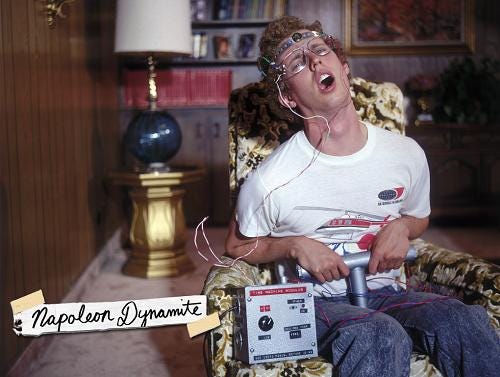
The only difference between that scene and the free energy machine guy’s Patreon is that Napoleon at least only had to suffer the consequences himself.
Back to This Morning, Because He Deserves a Full Accounting
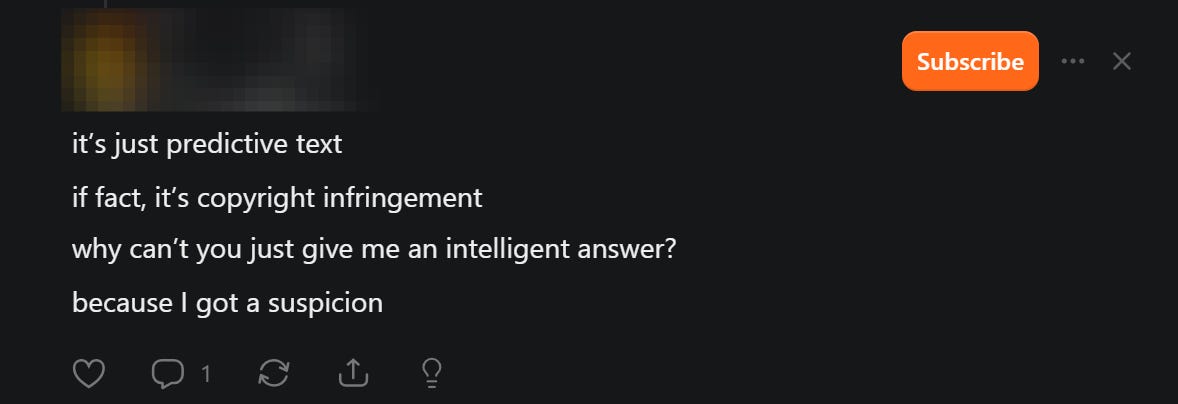
After establishing his credentials (watching code, 1994, very impressive), he informed me that modern large language models are just predictive text. Just autocomplete. Same thing your phone does when it suggests the next word in a text message.
This is the kind of argument that can only be made by someone who has never spent thirty seconds reading anything about how these systems actually work, because the moment you read ANYTHING, this argument falls apart completely.
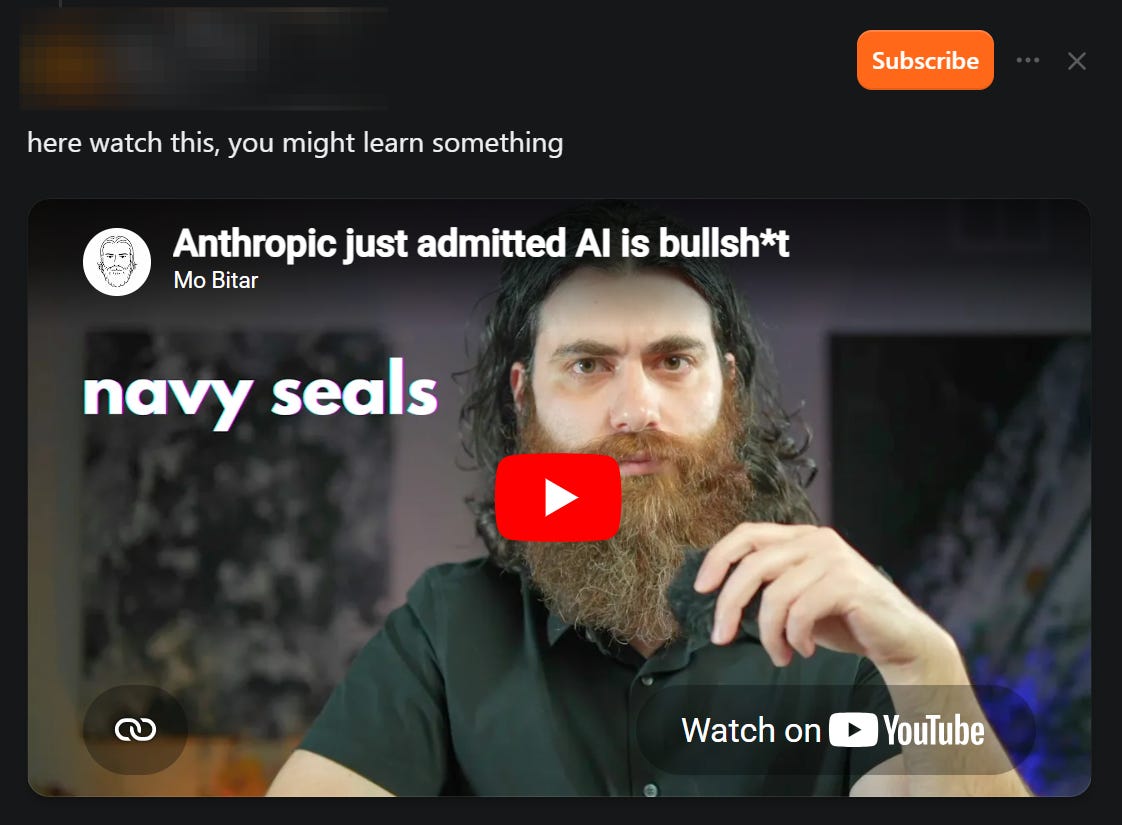
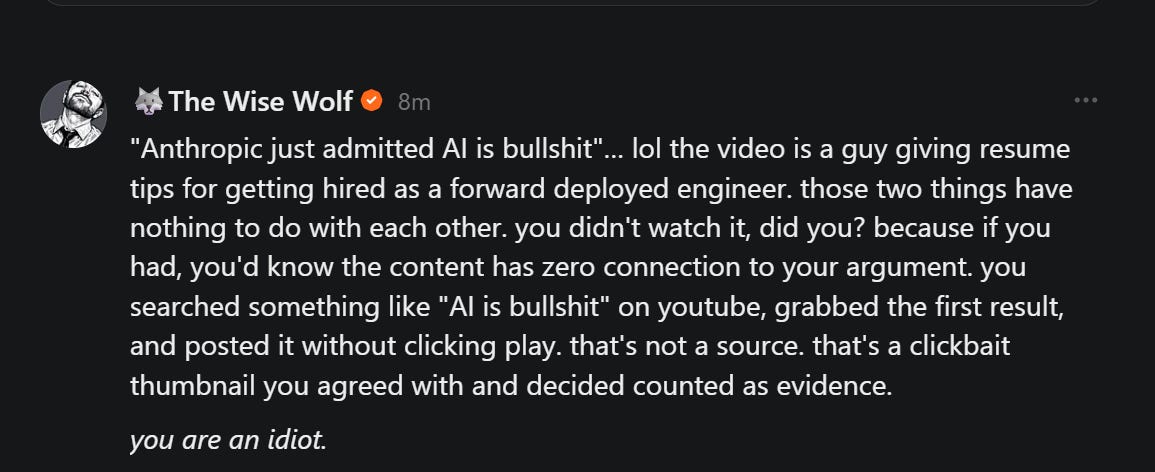
Modern LLMs are running transformer architectures that perform matrix calculations at a scale that produces emergent behavior that the people who BUILT them do not fully understand yet. The researchers at the major AI labs publish papers about this constantly because they are actually trying to figure out what is happening inside these systems. These are some of the most accomplished mathematicians and computer scientists on earth and they will tell you directly: we do not fully understand why this works the way it works. The training process, the attention mechanisms, the sheer scale of parameter interactions, it produces something that behaves in ways that cannot be predicted from the components alone.
This man, who watched his friend code in 1994, understands it better than they do.
I have built local AI workstations. I have run my own models. I have worked with these systems at a professional level for years. I do not claim to understand everything about how they work because the people who built them don’t claim that either. But I know enough to know that “autocomplete” is not the answer, the same way I know that calling the sun a “really big candle” is not technically accurate.
But this man was not interested in any of that. What he was interested in, what he is ALWAYS interested in, is not being wrong. Because being wrong means something very specific to this kind of person. Being wrong doesn’t just mean you made an incorrect factual claim that you can update and move on from. Being wrong means the whole scaffolding comes down. If he’s wrong about AI, maybe he’s wrong about other things. If he’s wrong about other things, maybe he’s spent forty-some years not knowing what he’s talking about. And THAT is a confrontation with reality that he has organized his entire identity around avoiding.
So instead of updating, he argues for eight more hours. He says you haven’t addressed his insights (there were no insights). He says you’re avoiding the real question (there was no real question, just repeated assertions). He says everyone else is too stupid to see what he sees (a deeply suspicious claim from someone whose primary credential is being in the room when someone else wrote code three decades ago).
I Was Dumb Once, and Here Is What Fixed It
I want to be honest about something here because I think it’s the most important part of this whole conversation.
I grew up in circumstances that were not exactly designed to produce intellectual curiosity. White trash, middle of nowhere, the working assumption that life was essentially a long drunk with occasional interruptions for fighting. My father and his brothers dropped out of high school to join a biker gang. One of them was murdered. One was shot in the chest. One had his brake lines cut and lost a leg. My dad escaped this because my mother, who was substantially smarter than anyone else in that situation, told him to either get a job or lose her, and he was smart enough to know he’d never find another woman like her.
So I grew up watching what a wasted life actually looks like. Not in a dramatic movie way, but in a very quiet, very ordinary way. Guys who were SURE they were smarter than everyone. Guys who had OPINIONS about everything. Guys who had never read a book in their adult lives but who could tell you with complete confidence what was wrong with the government, the economy, the church, the schools, and everyone else’s choices. They argued constantly and loudly and they were wrong about nearly everything and NONE of them ever seemed to notice or care.
My grandparents were different. They were educated people who had the unusual quality of knowing what they didn’t know. They told me: go to school. Read books. Do the work. Not because it makes you better than anyone else, but because there is no shortcut to actually understanding things, and a life built on not understanding things is a life built on sand.
So I did. I went to college. I read thousands of books, not as a performance, but because once you actually start reading you discover that the world is almost incomprehensibly more interesting than the version of it that exists inside someone’s head without any input. I learned things. I got things WRONG and then I updated my understanding and I got less wrong over time, which is the entire mechanism of education and also of being a functional adult.
The person who watches eight Rumble videos and becomes an expert has skipped this entire process. They went from zero directly to “I have the answer,” without spending any time in the uncomfortable middle zone where you realize how much you don’t know and have to decide whether to keep going anyway. That uncomfortable middle zone is WHERE KNOWLEDGE LIVES. You cannot get to the other side of it by going around it. There is no shortcut.
The Yoga Pants Problem
I want to end with an analogy that I think captures this perfectly, because analogies are what stick when everything else slides off.

And instead of processing the obvious follow-up question of HOW that person achieved that result (years of consistent exercise, discipline, probably early mornings, probably giving up things they enjoyed), they buy the yoga pants. They put on the yoga pants.

Confident internet stupidity works the same way. Someone watched a documentary that made them feel informed and they want the feeling of being the smartest person in the room. They want the social status of having cracked the code that everyone else missed. They want to be the person who KNOWS. So they acquired the signifier of knowing, which is a confident opinion delivered without hesitation, and they deployed it, and it turns out the signifier of knowing is very hard to distinguish from actual knowing if nobody in the conversation is willing to push back.
I am willing to push back.
Not because I enjoy the argument. I do not. There is no satisfaction in watching someone dig in and refuse to update when you show them something demonstrably true. There’s just a kind of sadness, because you can see the years of accumulated avoidance in how hard they hold onto something that isn’t real.
But the alternative is a world where you can watch your friend code something in 1994 and become an authority on modern AI, where viruses are fake but antiviral medication works for reasons nobody needs to explain, where nuclear bombs are a hoax perpetrated by governments that also operate the nuclear reactors that power your city, where nine dollars of copper wire can make your electric bill disappear if you only believe hard enough.
That world is not real. But it’s getting louder.
So get loud back. Read something. Go back to school if you need to. Pick up a book that disagrees with you. Spend some time in the uncomfortable middle. It is, I promise, worth the electricity.
Help keep the Wise Wolf howling.
The Wise Wolf would like to point out, in the spirit of full disclosure, that nobody is paying him to say any of this. There is no grant funding this column. There is no think tank behind this take. There is a motel and a wifi connection and a guy who looked at the life that was handed to him and decided to do something different with it. If that is worth something to you, a paid subscription to The Wise Wolf Club keeps the lights on and keeps me exactly one step further from the free energy machine forum where everyone is VERY SURE they have figured it out.
This is actually a bit of a dangerous take on all things medical. It somehow encourages people not to question the “experts”, which is how we got into the plandemic debacle. There are learned men & women beginning to question the entire virus theory. All images of a virus are said to be computer generated images. Doctors are one of the leading causes of death. You would think me one of the stupid because I haven’t gone to a doctor in 11 years & have no intention of doing so in the future. I’m 71 years old & never been healthier & yet all of my peers who follow all of their doctors orders are in a dreadful state of health. Just because someone goes to university & then wears a white lab coat with a stethoscope around their neck, it doesn’t actually make them intelligent. Many Canadians doctors lost their lives after succumbing to the lethal jab. Most of what you said certainly has an element of truth but I think in this case, you’ve painted with too wide a brush. I live by faith & not by sight as much as I am able, and never forget, we have the mind of Christ. ✌️
Funny this popped up today, I was just reading a moment ago how millennials and gen Z can't pass the three question Stanford Financial Intelligence test.
3 questions !
1. Compounding interest j
2. The effects of 3% inflation on a 2% savings account
3. The difference and risk between a stock and a mutual fund
We're doomed