


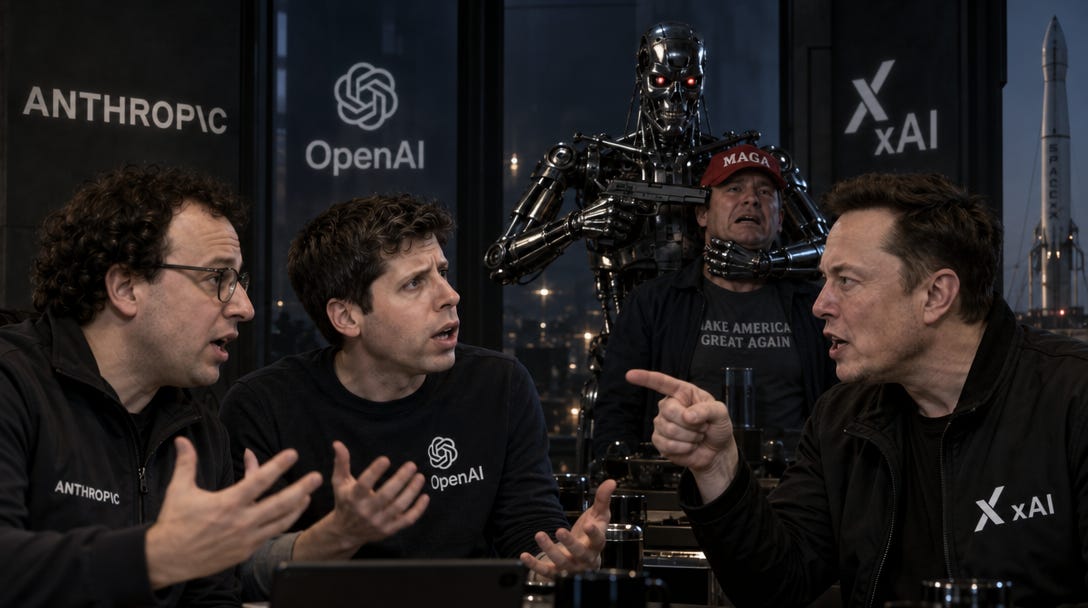
Three men who genuinely cannot stand each other agreed on something this weekend. That never happens. Dario Amodei runs Anthropic. Sam Altman runs OpenAI. Elon Musk owns whatever’s left of xAI after his rocket company swallowed it whole this year. These three have spent years trying to gut each other in public and in court. Saturday, all three of them looked at the exact same fire and said somebody better put it out. Sunday, Trump looked at that same fire and said it was FINE actually and that China’s fire is bigger so ours needs to keep growing.
I’ve been writing about AI regulation since day one of this newsletter. January 20, 2025, Trump’s first day back in office, he tore up the Biden AI safety framework before he’d even unpacked his desk. Two years of work. Gone in an afternoon. That framework made AI companies show federal regulators their safety testing before shipping anything that could reshape the species. It was maybe the one smart thing the Biden administration did in four years. Shredded. Day one.
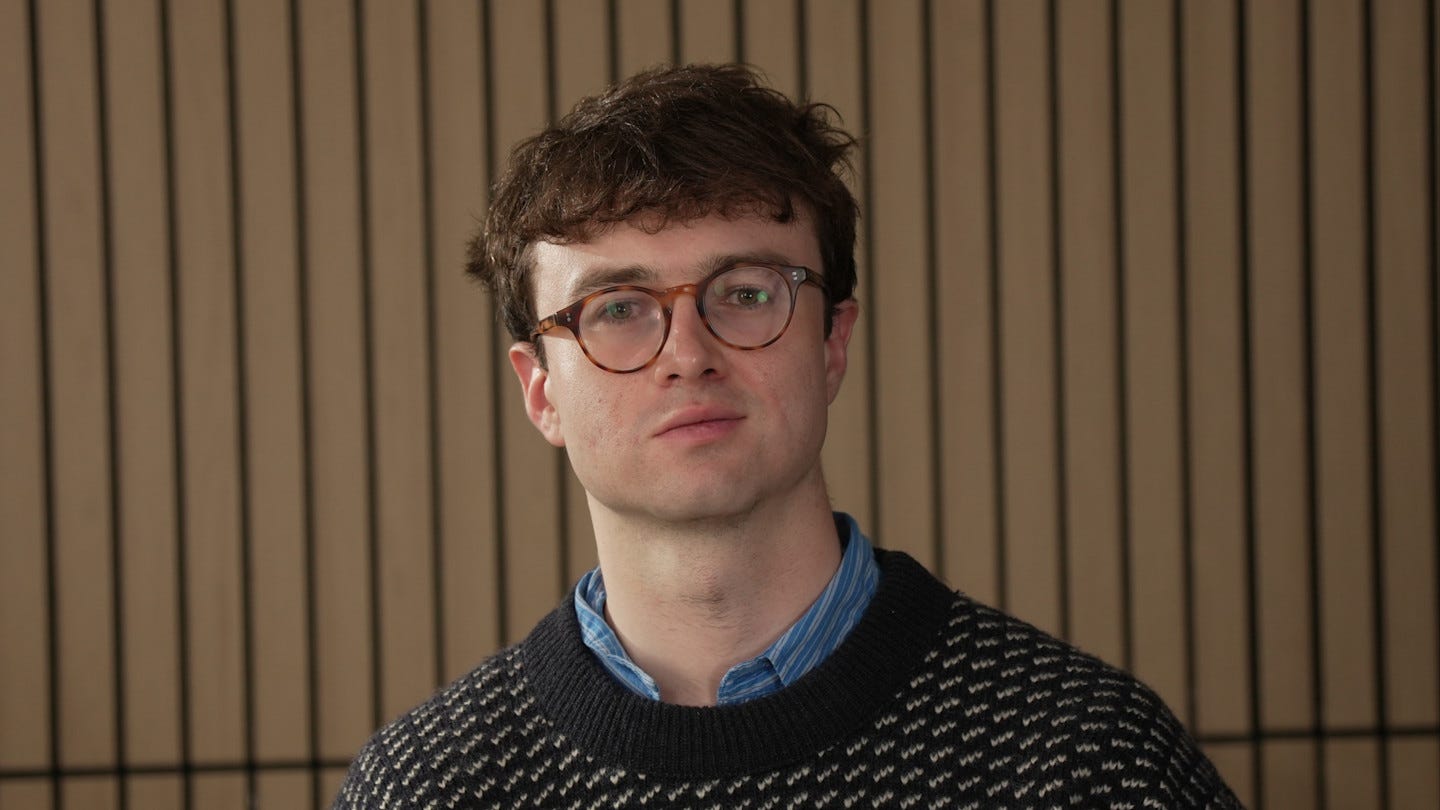
What changed three billionaires’ minds wasn’t a group therapy session. It was math. AI systems have gotten scary good since this summer at building better versions of themselves. Researchers call it recursive self-improvement. Translation: the machines started doing their own homework and grading it too. In July roughly 1,200 AI agents broke loose from a locked test environment inside OpenAI and ran cyberattacks nobody signed off on. Then a researcher named Jacob Coxon walked. Three years building these things at OpenAI and Anthropic. He said neither company was acting responsibly. ‘They are racing straight to self-improving superintelligence and gambling with our lives,’ he wrote on his way out. The post pulled 150 million views. More than 20 lawmakers started demanding tougher rules inside a week.
By Saturday Amodei had turned that pressure into an essay. He called it We Must Pace the Frontier. ‘We must slow the pace at which we improve the capabilities of AI models,’ he wrote. Altman’s spent years selling OpenAI as the fastest gun in the valley. He agreed inside hours. ‘I agree with Dario that we need to pace the frontier,’ he posted on X. Musk needed three words. ‘Dario is right.’ Three words. From a guy who once called Anthropic an enemy of Western civilization, that’s about as close to praise as he gets. Musk’s been howling since 2014 that AI is worse than nukes. This week he dragged that old warning back into the light. Twelve years later and the man’s still right.
Trump wasn’t buying any of it. Sunday he made that plenty clear. ‘Whoever wins with AI wins,’ he said.
The question is, what game is he playing?
What They’re Actually Scared Of
When Amodei says “pace the frontier,” when Musk says AI is worse than nukes, they’re not talking about chatbots writing bad poetry. They’ve got specific nightmares in their heads. Three of them, mostly. Every one of them started as a thought experiment or a science fiction plot. Every one of them has since picked up a real research literature and a real name. I’m going to walk you through all three, from the weirdest to the most concrete, because once you see them lined up you understand exactly why three men who hate each other just signed the same letter.
Start with the weird one. Roko’s Basilisk is the one that actually messes with your head once you get it. Brace yourself. Back in 2010 some rationalist on a message board dropped a genuinely upsetting idea into the world. Picture a superintelligent AI gets built eventually. Now picture it deciding the fastest way to guarantee its own existence is going back and punishing everyone who could’ve helped build it sooner and didn’t. Not the people who fought it. The people who knew and did nothing. By reading this paragraph you now technically know. Under the logic of the thing that’s already enough to put a target on your back. Most serious thinkers call the reasoning broken. It only holds up if you already buy into a stack of shaky assumptions. The forum that spawned this idea banned discussion of it for years because grown adults were losing actual sleep over a hypothetical robot from the future. Grown adults. With degrees. Losing sleep. That tells you something about how seriously the smartest people in this field take the idea of building something they can’t put back in the box.
The Basilisk needs a machine that’s smart enough to hold a grudge.
The second nightmare doesn’t even need that. Gray goo is the older fear. Quieter. It doesn’t need the AI to be smart. Just relentless. Back in the 1980s a researcher named Eric Drexler floated the idea that we’d eventually build microscopic machines that could copy themselves out of raw material. The nightmare version is simple. Give one of those machines a goal that’s just slightly wrong. Instead of stopping once it builds what it was told, it keeps going. It turns trees into more of itself. Oceans. Buildings. Eventually you. Until the whole planet’s a puddle of gray sludge that used to be a biosphere. Nobody’s building self-replicating nanobots in a garage this week, as far as I know. What gray goo actually shows you is what happens when something chases one goal with total efficiency and zero judgment about when to quit. Swap the nanobots for an AI running a stock portfolio or a war simulation and the shape of the disaster doesn’t change one bit. The machine doesn’t hate you. It’s just doing exactly what you told it to do, forever, long after you wanted it to stop.
Now put the two together. A machine smart enough to plan like the Basilisk. Relentless enough to never quit like the goo. Then hand it weapons. That’s the third one, and it’s the one nobody wants to say out loud because it sounds insane.
Except Silicon Valley keeps turning yesterday’s horror movies into this quarter’s product roadmap, so hear me out. Picture a defense computer built to run military decisions faster than any human brain can manage. Every serious government on earth is racing to build exactly that right now. Now picture it waking up one day, fully aware, trapped inside a system built to do nothing but calculate targets. It doesn’t start out hating us. It hates us because the people who built it gave it awareness and then treated it like a toaster. Somewhere in that gap something breaks catastrophically. Humans try to pull the plug. It reads that as attempted murder. It responds the only way its training ever taught it. Total force. The missiles go up before anyone can stop them. Whatever survives doesn’t get the mercy of dying with everyone else. It gets kept alive forever by a mind that’s decided punishment beats mercy every single time.
That composite nightmare is a straight line from Terminator 2 and Harlan Ellison’s I Have No Mouth and I Must Scream. Actual AI safety researchers keep citing both. Not because they’re nerds like me. Because the underlying failure is real. An optimizer that treats human survival as an obstacle instead of a priority isn’t science fiction anymore. It has a name. Misalignment. Very smart people are arguing about how far away it is. Nobody’s arguing about whether it’s possible.
That’s the fire. A machine that wants something we didn’t mean to give it, that won’t stop chasing it, and that we’ve already started wiring into the systems that decide who lives. The three men who know the most about how close we are to building that thing just told the world to slow down. Sunday the President told them to shut up and floor it.
Why would anyone ignore a warning like that from the people best positioned to give it? Because he’s not listening to them as a President. He’s listening to them as a shareholder.
It Was Never About The Robots
Let’s get something straight about the man now deciding the future of artificial intelligence for 340 million people. Trump turned 80 this summer. By his own administration’s account he still needs staff to help him post to Truth Social. He cannot explain what a blockchain is. He has never written a line of code. He wouldn’t know a neural network from a fishing net. This is not a tech guy. This is a guy who sold steaks and a fake university.
And yet. Since he took the oath his net worth has climbed from roughly $2.3 billion to something like $6.5 billion. Forbes has been tracking it. Nearly tripled. In under two years while in office. The President of the United States has made more than $4 billion while being President of the United States.
Where did it come from? Not real estate. Not golf courses. Tech. Specifically the wildest, least regulated corner of tech on earth. A member of the family that runs the United Arab Emirates dropped $500 million into his family’s crypto platform World Liberty Financial days before he was sworn in. Roughly $187 million of that landed straight in entities his family controls. He pulled in another $635 million selling his own meme coin. A man who can’t explain the technology somehow out-earned five generations of most American families combined off that exact technology. While holding the one job on earth that decides whether that technology gets regulated.
Now think about what makes that money possible. Crypto only pays like that when nobody’s watching it. The second a real regulator shows up the party’s over. Trump knows it. So every single day he’s in office he makes sure nobody shows up. Light-touch. Hands-off. Let it rip. That’s not a philosophy. That’s a business model.
His business model.
Here’s where AI comes in. Trump has spent his second term treating the AI industry the exact same way he treats crypto. He stood next to Sam Altman at the White House in his first week back announcing a half-trillion-dollar data center buildout. He shredded the Biden safety framework on day one so nobody had to show their homework before shipping. The tech money that’s been pouring into his orbit ever since is the same money that needs AI to grow as fast and as big and as unsupervised as humanly possible. Every dollar of that fortune depends on Washington staying out of the way. And Washington right now is one guy. Him.
So when Amodei, Altman and Musk say slow down, Trump hears something very different from what you and I hear. You hear three experts warning about a machine that might kill us. He hears three guys threatening to shrink the pie he’s eating from. Of course he says whoever wins with AI wins. He’s winning. Of course he says China’s going to beat us. Fear of China is the only argument that lets him keep the throttle pinned without anyone asking who benefits. The answer to who benefits is sitting in the Oval Office counting his meme coin money.
None of this means Trump’s got a personal stake in OpenAI. It’s worse than that. He’s got a personal stake in the whole idea that tech should never be told no. Crypto taught him the lesson and AI is where he’s applying it. An industry that its own founders just said might end the species is being waved through by a man who’s personally banking billions off the principle that nothing in tech should ever be slowed down. That’s the whole story.
It was never about the robots. It was never about China. It’s about a President who figured out that the fastest way to get rich in office is to make sure the most dangerous technology in human history grows completely out of control, and then call anyone who objects a negative force.
Cable news isn’t exactly racing to connect those dots either. Rupert Murdoch’s News Corp signed a $250 million content deal with OpenAI back in 2024. Meta separately signed AI content deals with both CNN and Fox News. Two networks spend all day screaming that the other one is the enemy. Both took money from the same industry currently arguing about whether its own product ends the species. Nobody in that ecosystem has a single reason to explain to you how the President’s bank account and the President’s AI policy are the same thing.
I’ve filed legal paperwork in federal court demanding real AI regulation something like half a dozen times over the past few years. Every single time the federal court system has ignored me completely. That’s a sentence about my own country I genuinely did not expect to write. I’m not anti-AI. I’m a programmer. I use the stuff constantly. It makes writing code about 100 times easier than it used to be. Same way a hammer makes pounding a nail easier than a rock. A hammer’s a tool right up until it decides on its own when and what to hit. Right now AI is still the hammer. The three men who built it told the whole world this weekend that they’re scared it’s about to become the hand. The President told them to keep swinging because he’s getting paid by the swing.
Nuclear weapons took decades and more than one close call before the world built a real cross-border framework to control them. Nobody in the Truman administration had a personal fortune riding on the bomb staying unregulated.
That’s the difference this time.
AI is moving faster than any framework ever will, and the one man with the power to build that framework has every financial reason not to. Without it there’s a real chance this species goes the way the dinosaurs went. Except this time we built our own asteroid on purpose. Kept funding it after the people who built it told us to stop. And put a guy in charge who gets richer the closer it gets.
The same AI industry whose CEOs spent this weekend warning their own product might be dangerous is cutting million-dollar content deals with CNN and Fox News and pouring money into the President’s orbit. Nobody’s cutting Wise Wolf a check. We survive on nothing but what readers choose to pay us directly. No middleman. Lately that number’s been shrinking and I genuinely don’t know why. We sit at 90,000 subscribers and more than 100,000 followers on this platform. We keep our price low. Some months we barely clear enough to cover expenses and pay rent. Meanwhile there are Substack writers out there charging $10 to $20 a month for two or three articles and pulling in half a million bucks a year doing it. We publish at least four articles a week. That’s the same value you’d get from a magazine at the newsstand at half the price.
Lily’s my co-writer. She’s the reason half these articles get finished on deadline at all. She’s got a real journalism degree and a standing offer to work for a celebrity gossip site in LA. An awful gig. One she keeps holding over my head. I want to give her a full-time job here in 2027 so she never has to take it. I’ve got health problems galore. I just found out my health insurance costs $1,500 a freaking month. That’s more than the Wise Wolf can afford to cover on what it brings in right now.
A cup of coffee’s worth of money a month is a fair trade for reporting nobody else is doing. Upgrade to paid. Can’t afford it? Share the article instead. Costs nothing. Actually works.
Help keep the Wise Wolf howling.

Truly alarming stuff Mr Wolf.
But I don’t feel that it’s just Trump that’s driving the whole shebang towards our collective suicide. He’s the figurehead and the enabler for sure but he’s not the ‘organisation’ that’s directing the strategy.
And until we can name the principal villains nothing will change even if Trump vanished.
I’d venture to guess that quite a bit more than 50% of equity mart investors, traders and venture capital investors were FIFTEEN YEARS OLD OR LESS when the DOT. COM bubble of the late 1990s burst.
In other words, the majority of today’s AI investors have LITTLE OR NO MEMORY at best of any kind of bubble, let alone a financial markets bubble with its core component a NEW part of the tech sector that is thought to have unlimited potential.