


Every October I get paranoid. Not about ghosts or werewolves or whatever knockoff costume trends TikTok is pushing this year. I get paranoid about vampires. Specifically, I get paranoid that Halloween night is when they’ll finally decide to stop hiding and just take over. It’s the perfect cover, right? Everyone’s dressed like monsters anyway. Who’s going to notice when the fake fangs start drawing real blood? So this year, instead of spending the last week of October barricading my windows with garlic and religious iconography from six different faiths, I decided to write something truly spooky for all of you. Something real. Something that’ll make you question why every culture on Earth independently decided the dead might come back to feed on the living.
Consider this your Halloween gift: the story of Mercy Brown, vampire protocols that your ancestors definitely knew about, and the uncomfortable question of what really happened to Cain after God sent him into darkness.
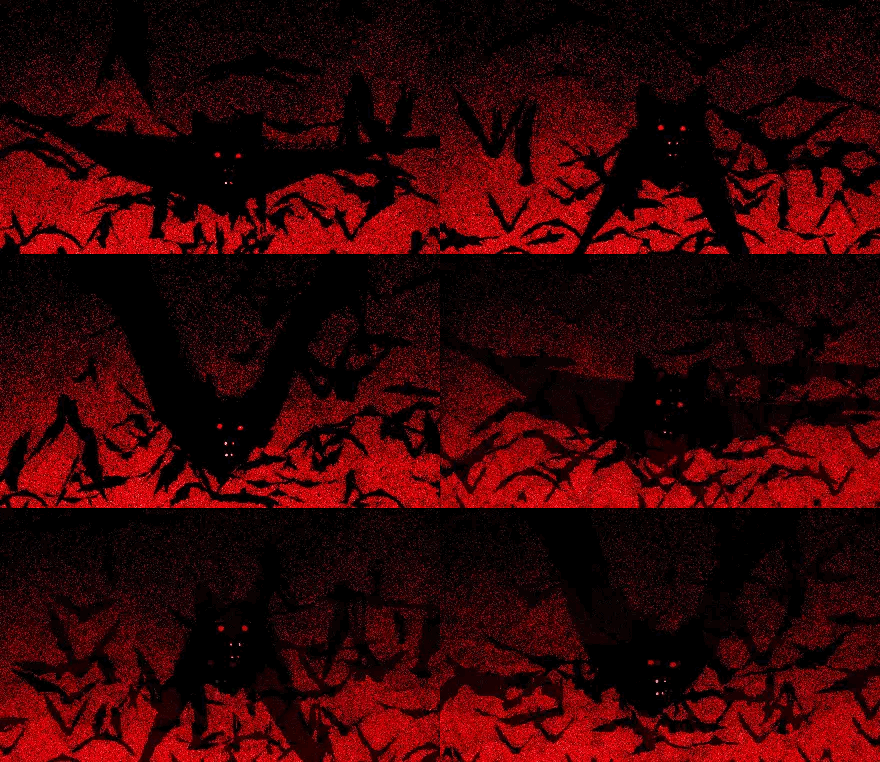
There’s a rock in Rhode Island where they burned human organs in 1892. Your great-great-grandparents were alive when this happened. The light bulb existed. People were making phone calls across state lines.
And in 19th-Century Exeter, Rhode Island, farmers were cutting open corpses and setting hearts on fire.
Mercy Brown was nineteen when tuberculosis killed her in January. By March, her father and the town doctor had dug her back up. Here’s what you need to understand: they found fresh blood in her heart. Two months dead in frozen ground, and the blood was still liquid, still pink. Dr. Harold Metcalf documented it. The newspapers confirmed it. This isn’t folklore. The blood was there.
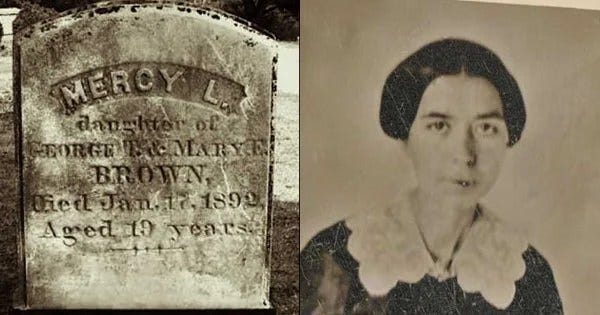
So they burned her heart on a flat rock, mixed the ashes with water, and made her dying brother Edwin drink the whole cup. He died anyway. The city papers mocked them, called them backwards superstitious hicks. The story became proof that rural America needed to be civilized, educated, dragged into modernity. But here’s what those smug reporters didn’t know: this was happening everywhere.
Between 1784 and 1892, there were at least eighty documented vampire exhumations in New England. Not rumored, but documented with witnesses and official records.
Eighty families who dug up their dead, cut them open, and burned what they found. A Dartmouth student named Frederick Ransom, from a rich and educated family, had his heart burned on a blacksmith’s forge in 1817. In Griswold, Connecticut, archaeologists found twenty-nine bodies, all mutilated after death, all showing tuberculosis, all arranged in skull-and-crossbones patterns. Ribs broken post-mortem. Chest cavities opened. Someone was looking for something.
One coffin just said “JB-55.” Not even a full name. Why would you only use initials on a grave unless you were afraid to say the full name out loud?
These weren’t isolated incidents. This was a system, a protocol, something being passed down through generations. Here’s what should terrify you: these people had buried hundreds of bodies. They knew what normal death looked like. When they opened those coffins and found pink skin and wet blood, they weren’t hallucinating. They were finding exactly what they’d been taught to look for. Who taught them? And why?
The Text That Started Everything
Genesis 4:10. Go read it right now.
God confronts Cain about murdering Abel, and God says something bizarre: “Your brother’s blood cries out to me from the ground.” Not his soul. Not his spirit. His blood. Then God tells Cain the earth won’t grow crops for him anymore. He can’t die. Can’t stay in one place. Gets marked with something for “protection” and wanders east to the Land of Nod. Some translations call it the Land of Darkness. Then the Bible just stops. Doesn’t say what happened to Cain. Doesn’t say if he died. The story cuts off mid-sentence and never comes back.
What happened to the first murderer?
Jewish scholars spent centuries piecing together what happened next. Different communities, different time periods, no contact between them. And they all came to the same conclusion independently. The Talmud says Cain met Lilith in the Land of Nod. You know Lilith? Adam’s first wife in Jewish folklore, the one who refused to submit, spoke God’s secret name, and flew away? The one who became something that fed on newborns? She found Cain, another outcast. She cut herself, collected blood in a vessel, told him to drink.
Three angels appeared. Each offered Cain a chance to repent. He refused all three times. Each refusal brought a new curse: fire vulnerability, sunlight weakness, hunger for blood that never stops.
These texts were written in medieval Spain, Eastern Europe, and the Middle East with zero contact between the communities. But they all say the same thing: Cain drank blood, became immortal, and passed the curse through his bloodline. How does that happen? How do separate communities across centuries independently create the same story?
Around 700-1000 AD, whoever wrote Beowulf explicitly connected Grendel to Cain’s descendants: “Spawned in that slime, conceived by monsters born of Cain, murderous creatures banished by God.” Grendel drank blood from veins. For medieval Christians who knew Leviticus by heart, this was the ultimate horror. Blood consumption was one of the most serious taboos. But Grendel came from before the Flood, before God’s covenant, from a cursed bloodline that followed different rules.
Medieval Christians built an entire taxonomy around this idea. Vampires, werewolves, demons, giants, all descended from Cain. His crime spawned a race of things outside God’s order. The Irish text “Sex Aetates Mundi” says Cain’s line produced all monstrous races.[1] Scribes copying Beowulf sometimes mixed up Cain with Ham, Noah’s cursed son. Multiple cursed bloodlines bleeding together. But they all traced back to the first murder. The blood crying from the ground.
Now ask yourself: why would European Christians and medieval Jews independently develop the same origin story for vampires?
Chinese records from 600 BC describe the jiangshi, the hopping vampire, corpses rising to drain life force. Fast forward to Victorian London, 1837. Witnesses across the city report a figure leaping over walls and fences, attacking women in dark alleys.
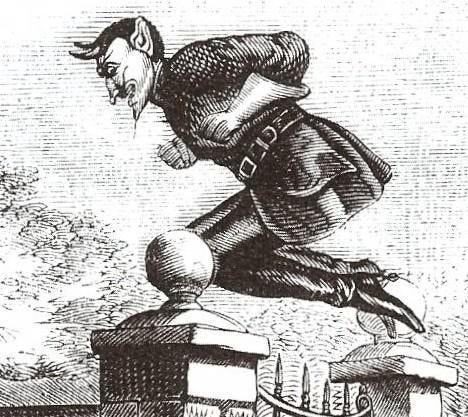
Nine feet tall, some said. Breathing blue flames. Clawed hands that tore at clothing and flesh. The attacks continued sporadically until 1904. Some witnesses described him as hopping, bounding impossible distances. The Chinese jiangshi hops because rigor mortis has locked its knees. Spring Heeled Jack moved the same way. Separated by two thousand years and six thousand miles, the descriptions match. Was Jack a copycat inspired by Chinese folklore he couldn’t possibly have known about?
Or was he something older, something that moves through time wearing different names?
Mesopotamian texts from 2000 BC talk about Lilitu demons drinking newborn blood. Slavic folklore has the upir rising from graves to feed on families. Between 1679 and 1755, Eastern European villages conducted mass exhumations with thousands of bodies and official government records. African traditions describe the asanbosam with iron teeth that drops from trees to drain blood. Australian Aboriginal lore has the yara-ma-yha-who, dropping from trees, draining blood through its fingers. Caribbean folklore has the loogaroo shedding its skin at night to feed.
These cultures had zero contact when these myths developed. No trade routes. No missionaries. No way to share stories. Yet they independently created remarkably similar vampire mythology: the dead returning to feed, blood hunger, curses passing through families, inability to die naturally, specific methods to stop them. Anthropologists call this “convergent evolution,” different cultures solving the same problem with similar answers. But what problem? What were they all responding to?
Every major religion forbids blood consumption. Judaism, Islam, Christianity, Hinduism, Buddhism. Cultures that developed independently with zero contact all arrived at the same prohibition. The standard explanation claims blood spoils and transmits disease, so ancient people learned to avoid it and wrapped that knowledge in religious prohibition. Sounds reasonable. Except: where are the universal taboos against raw meat? Spoiled fish? Toxic plants? Dozens of things will kill you faster than blood. Why is blood special? Why did culture after culture, separated by continents and millennia, decide blood was too dangerous, too sacred, too loaded to consume?
What did they know that we’ve forgotten?
The Companies That Can’t Stop Talking About Cain
In 1991, White Wolf Publishing released Vampire: The Masquerade. Their vampires weren’t just called vampires. They were Cainites, direct descendants of Cain himself. The game’s mythology claims Cain was cursed by God, wandered into darkness, and spawned the first generation of vampires.
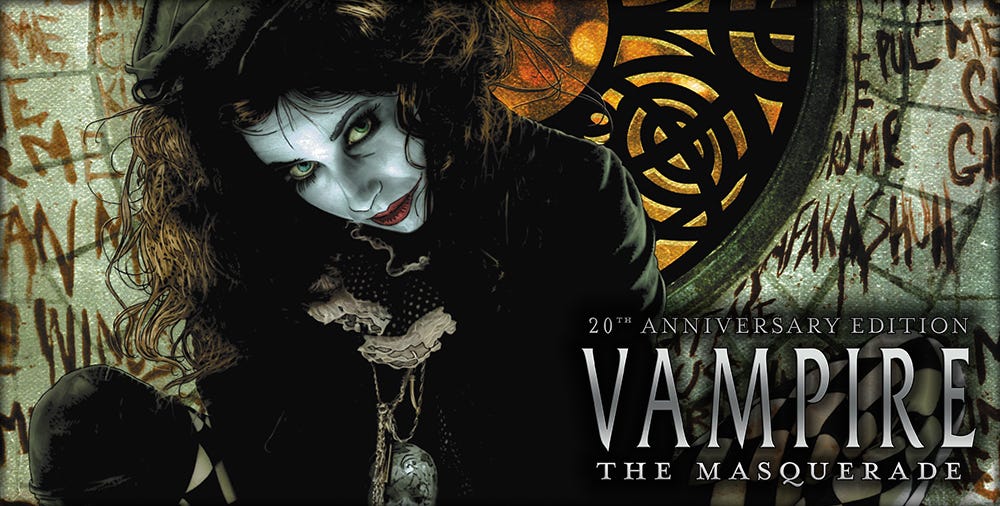
Players inhabit members of different vampire clans, all tracing their lineage back to Cain’s childer. The game sold millions of copies. It became a cultural phenomenon. But here’s what’s strange: the lead designer, Mark Rein-Hagen, claimed the mythology “came to him” during development. He couldn’t explain where the specific details originated.
Five years later, Silicon Knights released Legacy of Kain. The protagonist’s name sits one letter away from Cain. The game’s plot revolves around an ancient vampire lord named Kain who was murdered, resurrected, and cursed with an unquenchable thirst for blood. Sound familiar? Director Denis Dyack said in interviews that the biblical connections were “intuitive” rather than researched. He just knew the mythology felt right.
Anne Rice published Interview with the Vampire in 1976. Her vampires possess ancient knowledge, pass their curse through blood, and trace their lineage back to a first vampire whose origin remains deliberately murky throughout the series. Rice claimed she never intended to write vampire fiction at all. The characters appeared in her mind fully formed. When asked about the theological implications of her vampires, she said the mythology “presented itself” rather than being constructed.
In 2008, Stephenie Meyer released Twilight. Her vampires descend from a transformation that grants immortality, superhuman abilities, and an insatiable hunger for blood. The Volturi, the oldest vampire coven, claim to remember the beginning of their kind but refuse to speak about it directly. Meyer is a devout Mormon. The Book of Mormon contains its own version of Cain’s curse. When asked if her vampires connected to Cain, she gave vague answers about “archetypal evil” and “inherited sin” but never confirmed or denied the link directly.
True Blood premiered in 2008. The show’s vampires descend from Lilith, explicitly named as Adam’s first wife. In the show’s mythology, Lilith birthed the first vampires after God cast her out of Eden. The show runners didn’t hide the connection. They leaned into it. Lilith becomes a messianic figure for vampire fundamentalists. Her blood grants visions and power. The show depicts her as the mother of an entire cursed race.
Notice the pattern?
These aren’t casual references. These are entertainment companies, separated by decades and mediums, all reaching back to the same source mythology without being asked. Nobody demanded that White Wolf call their vampires Cainites. Silicon Knights could have named their protagonist anything. Rice could have made her vampires soulless monsters with no theological baggage. Meyer could have written sparkly demons with no connection to biblical narrative. The creators of True Blood could have invented any origin story.
But they didn’t. They all went back to Cain. They all went back to Lilith. They all went back to the Land of Nod, to cursed bloodlines, to the first murder and the blood crying from the ground.
Here’s where it gets uncomfortable. White Wolf Publishing was founded by Steve and Stewart Wieck, along with Mark Rein-Hagen. The company’s logo features a wolf’s head and crescent moon. Ancient symbol for things that hunt in darkness. Silicon Knights was founded by Denis Dyack, who studied philosophy and psychology before entering game development. His thesis work focused on Jungian archetypes and inherited cultural memory. Anne Rice grew up in New Orleans, a city with deep roots in Haitian Vodou and Caribbean folklore about the dead returning to feed. Stephenie Meyer belongs to a faith tradition that teaches Cain’s curse persists through bloodlines to this day. Alan Ball, who created True Blood, studied theater at Florida State but spent years researching comparative religion before writing the show.
These aren’t random people. They’re educated, well-read creators who somehow keep circling back to the same ancient mythology. And they all claim the mythology “came to them” rather than being deliberately chosen. Intuitive. Natural. Obvious. As if the story was already there, waiting to be rediscovered.
What if they’re not making it up? What if there’s something else happening? Something that looks like convergent creativity but might actually be inherited memory, the kind of deep knowledge that gets passed through bloodlines and cultures and time? The kind of knowledge that makes you look at a cursed figure from Genesis and think, “Yes, that’s where vampires come from,” without quite knowing why you’re so certain?
What if some of these creators descend from families that practiced the old protocols? The ones who knew to look for liquid blood in corpses, who knew the rituals, who passed down the stories about what happened to Cain after God sent him east into darkness? What if they carry fragments of that knowledge in their DNA, in their cultural memory, and it surfaces when they sit down to create?
That sounds insane. Conspiratorial. Paranoid. Except we know inherited cultural memory exists. Epigenetics has proven that trauma and knowledge can be encoded in DNA and passed to descendants. Studies on Holocaust survivors show their grandchildren carry stress markers in their genes. Aboriginal Australians possess detailed knowledge of coastlines that were submerged 10,000 years ago. The information survived. It moved through generations without written records.
Why couldn’t the same thing happen with Cain?
Why couldn’t the descendants of those who knew what happened to the first murderer carry that knowledge forward, surfacing it in their art, their games, their stories?
The companies keep going back to Cain. The creators keep claiming it came to them ‘naturally’. The mythology keeps reappearing across cultures and centuries. Either it’s the most persistent coincidence in human history, or something else is happening. Something older. Something that started when Abel’s blood cried from the ground and hasn’t stopped crying yet.
George Brown, Mercy’s father, the man who watched them burn his daughter’s organs and made his dying son drink the ashes, died in 1922. Thirty years after the exhumation, he was still alone on his farm in Exeter. Never remarried. Never had more children. Just him and that rock and the weight of what he’d done. Carrying what weight? Guilt for killing her a second time? Or knowledge that what they found in her corpse was real, was accurate, was exactly what his ancestors had taught him to look for?
Mercy’s grave is still there. Baptist Church Cemetery on Ten Rod Road. Simple granite marker. Someone always leaves offerings. Fresh flowers. Coins. Notes. Who leaves them? Descendants of the families who performed the ritual? Members of occult groups who know what really happened? Or people like those game designers and authors, people who feel drawn to the story without quite knowing why, who sense something true beneath the surface?
What Happened After Eden?
Science explains everything about Mercy Brown. Tuberculosis causes mummification. Cold preserves tissue. Blood can stay liquid for weeks after death in the right conditions. Perfect, clean, rational. Except it doesn’t explain why the mythology was already there, why the framework existed, why cultures across the planet all developed the same horror of the dead returning to feed.
Why did those farmers in Exeter know to look for liquid blood? Who taught them? How did the protocol survive hundreds of years and travel thousands of miles? What if the Exeter farmers weren’t superstitious? What if they were continuing something older than they knew, some memory that started in darkness east of Eden when the first murderer learned that blood is life and life can be stolen and some hungers don’t end?
The graves are real. The exhumations are documented. The burned organs are attested by witnesses. The liquid blood in Mercy Brown’s heart is in Dr. Metcalf’s report. Everything else is interpretation.
The Bible says Cain was marked, protected from death, sent east into darkness. Then nothing. The story stops. But myths don’t stop. They just change shape, move through cultures, adapt to new languages and new continents. Medieval Jews said he drank blood and became immortal. European Christians said his bloodline spawned all monsters. Chinese records describe blood-drinking corpses six hundred years before Christ. Australian Aboriginals told stories about blood-feeding creatures from the Dreamtime.
All describing the same thing.
You can call it coincidence. Convergent evolution. Pattern-seeking run amok. Or you can ask the question nobody wants to ask: What if they were all describing something real? Not vampires like in the movies. Something else. Something that started with Cain and never stopped. Something that moved through bloodlines and cultures and time, leaving bodies behind, leaving myths behind, leaving that rock in Exeter behind. Something that surfaces in the work of game designers and authors who swear they didn’t plan it, didn’t research it, just knew.
The mark doesn’t fade. It just keeps moving forward through time.
That rock is still there in Exeter, the one they used for the burning. You can find it if you look hard enough. And if you visit Mercy’s grave at sunset, stand there for a while. Be quiet. Feel the weight of the trees. The watching darkness. Ask yourself: do you really believe those farmers were crazy? Do you really believe eighty separate families across a hundred years were all suffering mass delusions? Do you really believe cultures across the planet independently invented the same monster with no contact, no trade routes, no reason to?
Or is there something we’re not being told? Something we’ve been trained not to see? Something that started in Genesis and never actually ended? The blood is still crying from the ground. And sometimes the dead refuse to stay buried.
What happened to Cain? The Bible doesn’t say. But maybe New England farmers knew. Maybe game designers and authors know without knowing they know. Maybe the story keeps surfacing because it never ended. Maybe we’re still living in the aftermath of that first murder, that first curse, that first taste of blood that granted immortality at the cost of everything else.
And maybe some families never forgot.
The 10 Most Disturbing Vampire Films Ever Made (Because You’re Already Not Sleeping Tonight)
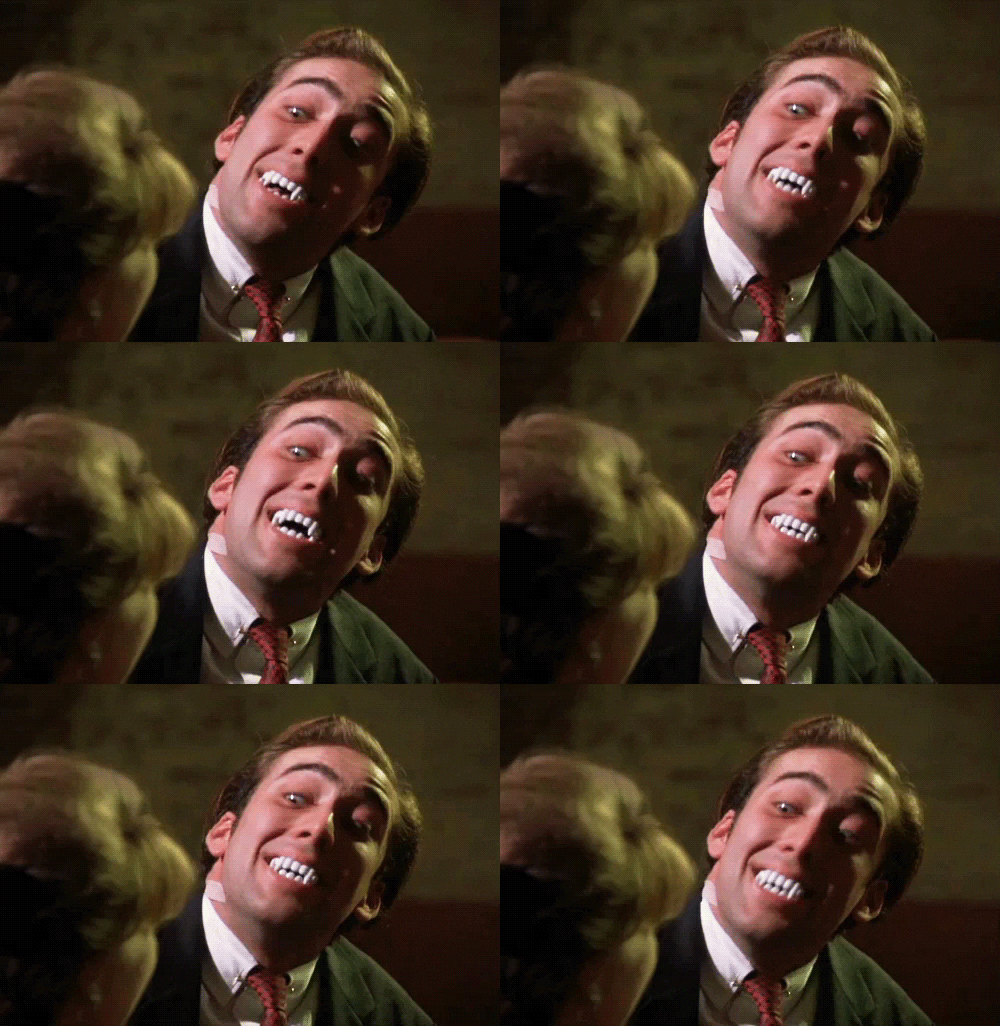
Since we’re talking about real vampires and ancient curses and blood crying from the ground, you might as well lean into the horror. Here are the ten vampire films that actually understood something dark about the mythology, ranked by how much they’ll make you check your windows before bed.
10. Let the Right One In (2008) Swedish slow-burn horror about a child vampire that feels more like a documentary about predation than a monster movie. The pool scene alone will ruin swimming for you. Skip the American remake.
9. Near Dark (1987) Kathryn Bigelow made a vampire western where the monsters are drifters, outlaws, and genuinely scary. No castles. No romance. Just blood-drinking nomads in pickup trucks moving through small towns. The sunlight motel scene is brutal.
10. Nosferatu (1922) The original unauthorized Dracula adaptation that they tried to destroy all copies of. Max Schreck’s Count Orlok looks like something that crawled out of medieval plague pits. Silent film that’s still more unsettling than most modern horror.
7. Only Lovers Left Alive (2013) Jim Jarmusch’s vision of immortal vampires who’ve been around so long they’re just tired. Tilda Swinton and Tom Hiddleston as ancient beings who remember what really happened in history. More existential dread than jump scares, but it lingers.
6. Martin (1977) George Romero asked “what if vampires are just delusional serial killers?” Then he asked “but what if they’re not?” Ambiguous, disturbing, shot in Pittsburgh like a crime documentary. You never know what you’re actually watching.
5. The Hunger (1983) David Bowie and Catherine Deneuve as immortals who age suddenly and catastrophically when their time runs out. That opening scene with Bauhaus playing while they hunt in a nightclub? Peak 80s gothic horror. The aging sequence will haunt you.
4. Shadow of the Vampire (2000) Meta-horror about the filming of Nosferatu where Max Schreck might actually be a real vampire. Willem Dafoe playing a creature pretending to be an actor pretending to be a vampire. Method acting taken to its logical extreme.
3. A Girl Walks Home Alone at Night (2014) Iranian vampire western in black and white. The skateboarding vampire scene shouldn’t work but it does. Lonely, strange, beautiful, and deeply unsettling. Vampires as outcasts and predators living in the margins.
2. Let Me In (2010) Okay, I lied earlier. The American remake is actually good. Different from the Swedish version but equally disturbing. The car crash scene and the pool scene hit differently. Chloe Grace Moretz as a centuries-old predator in a child’s body.
1. Possession (1981) Is it about vampires? Is it about demons? Is it about a woman’s breakdown? Yes to all three. Isabelle Adjani’s performance is so unhinged it’ll rewire your brain. The subway scene and the creature design will ensure you never feel safe watching anything else. This is what horror looks like when it stops pretending to be safe.
