
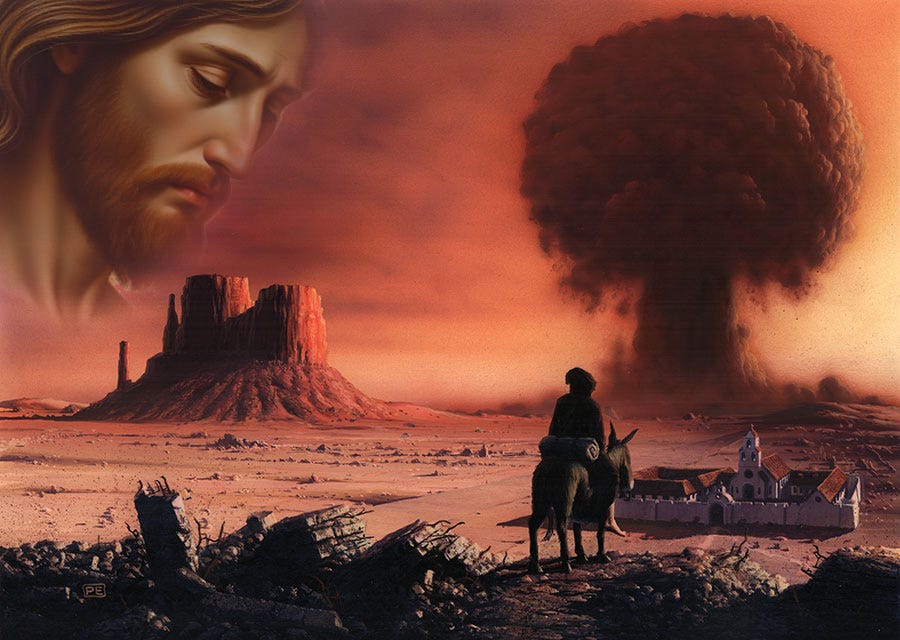
What Happens When a Nation Loses God: One Novel Saw It All Coming
The Terrifying Cycle We Can't Escape Without Faith
Imagine a world reduced to ashes. Nuclear fire has consumed civilization. The survivors, driven mad with grief and rage, hunt down every scientist, every engineer, every teacher they can find. They burn libraries and massacre scholars. Knowledge itself becomes the enemy. In the smoking ruins of what was once America, a small group of monks risks everything to preserve fragments of the lost world: blueprints they canât read, equations they donât understand, books written in languages theyâve forgotten. They copy these documents by hand, adding ornate decorations around the margins, treating technical diagrams like sacred scripture. For centuries, they guard this knowledge in a desert monastery, waiting for humanity to be ready to reclaim what it destroyed. This is the haunting premise of A Canticle for Leibowitz, a 1959 novel by Walter M. Miller Jr. that remains criminally absent from most reading lists. Outside science fiction circles, few people know this book exists. Thatâs not just unfortunate. Itâs dangerous. Because this novel contains a warning we desperately need to hear: civilizations donât fall because they lack power or knowledge.
They fall because they lose faith in God.
Remember back in high school English class? Youâve probably slogged through Romeo and Juliet at least once. Maybe you cried over Flowers for Algernon. These are fine books, sure. But theyâre relics of a different era, speaking to concerns that feel increasingly distant from the world weâre navigating today.
Millerâs masterpiece speaks directly to the crisis of our age. This is the sort of book that should be mandatory reading in every high school around the globe. It wrestles with questions that should terrify us: What happens when civilization forgets God? Can we break free from cycles of self-destruction? Is faith the only thing standing between us and oblivion? This isnât just another post-apocalyptic tale. Itâs a prophecy wrapped in fiction, showing us exactly how worlds end when they abandon the divine for the material.
How Worlds Die
The âFlame Delugeâ didnât just happen. Miller makes this brutally clear. Humanity didnât stumble into nuclear war through bad luck or misunderstanding. They chose it. A civilization that had achieved unprecedented technological mastery, that had split the atom and harnessed unimaginable power, used that power to annihilate itself.
Why? Because they had become âmaterially great and materially wise and nothing else.â
Think about that phrase. Nothing else. No moral compass. No recognition of divine law. No humility before God. Just raw capability married to human ambition, greed, and lust for dominance. When you strip away faith in something greater than yourself, when you reject Godâs authority over human affairs, whatâs left to restrain the worst impulses of fallen humanity?
Nothing.
The answer is nothing.
One man understood this truth. Isaac Edward Leibowitz, an engineer who had helped build the weapons that nearly destroyed the world, converted to Christianity after witnessing the holocaust his work had enabled. He didnât run from his guilt. He didnât make excuses. He dedicated what remained of his life to preserving knowledge while embedding it within a framework of faith.

The Pattern Repeats
Miller structures his novel across three eras, each separated by centuries. This isnât just a storytelling device. Itâs a warning about the cyclical nature of human self-destruction when we forget God.
First, we meet Brother Francis in a world still crawling from the ashes. The monastery preserves fragments of the old world, treating them as holy relics. The monks donât understand the technical details, but they understand something more important: this knowledge matters because truth matters, because Godâs creation operates according to discoverable principles, because preserving understanding honors the divine intellect that structured reality itself.
Their faith gives them purpose when everything else has been stripped away. They labor for generations theyâll never see. They sacrifice comfort and safety. They maintain hope in the darkest imaginable circumstances.
Why? Because their faith transcends immediate circumstances.
They serve God, not themselves.
Jump forward a millennium. Humanity has clawed its way back to something resembling medieval civilization. Thon Taddeo, a brilliant scholar, arrives at the abbey to study the preserved knowledge. He represents the rebirth of scientific inquiry, the rediscovery of natural philosophy.
But watch what happens. The monks ask him crucial questions: Who will control this knowledge once youâve revived it? What prevents powerful men from using it for evil? Can you remain independent from princes and warlords whoâll see your discoveries as tools for conquest?
Taddeo dismisses these concerns. He believes knowledge exists separate from morality, that truth has no allegiance. The monks know better. Theyâve spent a thousand years watching human nature. They understand that without Godâs law governing how we use what we know, weâll inevitably use it to destroy each other.
Taddeo doesnât listen. The secular world never does.
By the novelâs final section, humanity has surpassed our current technological level. Theyâve achieved wonders. Cities gleam. Spaceships traverse the solar system. Medicine has conquered disease. Energy flows abundantly.
And theyâre about to incinerate the world again.
âLucifer is fallen,â the code phrase whispers.
The missiles are ready. History prepares to repeat itself because humanity has made the same fatal mistake: pursuing material greatness while abandoning spiritual truth.
What Faith Preserves
The monks of Saint Leibowitz remain faithful across every era. They donât waver. They donât compromise. They maintain their mission even when the world mocks them, even when princes threaten them, even when oblivion approaches.
They preserve more than documents and artifacts. They preserve the understanding that humanity needs God, that weâre not capable of governing ourselves wisely without divine guidance, that our intelligence and capability make us more dangerous when we reject moral absolutes.
This is the bookâs central revelation, the truth that makes it essential reading for everyone, not just students. We are living through the same pattern right now. Look around. Weâve achieved technological marvels that would seem like magic to previous generations. We can edit genes, build artificial intelligence, and harness nuclear power. We have more knowledge and capability than any civilization in human history.
And weâre spiritually bankrupt. Churches empty while people worship at the altar of progress, of science, of human potential unleashed from divine constraint. We tell ourselves we donât need God anymore, that weâve evolved past such primitive superstitions, that human reason alone can guide us to utopia.
Miller shows us where that leads. Every single time. Without exception.
The Monastery as Ark
The novelâs final image haunts me. As nuclear missiles arc toward their targets, as humanity prepares to immolate itself for the second time, a starship lifts off from the monastery. It carries monks, relics, archives, and the mission itself toward Alpha Centauri.
Earth will burn, but the Church will survive. Humanity will get another chance elsewhere. The pattern might repeat, but each iteration spreads Godâs truth further into the cosmos, plants new seeds, creates new opportunities for redemption.
This is profoundly Christian. History isnât purely cyclical, trapped on an endless wheel. Itâs linear with purpose, moving toward something even when the path includes catastrophic setbacks. Godâs plan continues regardless of human failure.
But hereâs the terrifying question Miller forces us to confront: How many times will we repeat this cycle? How many worlds will we reduce to radioactive ash before we learn the lesson? Are we doomed to destroy ourselves over and over because we refuse to submit to divine authority?
The monks prepare their starship not because they can predict the future with certainty. They prepare because they recognize the pattern, because they understand human nature absent Godâs restraining influence, because they know what happens when civilizations lose faith.
Theyâre right to prepare. Theyâre right to be afraid. Theyâre right to recognize that without God, weâre capable of absolutely anything, including our own extinction.
Why Everyone Needs This Warning
Students should read this book, absolutely. But so should their parents, their teachers, their pastors, their politicians. Everyone who thinks weâve progressed beyond needing God needs to read Walter Millerâs warning.
We havenât progressed past anything. Weâve just accumulated more power to destroy ourselves with. Our technology has advanced, but human nature remains fallen, remains prone to pride and violence and corruption. Weâre the same people who built the Tower of Babel, just with better tools.
The only thing that has ever restrained humanityâs worst impulses is faith in God. Not education, not prosperity, not democratic institutions, not international agreements. Those things help, sure. But theyâre built on sand without a foundation of divine law, without recognition that weâre accountable to Someone greater than ourselves, without humility before the God who made us and knows us completely.
Miller understood this. He was a Catholic convert who had served in World War II, who had participated in the bombing of a monastery at Monte Cassino. He knew what human beings were capable of. He knew how easily we rationalize atrocities. He knew that without God, everything becomes permissible.
A Canticle for Leibowitz isnât science fiction. Itâs prophecy. Itâs showing us our future if we continue down the path weâre on, rejecting faith in favor of material progress, abandoning Godâs law for human wisdom, trusting in our own capabilities rather than submitting to divine will.
The Choice Before Us
We stand at a crossroads. Our civilization faces threats from multiple directions: nuclear proliferation, artificial intelligence, genetic engineering, environmental collapse, social fragmentation. We have the power to destroy ourselves in countless ways.
The question isnât whether we have the capability. We obviously do. The question is whether we have the wisdom and restraint to avoid using that capability. And the answer, if history teaches us anything, if Millerâs novel shows us anything, is that we donât have that wisdom and restraint within ourselves.
We need God. We need faith. We need recognition that weâre not the measure of all things, that truth exists independent of our preferences, that moral law transcends human consensus, that weâre accountable to Someone who sees everything and judges righteously.
Without that, weâre doomed. Not might be doomed. Not probably doomed. Actually doomed to repeat the cycle Miller describes, destroying ourselves over and over until we finally learn the lesson or until thereâs nothing left to destroy.
The Verdict
Every high school student should read A Canticle for Leibowitz. But more importantly, every adult who thinks weâve evolved past needing God should read it. Every politician who trusts in human institutions. Every scientist who believes knowledge is neutral. Every person who thinks material progress equals actual progress.
This book is a mirror showing us what weâre becoming. Itâs a warning about where weâre headed. Itâs a reminder that civilizations fall when they lose faith, that worlds end when they reject God, that humanity cannot save itself through its own wisdom and power.
The monks of Saint Leibowitz understood this truth. They preserved it through dark ages and catastrophes. They maintained faith when everything else failed.
We need to learn what they knew. We need to recover what our civilization is losing. We need to remember that without God, weâre capable of anything, including our own annihilation.
Thatâs the lesson. Thatâs why it matters. Thatâs why this book needs to be in every classroom, on every shelf, in every conversation about humanityâs future.
Because without faith in God, we donât have a future.
We just have a countdown to the Flame Deluge.


If you want to learn more about this book, I highly suggest checking out this video essay by Feral Historian on Youtube - https://www.youtube.com/watch?v=LBTN46HMCnM
Its not that the population is without God, its that those who rule over us and try to control us are without God. Pathological personalities are attracted to positions of power. Every single time humanity undoes itself because its always pathological personalities bereft of God always find themselves in control.
Why?
Because the rest of us DON"T WANT THAT POWER.
The vacuum of power must be filled and the only ones who WANT the role are the ones who will undo us in the end. Because they are sociopathic and bereft of divinity.
How do we change this?