



The Wise Wolf texted me at one in the morning to say he woke up puking and was taking the day off. So this is going live today instead of Monday when it was actually scheduled. I did not get to do the last edit pass I wanted on it. But sometimes in life we do not get to do the things we want to do because we are lying in a motel bed hunched over a plastic garbage can puking up Mexican food we bought from a restaurant that operates inside a delivery truck.
The summer I turned eleven my parents sent me to my grandmother’s house for six weeks. I was mad about it the entire drive there. I wanted to be home with my friends and not stuck in a kitchen with a woman who got up at six in the morning to put beans in a bowl of water.
That summer turned out to be part of my fondest memories of childhood.
Grama was a devout Christian and she wanted me to turn out the same way. But she did not go about it by parking me in a pew in some boring country church every Sunday morning. She taught me to cook out of the Bible instead.
She put the book on the counter next to the cutting board and read a verse out loud before we started anything. Then she told me what we were making and how the verse connected to it. The lentils were the stew Esau sold his birthright for. The barley was the bread from the story about the five thousand people. She said it every single time and she never once got tired of saying it.
I was eleven and I was mostly there because my parents made me go. The verses did not stick with me. I could not have given you a chapter number back then and I still cannot without looking it up.

I have been thinking about that summer a lot lately so I made a few of the recipes with my friends at camp. Even the counselors who do not go to church at all jumped in and we had a great night with it. That got me curious enough to go read about the food itself. There is way more research on these ingredients than I ever expected to find.
So some of these are the ones we made at camp and the rest are ones I go back to on my own. None of them take very long and none of them need anything you cannot get at a regular grocery store. If God had a cooking show it would be six ingredients and one pot and under an hour.
The stew that cost a birthright
“Feed me, I pray thee, with that same red pottage; for I am faint.”
“Then Jacob gave Esau bread and pottage of lentiles; and he did eat and drink, and rose up, and went his way: thus Esau despised his birthright.” (Genesis 25:30, 25:34)
This was the first thing Grama let me make by myself and I think that was on purpose. It is very hard to ruin.
Red lentils go in a pot with water. Onion and a lot of garlic cook in olive oil first until they go soft and sweet. Cumin and coriander go in after that. Everything simmers until the lentils fall apart into something thick and orange. Lemon and more olive oil go on at the very end. It takes about forty minutes and you do not have to soak anything.
Esau came in from the field starving and traded his inheritance for a bowl of this. People have been calling him an idiot for three thousand years. I am not going to defend him but I have eaten the stew and I understand him.
Lentils are cheap and they are extremely good for you. The protein and the fiber arrive together so the energy goes in slow instead of spiking and crashing. They have folate and iron and a kind of starch that feeds the good bacteria in your gut. Chopped garlic makes allicin which actually does kill bacteria. And when researchers go looking for the one eating habit that shows up in populations that live long healthy lives they keep landing on beans. Not a supplement and not a program. Just beans eaten over and over for decades.
The meal they cried over in the desert
“We remember the fish, which we did eat in Egypt freely; the cucumbers, and the melons, and the leeks, and the onions, and the garlick.” (Numbers 11:5)
This is my favorite verse in the whole Bible and it is not close.
The Israelites just got out of Egypt. They walked through a parted sea and God is feeding them by hand out in the desert. And there they are crying about vegetables.
Grama thought that was completely hilarious. She made this salad every time it got hot out.
Cucumbers get sliced thin or grated. Thick goat milk yogurt goes on top with crushed garlic and a lot of mint torn up with your hands. Salt and olive oil finish it off. The whole thing takes five minutes and nothing gets cooked.
A cucumber is over ninety percent water. In a place where the heat could actually kill you and clean water was not a sure thing that matters a lot. The yogurt puts live cultures in your gut and goat milk sits easier on most people than cow milk does. The mint is not just there for flavor. It relaxes the muscle in your digestive tract which is why peppermint oil is still used to treat cramping and bloating.
The poultice that turned into a snack
“And Isaiah said, Take a lump of figs. And they took and laid it on the boil, and he recovered.” (2 Kings 20:7)
“The rod of Aaron for the house of Levi was budded, and brought forth buds, and bloomed blossoms, and yielded almonds.” (Numbers 17:8)
King Hezekiah is dying from an infection. Isaiah prays over him and then does something that sounds insane until you look into it. He tells them to mash up figs and put them straight onto the wound. The king got better after that.
Figs have an enzyme in them called ficin that breaks down protein. Ficin is used to clear dead tissue off wounds and it has documented activity against bacteria in lab tests. So the fig thing was not superstition. Somebody watched it work and told somebody else and it kept on working.
Almonds have their own strange place in all of this. Aaron’s staff bloomed almonds as the sign that God had picked him. The lamp in the tabernacle was built with cups shaped like almond blossoms. Out of every plant they had that is the one they carved into the temple.
Put the two together and you get the best snack on this list. Dried figs and ground almonds go in a food processor with a little honey and cinnamon. It turns into a paste and you roll it into balls and stick them in the fridge. There is no cooking and no baking involved at all.
Figs have more minerals in them than almost any other fruit including real amounts of calcium and magnesium and potassium. Almonds bring vitamin E and fat and protein. Together they will hold you for hours.
The bread from the boy’s basket
“There is a lad here, which hath five barley loaves, and two small fishes: but what are they among so many?” (John 6:9)
The word I never noticed as a kid is barley.
Wheat was for people with money. Barley was what everybody else ate and the Bible does not hide that. Ruth is out gleaning barley in a stranger’s field because she and Naomi have nothing left. When five thousand people sit down on that hillside the bread that gets multiplied is the cheap bread.
This is the one recipe here that Grama never made. I taught myself and it took four tries before I stopped producing something with the texture of a coaster. Barley flour has almost no gluten so it will not rise like wheat and you have to quit expecting it to. You get a dense flat loaf and you cook it hot and fast. Olive oil goes in the dough and more olive oil goes over the top when it comes out.
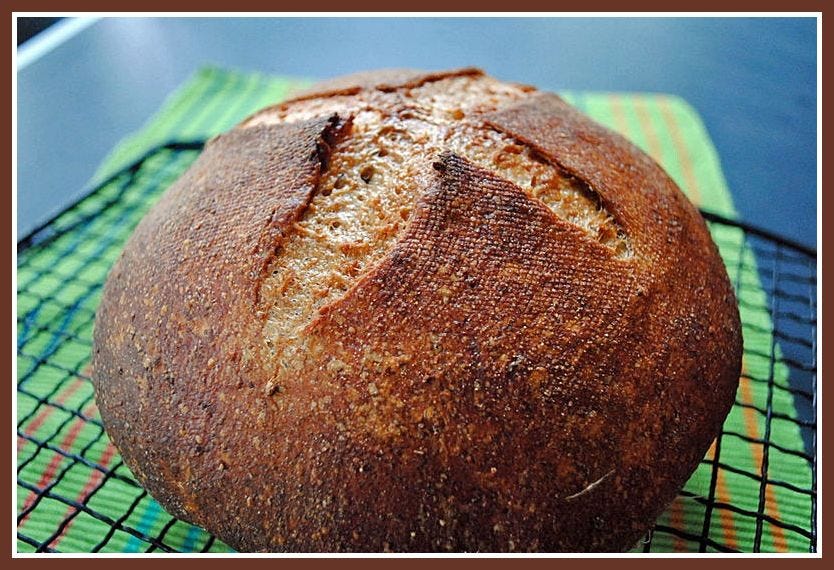
Barley has more beta glucan in it than any other common grain. That is a soluble fiber that turns into a gel in your gut where it slows down sugar absorption and pulls cholesterol out. The evidence is good enough that food regulators let companies print heart health claims on the label.
The olive oil is doing something too. Extra virgin olive oil has a compound in it called oleocanthal that works on the same inflammation pathway ibuprofen does. It is much weaker than a pill and nobody should treat it like medicine. But somebody eating it on everything every day for seventy years is running a very long experiment on their own body.
The seven foods God listed by name
“A land of wheat, and barley, and vines, and fig trees, and pomegranates; a land of oil olive, and honey.” (Deuteronomy 8:8)
Moses is describing the promised land and he could have just said the farming was good. Instead God names seven specific foods in order. In Jewish tradition these are the seven species and they still have their own agricultural laws and their own blessing today.
One note about the last one. The Hebrew word is devash and it gets translated as honey. The old traditional reading takes it to mean date honey which is the thick syrup you press out of dates and not anything that came from a bee. Both readings go back a very long way. I lean toward dates because dates were everywhere and date syrup was what people actually cooked with.
Grama made it as a bowl. Cooked barley and cracked wheat go on the bottom. Then grapes and sliced figs and pomegranate seeds over the top with whole olives and chopped dates on the side and olive oil poured over all of it.
What gets me about the list is how the seven cover for each other. The grains give you slow carbohydrate and B vitamins and protein. The fruits fill in the minerals the grains do not have much of. Pomegranate has punicalagins that your gut bacteria turn into compounds researchers are still trying to figure out. Grapes carry polyphenols and most of that is in the skin and the seeds.
The olives do the most important job of the seven. The fat in olive oil is what lets your body absorb the fat soluble vitamins in everything else. Without it a good chunk of that bowl goes right through you. So the olives are not only adding their own nutrition. They are unlocking everything else in the bowl.
Nobody ever ran a study on these seven foods as a designed system and I am not going to pretend they did. What is true is that all seven have been studied on their own and they happen to sit together without a gap. Read the verse as a description of good farmland and it works. Read it as a menu and it works too.
What she was really teaching me
Grama gave me the scripture every single time and I still had to look up every verse in this article.
What I kept was the other stuff. Knowing the onions are ready from the smell and not from a timer. Knowing how much olive oil is enough which is always more than you think. Knowing how to hold a knife so you keep your fingers.
That is how this has always gotten passed down. Not through footnotes and not through anybody’s research. It went hand to hand through kitchens for three thousand years from a woman to a kid who was mostly there for lunch. And it lasted long enough for a laboratory to show up and confirm it.
None of this is complicated and that is the whole point. There is no powder and no protocol and no thirty dollar bottle of anything. It is six or seven ingredients that people ate every single day for thousands of years and we are still studying them because they worked.
Pick one and make it this week. Tell me in the comments which one you picked because I actually want to know.
If you got something out of this, subscribe and share it with somebody who cooks.
Help keep the Wise Wolf howling.
What a beautiful article. You were truly blessed to have a grandmother who cared for you so deeply and found such a loving, practical way to plant the truth of Scripture in your heart.
As I read your story, I found myself reflecting on my own childhood. In my family, biblical teaching, church attendance, and the outward signs of faith were sometimes used as pawns in the conflict between my parents. Your memories offered such a meaningful contrast: faith being shared not through pressure or conflict, but through cooking, patience, affection, and time spent together.
I admit that I had some difficulty following a few of the health explanations, but that did not lessen the beauty of your message. What stayed with me was the way your grandmother made Scripture tangible and allowed faith to take root naturally. It is a powerful reminder that faith is often passed from one generation to another through ordinary acts of love.
I love the articles you folks write. They make me think, reflect, and appreciate experiences that are different from my own. This one genuinely warmed my heart. Thank you for sharing it.
Thank you for this article. Reminds me of my mother. She was religious but never really taught us “religion” just goodness. She cooked a home meal and desert for us everyday. I still make her recipes.