


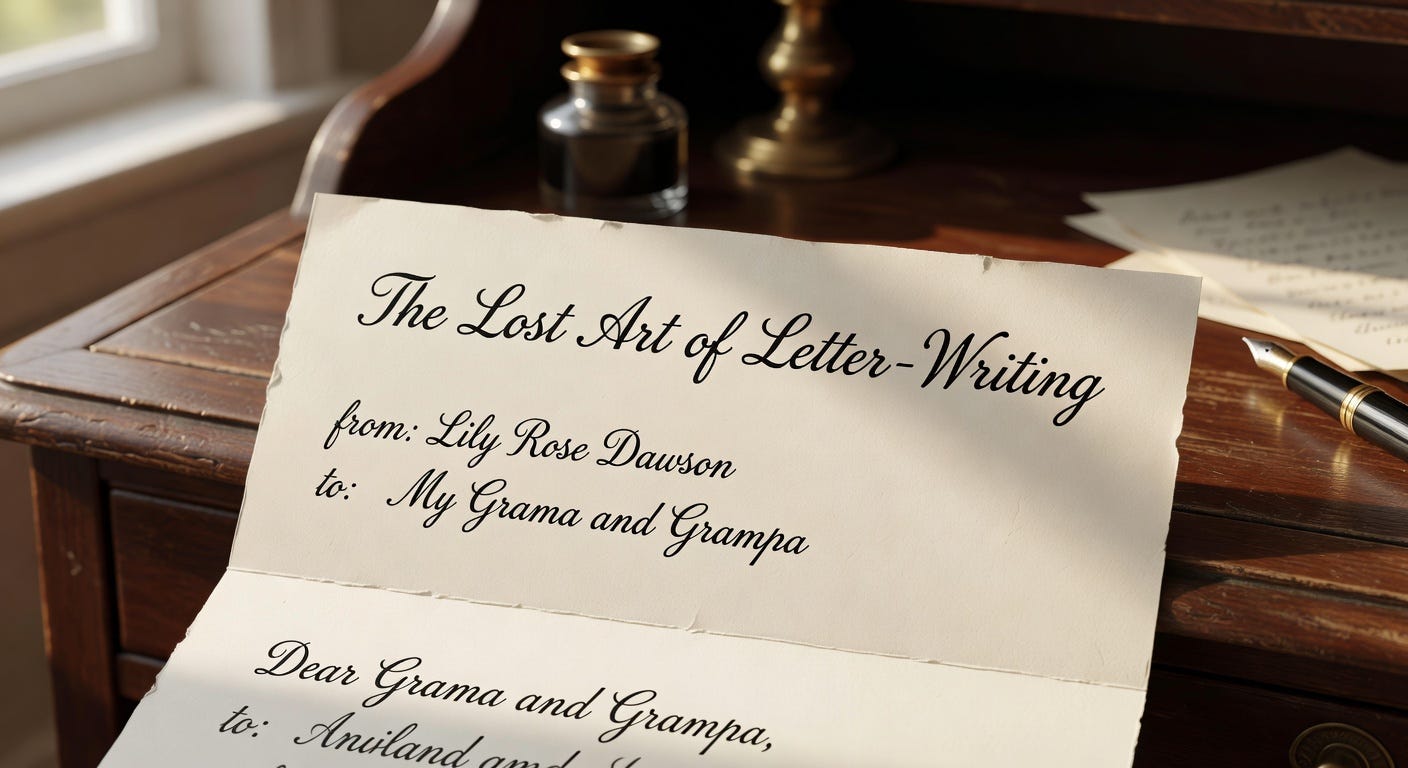
Every other weekend when I was growing up, my parents would drop me off at Grama and Grandpa’s cottage in the country. This arrangement served multiple purposes. My parents got some alone time (which is how I ended up with my little brothers, if you’re wondering about the birds and the bees and also basic math). And I got to spend weekends at what I can only describe as the most magical place a kid could possibly be.
Grama’s cottage was surrounded by wildflowers. Not the Pinterest kind where someone spent $400 at a nursery and arranged them in aesthetically pleasing color-coordinated rows. I mean the actual chaotic kind where Black-Eyed Susans grew next to Queen Anne’s Lace next to wild daisies next to things I still can’t identify but were probably some form of aggressive weed pretending to be beautiful. (It worked.) The bird feeders were EVERYWHERE. Grama had at least seven of them scattered around the property, and every spring the same birds would come back. Cardinals, blue jays, goldfinches, chickadees, even the occasional oriole if we were lucky. I learned to identify bird calls before I learned algebra. Probably more useful in the long run, honestly.
And Grandpa? Grandpa was always in the barn. He’d been working on a sailboat since 1977. The same sailboat. It was beautiful, even half-finished (which is how it stayed for decades). Smooth curved wood, the smell of varnish and sawdust, classical music playing from an old radio that only got two stations. I asked him once when he was going to finish it. He looked at me like I’d asked when he was planning to stop breathing.
“Lily,” he said, running his hand along a piece of wood he’d been sanding for what might have been weeks, “the boat isn’t the point.”
I was maybe nine. I didn’t get it. Now I’m twenty-three and I GET IT. The meditation was the work. The repetition. The craft. The way your hands know what to do and your brain gets to just exist for a while without scrolling or refreshing or checking to see if anyone liked your post. Grandpa wasn’t building a boat. He was building a life worth living, one plank at a time. But this story isn’t about Grandpa’s sailboat (although I think about it constantly and might cry). This story is about Grama’s stationary drawer.
The Lesson I Didn’t Know I Was Learning
Grama kept her stationary in the bottom drawer of the antique desk in the living room. She had about forty different sets. Some had flowers. Some had chickadees (obviously). Some were plain cream-colored with her initials embossed at the top in a font that screamed “I am a classy lady from 1952 and I will outlive all of you.” Every Sunday after church, Grama would sit at that desk and write letters. Thank you notes to friends who’d brought over casseroles. Letters to my mom updating her on garden progress and bird activity. Birthday cards for cousins I’d never met. And she made me write them too. Not emails. Not texts. LETTERS. With my actual hand. In cursive. (This was before they stopped teaching cursive in schools, which is its own tragedy we don’t have time to unpack.)
“Lily,” she’d say, pulling out a fresh sheet of her chickadee stationary, “anyone can send a text. A letter means you took time. You chose paper. You chose words. You put your hand to work. That MEANS something.”
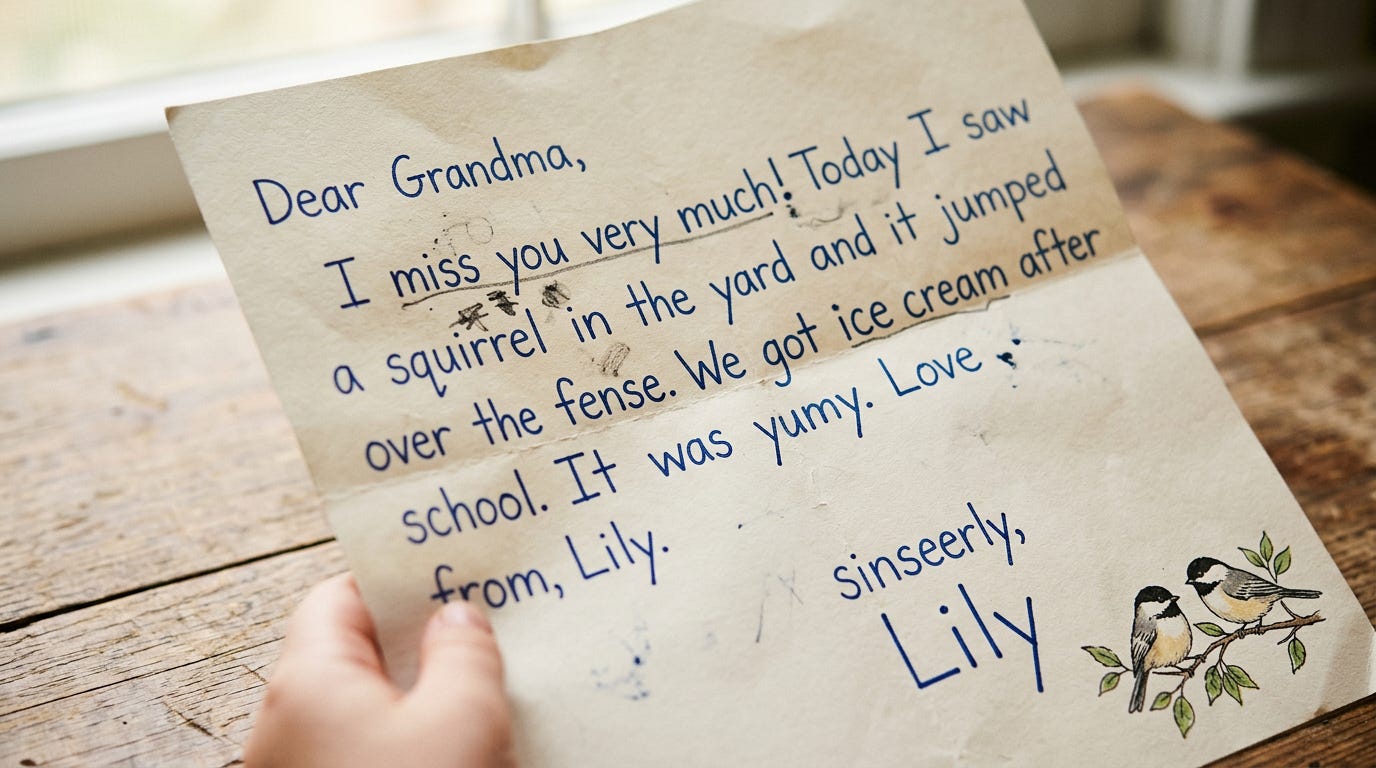
But she never made me feel bad about it. She just made me keep doing it. And somewhere in all that doing, I learned to WRITE.
Not just put words on paper. I learned to think about what I wanted to say and how I wanted to say it. I learned that communication takes effort, and that effort is a form of love. I learned that some things are worth slowing down for. I went to journalism school because of Grama. Not because she was a journalist (she was a homemaker, a gardener, a bird-watcher, a letter-writer, a woman who could make a peach pie that would make you believe in God). But because she taught me that WORDS MATTER. That putting them down carefully and thoughtfully is a way of honoring the person who’s going to read them.
What Paul Knew That We Forgot
Paul wrote letters. A lot of them. He didn’t have email. He didn’t have Slack. He didn’t have the ability to fire off a quick “hey u up?” text to the Corinthians at 2 AM. He had papyrus and ink and messengers who had to physically walk across the Roman Empire delivering his carefully chosen words. And those letters changed the world.
Half the New Testament is Paul’s correspondence. Romans. Corinthians. Galatians. Ephesians. Philippians. Colossians. Thessalonians. Timothy. Titus. Philemon. These weren’t blog posts. They weren’t tweets. They were LETTERS. Personal, specific, handwritten (technically hand-dictated but you get the point), delivered with intention. Paul knew something we’ve forgotten: the medium matters.
When you write something by hand, you can’t backspace. You can’t delete. You have to commit to your words before you write them. You have to think. And that thinking changes what you say and how you say it. There’s something almost sacramental about it. (Yes, I just used a fancy theology word. Journalism school is paying off.) Putting pen to paper is a physical act that connects your brain to your hand to the page to the person who will eventually hold that same piece of paper and see the evidence of your effort. That’s INTIMACY. That’s relationship. That’s the opposite of firing off a text you didn’t even proofread while waiting in line at Starbucks.
Why I Still Do It
I have a smartphone. I have social media (well, I did until I deleted most of it, but that’s another article). I have email and Slack and Discord and every other digital communication tool known to man. And I still write letters by hand.
I write thank you notes to sources who took time to talk to me. I write birthday cards to friends. I write letters to my little brothers even though they probably think I’m insane. I write notes to people who’ve helped me, encouraged me, made my life better just by existing in it. Is it faster to send a text? Obviously. Is it more efficient? Sure. But efficiency isn’t the POINT.
The point is the same thing Grandpa understood about his sailboat. The point is the doing. The intentionality. The way it makes you slow down and think about what you want to say and who you’re saying it to. When I write a letter, I think about Grama. I think about Sunday afternoons at that antique desk with chickadee stationary and the smell of wildflowers coming through the window. I think about her patient hands guiding mine, teaching me that some things are worth taking time to do right.
I miss her so much. I miss both of them. Grama and Grandpa. The cottage is gone now (sold after they passed). The wildflowers are probably still there, doing their chaotic beautiful thing. The birds probably still come back every spring. And somewhere in heaven, I like to think Grandpa finally finished that sailboat. Or maybe he’s still working on it because heaven understands that the work IS the point.
I think they’re watching me. I think they see me working my little butt off at this journalism thing, writing for The Wise Wolf, trying to tell stories that matter. And I think they’re proud. I think they’re cheering for me. Because that’s what happens to good people when they die. They don’t just disappear. They live forever in God’s Kingdom. They watch over the people they loved. They leave behind more than memories. They leave behind LESSONS.
And one of Grama’s lessons was this: when you write something by hand, you give a piece of yourself to another person. Your time. Your attention. Your imperfect handwriting and carefully chosen words. You give them proof that they mattered enough for you to slow down. In a world that won’t stop moving, that’s a radical act.
So Here’s What I’m Asking You To Do
Write a letter. I know you’re busy. I know you have seventeen unread text messages and forty-three unopened emails and a Discord server that’s probably melting down as we speak. I know handwriting is hard and finding stamps is annoying and you can’t remember the last time you bought stationary, but do it anyway.
Pick one person. Just one. Someone who made your life better. Someone who showed up for you. Someone who taught you something or helped you or just made you laugh when you needed it. Get a piece of paper (printer paper is fine, Grama would prefer chickadee stationary but she’s not here to judge you) and a pen, and write something true.
Tell them what they mean to you. Tell them what they taught you. Tell them you’re grateful. Tell them whatever is true and kind and worth saying. Then put it in an envelope, put a stamp on it, and mail it. Yes, actually mail it. Through the actual post office. Like an ancient person from the 1990s.
I promise you this: it will matter more than any text you could send. It will sit on their counter for a week because they won’t want to throw it away. They’ll reread it. They’ll maybe even cry a little. And you’ll feel something shift inside you. Something that’s been hardening in the age of digital everything will soften just a bit. That’s what Grama knew. That’s what Paul knew. That’s what I know now, sitting at my desk with my own imperfect handwriting and my own stack of stationary (no chickadees, sadly, but I’m working on it).
One More Thing
I know The Wise Wolf can get pretty dark. We write about AI data centers with demon names and technocrats building digital Babylon and all the ways the world seems to be sliding toward some kind of cyberpunk dystopia nobody asked for. That’s why I try to write something like this every week. Something hopeful. Something that reminds us that beauty still exists and people are still good and God hasn’t abandoned us to the algorithms.
Because here’s what I believe: when the world NEEDS God, God has a tendency to show up and smash Babylon back into the dust where it belongs. Every time throughout all of history, whenever human beings build towers and systems and empires that forget about love and mercy and the inherent worth of every single person, God shows up with a wrecking ball. (Sometimes literally. See: Jericho. Babel. Rome. Every empire that ever thought it was too big to fall.) The AI priests and the data barons and the people building panopticons disguised as convenience think they’re invincible, but they’re not. They never are.
And in the meantime, while we wait for Babylon to collapse under the weight of its own hubris (as it always does), we can do small radical things. We can write letters. We can feed birds. We can build sailboats we never finish. We can plant wildflowers that will outlive us. We can love people with the time and attention they deserve. We can remember that we’re not just algorithms and data points and engagement metrics. We’re HUMAN, with hands that can hold pens and hearts that can choose care over convenience and souls that can recognize beauty and truth and goodness when we see it.
And that’s enough to keep hope alive. So write that letter. Feed some birds. Tell someone you love them. Remember that you were made for more than scrolling.
Help keep the Wise Wolf howling.
editor’s note: apparently some people are not intelligent enough to understand that I am talking ONLY ABOUT THE IMAGES in the article. Lily wrote this. I just added the images because she isn’t good with graphic design and it needed them.
if anyone is wondering, i generated the crappy images for this article using my local AI server. they are not real. i just want to point that out because i'd feel odd about not doing it. lily said she has a copy of the sinseerly letter back at her parents in a filing cabinet and she will send me a copy when she gets home from college. if i remember to update the article with it, i will - but that most likely will not happen because i am lazy AND forgetful.
Lily that was truly the lovliest piece I have read in a very long time. It transported me to a field of wildflowers and birds. Some cherished memories fluttered back. Thank you for that.