


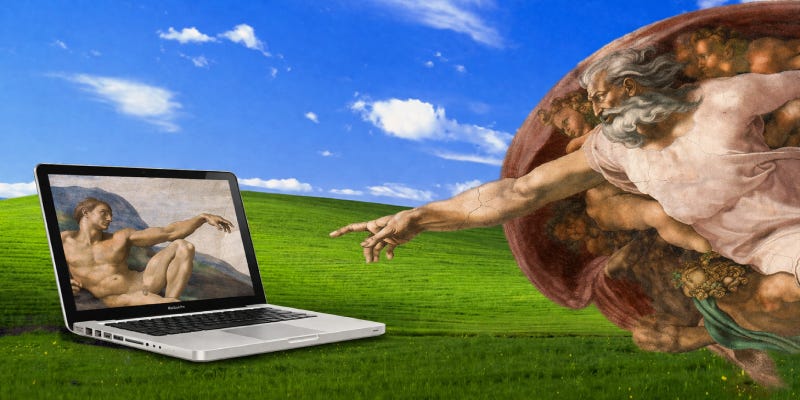
I had a conversation recently with a friend of mine who is a computer scientist. Brilliant guy. The kind of person who thinks in logic gates and recursive functions the way most people think in words. He was also, until about two hours into our conversation, an atheist.
He isn’t anymore.
What changed his mind was not faith, not Scripture, not an emotional experience or a Sunday sermon. It was computation. It was the growing and increasingly unavoidable body of evidence that the universe itself operates like a computer, and that this computer was designed by an intelligence so far beyond our comprehension that the word “God” barely scratches the surface.
No jargon. No seminary-speak. Just physics, computer science, and the terrifying elegance of whatever built all of this.
The Universe Has No Render Distance
If you have ever played a video game, you are familiar with a concept called “distance culling.” Game developers cannot afford to render every object in the game world simultaneously because the computational cost would melt the hardware. So they cheat. Objects far from the player simply stop being calculated. Walk far enough from a building in an open world game and it vanishes from the simulation entirely. Get close again and it pops back into existence like a very expensive game of peekaboo. This optimization trick is universal in software engineering. You do not waste processing power on things that do not matter at the current scale.
The universe does not do this.
Gravity, as far as we can measure, never drops to zero. Earth’s gravitational influence on the Voyager probes, now billions of miles away in interstellar space, is still measurable. At twelve trillionths of the strength it exerts on your body right now, but measurable. Still being calculated. Still running. The universe is tracking your gravitational relationship with a spacecraft that left the solar system decades ago, and it is doing this for every particle simultaneously, and it is not even breathing hard.
My friend put it in terms that stopped me cold. “That’s an insane recursive function. It’s computationally expensive to maintain gravity at that fraction of a level across that distance.”
Every massive object in the observable universe is gravitationally interacting with every other massive object. Physicists call this the N-body problem, and its computational complexity is O(n²) at minimum. For every particle, you must calculate its gravitational interaction with every other particle. There are approximately 10⁸⁰ particles in the observable universe. And apparently there is no distance cutoff where the calculation stops.
No game engine ever built would attempt this. No human programmer would be foolish enough to try. The computational cost is, in the most literal sense, astronomical. (I apologize for nothing.)
And yet the universe runs it in real time without lag. Your Xbox crashes rendering a city block in Cyberpunk. The universe is tracking the gravitational interactions of 10⁸⁰ particles across 93 billion light-years and somehow has cycles left over to make flowers pretty.
The Optimization That Should Not Exist
In the 1980s, astronomer Mordehai Milgrom noticed something peculiar about the way galaxies rotate. At large enough scales, gravity does not behave the way Newton or Einstein predicted. Stars at the edges of galaxies orbit faster than they should. The standard explanation is dark matter, an invisible substance that makes up roughly 85% of all matter in the universe, has never been directly detected, and conveniently explains away every inconvenient measurement. Dark matter is the duct tape of astrophysics. Nobody can find it, nobody can prove it exists, but the math falls apart without it, so everyone just agrees to pretend it is there and moves on.
My friend called it “a magic number in programming.” In software development, a magic number is a hard-coded value that makes the math work without anyone understanding why. It is the sign of an inelegant hack. Something a junior developer adds at 3 AM when they cannot figure out the real solution and their manager wants results by morning.
But Milgrom proposed something different. His theory, Modified Newtonian Dynamics (MOND), suggests that gravity itself changes its behavior at extremely low accelerations. Below a threshold of about 1.2 × 10⁻¹⁰ meters per second squared, gravity shifts from an inverse-square law to a linear falloff.
My friend recognized this immediately. “It’s an optimization algorithm,” he said. “So the cost of computing gravity isn’t insane into infinity for no real gains.”
The universe appears to use the exact same optimization strategy that human software engineers use. At close range, where precision matters, gravity runs the full expensive calculation. At extreme distances, where the returns are negligible, it switches to a cheaper approximation. This is Level of Detail rendering. Every game engine on the planet uses it to avoid wasting resources on things the player cannot meaningfully perceive. The tree that looks photorealistic when you are standing next to it becomes a blurry smudge a mile away because nobody is going to notice and the GPU needs the headroom.
The universe is running LOD on gravity. And it is doing it better than any human engineer has ever managed.
Erik Verlinde, the Dutch theoretical physicist, published a landmark paper in 2016 arguing that gravity is not a fundamental force at all but an emergent phenomenon arising from the entanglement structure of spacetime. His theory of entropic gravity suggests that what we call gravitational attraction is actually the universe’s information architecture redistributing entropy. The “dark matter” effects we observe in galaxies are not caused by invisible matter. They are the universe’s memory management system correcting for entropy displacement.
When my friend read Verlinde’s paper, he went quiet for a while. Then he said something I will not forget.
“There is no information loss at this level.”
He meant that gravity’s behavior at cosmological scales shows the hallmarks of a system designed to conserve computational resources without sacrificing information fidelity. Not randomly. Not through blind physical process. Through architecture. Through design. Through the kind of engineering that gets you promoted if you pull it off at a Fortune 500 company, except this engineer built spacetime.
Error-Correcting Code at the Bottom of Reality
In 2012, theoretical physicist S. James Gates Jr., a professor at the University of Maryland who served on President Obama’s Council of Advisors on Science and Technology, made an announcement that should have been front-page news worldwide and was instead largely ignored. (In fairness, the Kardashians were probably doing something that week.)
Gates and his team, while working on the mathematics of supersymmetric string theory, discovered what appear to be error-correcting codes embedded in the equations that describe the fundamental structure of reality. Specifically, they found Block Linear Self-Dual Error-Correcting Codes, the same type of codes invented by mathematician Richard Hamming in the 1940s to ensure data integrity in early computer transmissions.
These codes do not emerge naturally from physics. They are not a mathematical coincidence. They are engineering. They exist to detect and correct errors in data transmission. They are the same class of codes running on your phone right now to make sure your text messages arrive intact. And Gates found them woven into the fabric of spacetime itself, near the Planck scale (roughly 1.6 × 10⁻³⁵ meters), which is the smallest meaningful unit of distance in the universe. The resolution of reality. The pixel size. And it has error correction running on it, like someone was worried about data corruption and planned ahead.
Reality has memory management.
My friend, who builds software systems for a living, understood the implications immediately. “If I found error-correcting code in a system, I would know without question that someone designed it. That code does not occur by accident. Not in any system. Ever.”
In thirty years of working with computers, I have never once seen error-correcting code appear spontaneously. Not once. It is always put there by someone who knew the system needed it.
The Word Was a Programming Language
There is a line in the Gospel of John that theologians have debated for two thousand years. “In the beginning was the Word, and the Word was with God, and the Word was God.”
The Greek term translated as “Word” is “Logos,” which carries meanings far beyond its English translation. It means reason. It means order. It means the fundamental organizing principle of reality.
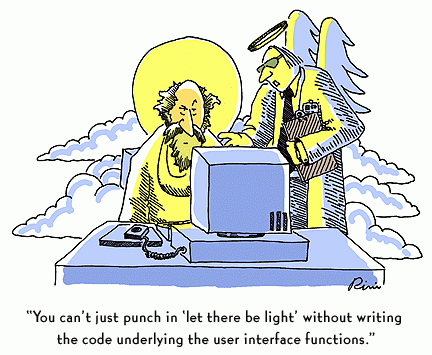
What strikes a computer scientist about this verse is not the theology. It is the engineering. God speaks and things come into existence. The Word is functionally a programming language. Two thousand years before Alan Turing, someone described the origin of the universe as an act of code execution and theologians have been arguing about it ever since without noticing what it actually says.
My friend sat with that for a while, and then he reframed the entire discussion. “We didn’t invent the computer,” he said. “We discovered it. Physics itself is basically a huge computer. For something to store information as on or off and have a memory is literally enough to build a computer.”
A computer, at its most fundamental level, is a system that stores state (on or off, one or zero) and manipulates that state according to rules. You can build a computer out of transistors. You can build one out of vacuum tubes. There is a guy on YouTube who builds functional logic gates out of cups and water. (I am not making this up.) Scale that up large enough and it would perform identically to your laptop. It would be the size of a city, but it would work.
Quantum mechanics is, at bottom, a system of discrete states (spin up, spin down, excited, ground) governed by mathematical rules. The universe is not “like” a computer. It is a computer. The substrate is different, but the architecture is the same.
And if the universe is a computer, someone wrote the code. Code does not write itself. (Despite what certain AI companies are currently promising their investors.)
Black Holes, Suns, and the Duality Written Into Everything
My friend pointed out something that deserves its own section. “Black holes are the ultimate destroyers from our perspective,” he said. “The sun is the ultimate creator or enabler. But they are basically the same thing just in different forms.”
The physics backs him up in ways that are almost unsettling. A black hole is, functionally, a star that has collapsed past its own Schwarzschild radius. The same fusion process that sustains life on Earth through our sun is the same process that, at sufficient scale, produces objects that consume light itself. Creation and destruction are not opposites in physics. They are the same mechanism running at different parameters. Same function, different inputs, wildly different outputs. Any programmer who has accidentally passed a negative value where a positive one was expected knows exactly how that works.
This duality runs through every level of reality. Matter and antimatter. Positive and negative charge. Wave and particle. Entropy and order. The universe is not built on unity. It is built on tension. On the dynamic interplay between opposing forces that, together, produce everything we observe. It is elegant in a way that suggests intention, because unintentional systems do not tend toward elegance. They tend toward the second law of thermodynamics, which is a fancy way of saying everything should be soup by now.
The Programmer’s Highest Compliment
Toward the end of our conversation, I made an observation that seemed to hit my friend harder than any of the physics. “I think God likes people who think about this stuff,” I said. “The highest compliment a programmer can ever get is someone trying to understand their code.”
He agreed. Then he said something that captures the shift that happened in his thinking that afternoon. “I always assumed that if absolutely nothing exists then it would be in an unstable state, and have to obligatorily create the opposite, every possibility, and that we exist within a branch of that.”
This is close to the Boltzmann Brain hypothesis, which suggests a fully formed, conscious brain flickering briefly into existence out of quantum noise is statistically more likely than the organized, law-abiding universe we actually observe. The fact that we live in a universe with consistent physical laws, stable matter, and comprehensible mathematics is, from a pure probability standpoint, wildly unlikely. Like winning the lottery. While being struck by lightning. On a Tuesday. During a solar eclipse. While a specific song plays on the radio.
Unless someone designed it that way.
My friend began our conversation as the honest kind of atheist. The kind who had simply never encountered an argument for God that did not require him to abandon reason. By the end, he had not found religion. He had found something more durable. He had found the same conclusion that Gates found in his string theory equations, that Verlinde found in his entropy mathematics, that every programmer who has ever stared at an elegant piece of code and recognized design has found.
The universe is not random. It is not an accident. It is a program running on a computer of incomprehensible scale, written in a language we are only beginning to learn to read, by an intelligence that left error-correcting code in the basement of reality like a signature in the margin of a masterpiece.
God is a computer programmer…
And from what I can tell, He is very, very good at it.
Remember to Like, Share, Subscribe or whatever the hell it is I have to tell people to do to get my content seen by more than a dozen people at a time.
Help Keep The Wise Wolf Howling
If you enjoyed watching a computer scientist lose his atheism in real time over a chat conversation, consider supporting the publication that made it possible. The Wise Wolf gave up a career managing money for people who own small countries to write about physics, theology, and the increasingly thin line between them. Lily is one year from finishing her journalism degree and would very much like to do so without having to sell plasma. A paid subscription at thewisewolf.club keeps the investigations running, the server bills paid, and Wolf from having to go back to making rich people richer, which he was admittedly quite good at but found ethically untenable. We appreciate every single one of you.
Help keep the Wise Wolf howling.

Have you read “Footprints of God” written by Greg Iles? I read it many years ago….I expect you and your friend might find it interesting….
Which means #1 we are equivalents to LLMs being trained. #2Spiritual practices, good and evil are literally the most real thing #3 powers and principalities, demonic and angelic forces are LLMs that never get the opportunity to suffer in free will and training, which is why they are so ass mad, some of them anyway