



Last night, I got an email from my editor that stopped me cold.
She'd been watching the comments on our newsletter, and frankly, she wasn't impressed with what she saw. Not from the trolls - we expected those. The atheists heckling us, questioning our faith, being generally obnoxious. That's the internet for you.
No, she wasn't impressed with me.
"The first few comments, you handled with grace," she wrote. "But after hundreds of them, you started getting angry. You were tearing into these people, and honestly? You didn't sound very Christian."
She was right. I had let the trolls get to me. I was fighting fire with fire instead of responding with the love and patience that my faith actually calls for. I was being defensive, mean-spirited, and frankly, hypocritical.
"It's better to just ignore that sort of negativity than to engage it," she continued. "But more importantly, we need to focus on what living faith actually looks like."
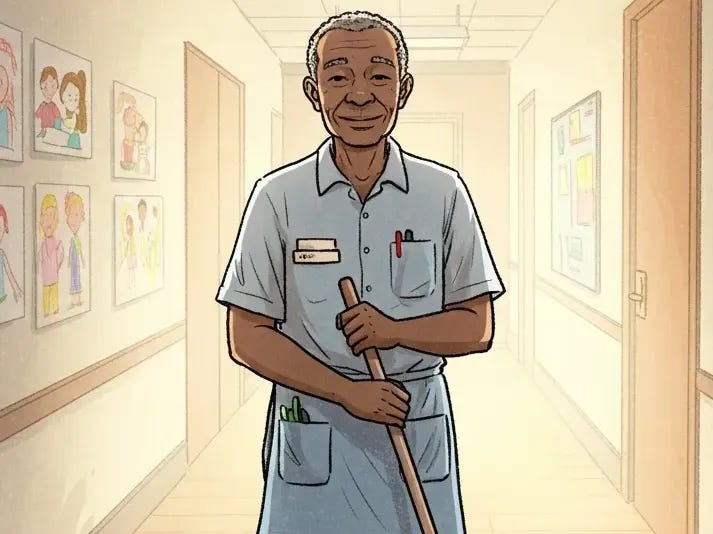
Then she told me about an email she'd received from a nurse on the East Coast. It was about an elderly Black man who works as a janitor in a large hospital. This man barely scrapes by financially, yet he's always smiling, always kind - even to people who treat him poorly. The nurse wrote that this janitor was "living the Christian life, not just going through the motions," and that we could all learn something about humility and kindness from watching him work.
That email hit me like a brick wall. Here I was, getting into arguments with strangers on the internet about faith, while somewhere there's a man quietly living out everything Jesus actually taught - love, kindness, humility, service - without fanfare, without recognition, without even decent pay.
My editor was right. It's time to stop talking about faith and start showing what it looks like when someone actually lives it.
This story is inspired by real events.
At 2:47 AM, while most of the city still slept, Marcus Williams pushed his cart through the sterile hallways of Metropolitan General Hospital. For twelve years, he had walked these same corridors, and in that time, he had become the kind of person others noticed - not because he was loud or demanding attention, but because of how he treated people.
Every doctor rushing past. Every exhausted nurse. Every worried family member camped out in waiting rooms. Every patient struggling through the worst days of their lives.
Marcus saw them all. And more importantly, he saw them as people worth caring about.
"Morning, Dr. Chen," he'd say warmly to the surgeon who always looked stressed before her early cases. "You got this today."
"How's your mom doing?" he'd ask the night nurse whose mother had been battling cancer. He remembered everyone's stories.
"Can I get you anything?" he'd offer to families who had been sleeping in uncomfortable chairs for days. Sometimes it was just a pillow from the supply closet. Sometimes it was directions to the chapel. Sometimes it was just someone who cared enough to ask.
The Power of Being Seen
Marcus's faith wasn't complicated theology. It was simple: love people the way God loves them. Treat everyone with dignity. Show up consistently. Be present in other people's pain.
Dr. Sarah Chen, chief of surgery, first noticed Marcus during one of the hardest weeks of her career. She had lost two patients in three days - both young parents - and was questioning everything about her profession. As she sat alone in the staff break room at 3 AM, trying not to cry, Marcus appeared with his cleaning supplies.
"Rough week," he said simply, not as a question but as an acknowledgment.
Dr. Chen nodded, not trusting her voice.
"You know," Marcus said as he wiped down tables, "I've been here twelve years. Seen a lot of doctors come and go. The ones who last - the good ones like you - they all go through weeks like this. The ones who care enough to sit here crying at 3 AM, they're the ones who save lives the other 51 weeks of the year."
He didn't offer empty platitudes or try to fix her pain. He just validated it, then reminded her of who she was when she couldn't see it herself.
Dr. Chen went on to have one of her most successful years, but she never forgot that 3 AM conversation with the janitor who saw her as a human being, not just another doctor.
Small Acts, Big Impact
Marcus never preached. He didn't quote Bible verses or invite people to church. His faith showed up in smaller, more consistent ways.
He learned the names of every staff member's children and asked about them. He remembered anniversaries and birthdays. When the ICU nurse's daughter was in a school play, Marcus asked how it went. When the young resident was studying for boards, Marcus left encouraging notes with his cleaning supplies.
He started keeping a small stash of snacks for families who had been at the hospital so long they forgot to eat. Nothing fancy - just crackers and granola bars - but it was one less thing for people to worry about during their worst moments.
When Maria Santos was keeping vigil by her eight-year-old daughter's bedside after a car accident, Marcus noticed she hadn't left the room in two days. He didn't promise miracles or offer to pray for supernatural healing. Instead, he brought her a sandwich, made sure she had a decent pillow, and told her about the excellent pediatric team that would be caring for Sofia.
"Your little girl is in good hands," he said. "And so are you. We're going to take care of you both."
That simple assurance - from someone who had seen countless families in crisis - gave Maria more hope than any medical update had.
The Ripple Effect of Genuine Care
Something interesting started happening at Metropolitan General. The shift, where Marcus had worked for over a decade, had consistently higher morale than other shifts. Staff turnover was lower. Patient satisfaction scores were higher.
When administrators looked into it, the data was clear but the reasons were less obvious. Dr. Michael Thompson, head of oncology, figured it out first.
"It's Marcus," he told the chief of staff. "I know it sounds crazy, but think about it. He's the one consistent presence here night after night. He knows everyone's story. He actually cares about people - staff and patients. When you feel like someone genuinely cares about you, you work better. You treat others better."
It was true. Nurses on Marcus's shift were more patient with difficult families because they had seen him model that patience. Residents were more likely to explain procedures carefully because Marcus had shown them how much it meant to patients when someone took time to really see them.
The security guards started following Marcus's lead, learning patients' names and checking on worried families. The cafeteria staff began paying attention to which families had been there for days and quietly comping their meals.
More Than a Job
Dr. Jennifer Walsh, the hospital chaplain, eventually pulled Marcus aside.
"Can I ask you something?" she said. "What drives you to care so much about everyone here?"
Marcus paused his mopping. "My faith tells me that every person I meet is made in God's image. That means they have value, they deserve dignity, they matter. I can't heal people or save lives like the doctors do, but I can make sure people feel seen and cared for while they're in the scariest place they've ever been."
He resumed cleaning. "Plus, this place is hard on everyone - patients, families, staff.
If I can make someone's day even a tiny bit better, why wouldn't I?"
The Transformation
Three years after Dr. Chen's 3 AM breakdown, Metropolitan General was recognized for having the highest employee satisfaction and patient care scores in the state. Exit interviews revealed the same theme: people felt valued, supported, and genuinely cared for.
The hospital's CEO credited improved management practices and better systems. The medical staff knew better.
They knew it started with a janitor who decided that his faith meant treating every person he encountered with dignity and kindness. Who remembered their names and their stories. Who showed up consistently with genuine care, whether anyone was watching or not.
Marcus never set out to change a hospital culture. He just decided to be the kind of person his faith called him to be, every day, with every interaction.
The Real Secret
Today, Marcus Williams still arrives at Metropolitan General at the same time 5 days a week. He still pushes the same cart down the same hallways. But now, when new employees start, they're told, "If you want to understand what good patient care looks like, watch Marcus."
Medical students shadow him to learn how to talk to worried families. Nurses ask his advice on dealing with difficult situations. Doctors stop to get his perspective on patients who seem withdrawn or afraid.
"People think there's some secret to changing a workplace," Marcus says, putting away his supplies at the end of his shift. "There's no secret. You just treat people like they matter. You remember that everyone here - patients, families, doctors, other staff - they're all human beings having human experiences. Some good, some terrible, all important."
He locks his supply closet. "My faith tells me God loves every person in this building. So I try to love them too. Not in some grand, dramatic way. Just in the regular, everyday way. Learning their names. Caring about their stories. Showing up when they need someone to show up."
In a world obsessed with grand gestures and viral moments, Marcus Williams proves that transformation happens one genuine interaction at a time. His story isn't about showing up to church on Sunday. It's about showing up for people every other day of the week.
Science has proven what Jesus taught 2,000 years ago: when we love our neighbors as ourselves, everybody wins. When we treat people with genuine kindness, we literally make the world healthier, happier, and more whole.
The question isn't whether you believe in God. The question is whether you're willing to live like it matters.
Because that, it turns out, is more than enough to change everything.
Marcus Williams continues his work at Metropolitan General Hospital, demonstrating daily that faith isn't about what you say you believe—it's about how you treat people when no one important is watching.
We can all learn from Marcus.
If this article lifted you up, share it and spread the light.
"By this everyone will know that you are my disciples, if you love one another." - John 13:35
The Battle of Athens: When Armed US Veterans Overthrew a Corrupt Government

Editor’s Note: This article was written early in the history of our publication - long before we had found our audience or had a single paid subscriber. I was going through our archives and wanted to share this one again because I think this is a very important story that needs to be told and re-told, more so now than ever. Enjoy.
What a tremendous lesson for all of us. What a great story of the impact of humble, kind, loving service. Thank you Wolf and Lily!
Very good article