


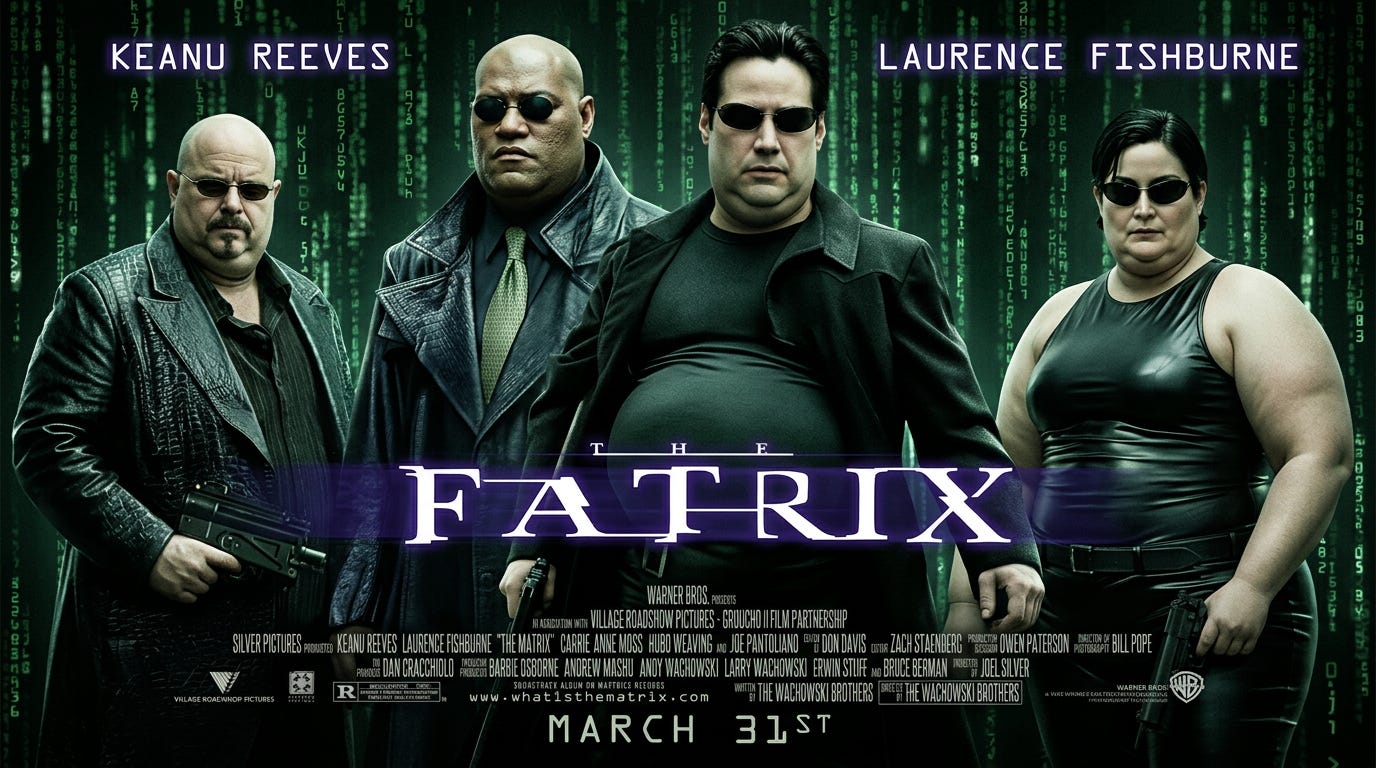
Nobody had to build the pods. They just had to open a grocery store…
Morpheus offered Neo a choice between two pills. This was, in retrospect, a simpler era.
In the actual version of this story there are no pills. There is a Hot Pocket. You already ate it. So did your kids. So did your parents. Everyone feels vaguely terrible all the time and has mostly stopped mentioning it because feeling vaguely terrible all the time is just called being an American now, and pointing it out at dinner is considered rude.
Here is what they figured out, the extraordinarily rich men in the extraordinarily nice suits. You do not need to plug wires into anybody’s brain stem. You do not need pods. You do not need sentient machines or a fake computer world or any of the expensive infrastructure that makes a dystopia such a logistical undertaking. You just need to get there first. You need to get there before the food does.
They got there first.
Pick up a loaf of store-bought bread. Not the eleven-dollar artisan situation with a name like “Gunderson’s Heritage Ancient Grain Boule.” The regular bread. The bread in your house right now. Read the ingredient list, all of it, which will take approximately as long as reading the book of Numbers and is equally enjoyable. You will find azodicarbonamide, which is a dough conditioner also used in the manufacture of yoga mats (the same compound, in the bread AND the mat, this is not a metaphor, this is the label). You will find calcium propionate, which does not exist in nature and which Australian researchers linked to irritability and inattention in children. You will find high-fructose corn syrup in the BREAD. In the bread. A sentence that should not grammatically work.
Your grandmother’s bread went bad in three days.
It went bad because it was food. Food rots. Bacteria like it for the same reason your body likes it, which is that it is made of things a living organism can use, which is the definition of food, which used to be the only qualification required. The bread on your shelf right now will outlast the houseplants. It will outlast the leftovers.
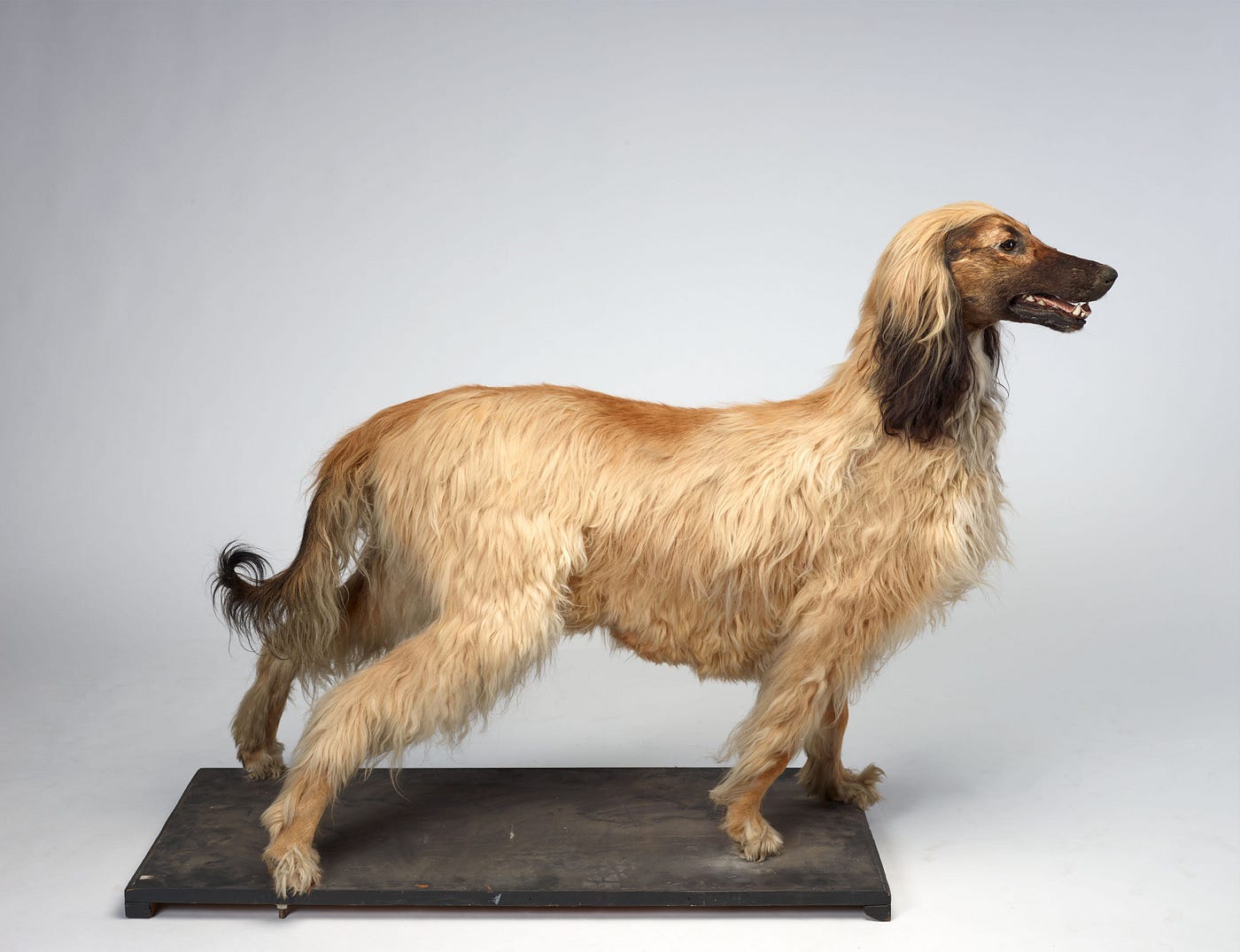
Somewhere in 1962 a food scientist asked “but what if it just didn’t rot” and a roomful of executives applauded.
Neo figured out the simulation was fake because things kept glitching. Déjà vu. Agents materializing from nowhere. A world that felt slightly wrong in ways he couldn’t name.
We have the same glitches. We just scheduled them into our calendars.
The brain fog you have normalized as “just how mornings are.” The inflammation your doctor calls “a little elevated” every year, every single year, without connecting it to anything or suggesting anything except a different pill. The ADHD diagnoses that went up 800 percent in thirty years, which we addressed by giving children amphetamines instead of asking what changed thirty years ago. The Alzheimer’s in people in their sixties. The type 2 diabetes in people in their thirties. The autoimmune conditions that previous generations simply did not have at these rates, which we have collectively decided to treat as a mystery of nature rather than a question with an answer and a return address.
Europe looked at these chemicals and said no. Not “no in large quantities.” Just no. Titanium dioxide, used to make processed food look whiter and more appealing, was banned by the European Food Safety Authority in 2022 after studies raised concerns about genotoxicity, which is the scientific term for “damages your DNA,” which is not a quality you generally seek in a coffee creamer. It is still in your American candy, your chewing gum, your salad dressing. Red dye No. 3 was found to cause cancer in rats in 1990. The FDA banned it from cosmetics in 1990. They left it in food for another thirty-four years. It was BANNED FROM LIPSTICK and legal in your child’s maraschino cherries for thirty-four years, which is either the most spectacular bureaucratic oversight in American history or it is something else entirely, and if you are reading this publication you probably already know which one it is.
Somebody made that decision. Somebody kept making it. Somebody collected a government paycheck every two weeks for three decades while making it, went home to a nice suburb, ate dinner, possibly involving maraschino cherries, and felt fine.
Trinity would not explain the next part. Trinity would kick through the wall, shoot the relevant person in the face, and be back in the helicopter before you finished the sentence. But here it is anyway. The FDA and USDA are staffed at their senior levels by people who came directly from the companies they regulate and will return to those companies when their government tenure ends. This has a name. The name is “the revolving door,” which is a remarkably cheerful name for a bribery system so normalized that nobody bothers being embarrassed about it anymore. The people whose job is to protect you from the poison have a direct financial incentive to approve the poison, because the companies that make the poison will pay them substantially more on the way out than the government paid them on the way in.
Then the pharmaceutical layer closes the loop in a way that would make the machines from Neo’s world genuinely envious. The food makes you sick. The sickness requires medication. The medication is manufactured by companies owned, in several well-documented cases, by the same parent investment funds that own the food companies. Vanguard and BlackRock hold major positions in both. You are not a customer. You are a pipeline. You get poisoned at one end, you purchase remediation at the other end, and somewhere in the middle a quarterly earnings report looks fantastic.
This is not a conspiracy theory. A conspiracy theory requires secrecy. This is in the SEC filings. This is in the lobbying disclosures. This is in the publicly available revolving-door employment records sitting on government websites, accessible to anyone patient enough to read them, which is not many people, because the food has made it genuinely difficult to sustain that kind of attention for that long, which is, and here is the part where you should feel the specific cold anger of someone who has been very carefully had, the design.
Neo did not save anybody by shooting an agent. He saved them by waking up. And waking up in the Fatrix does not involve two elegant capsules and a choice presented to you in a leather armchair. It involves standing in a fluorescent grocery aisle while a Muzak version of a song you used to love plays overhead, reading a label, deciding that “carrageenan” sounds like something your body probably cannot use, and putting the thing back. Then finding something else. Which costs more. Which is also not an accident. They made the poison cheap and the real food expensive and the correct choice the harder choice, every time, at every price point, in every store, in a country that told you your health was a personal responsibility and then spent sixty years making personal responsibility as difficult and expensive as possible.
Start reading the labels. Start asking why bread needs seventeen ingredients to be bread. Start noticing that the countries that banned these chemicals are not in fact dying from inadequate dough conditioning. Start being angrier about this than about whatever they put in your feed this week to make sure you weren’t angry about the food.
The Fatrix runs on your compliance. Specifically at the checkout line, with the thing you grabbed because it was cheap and fast and the ingredient list was too long to read, which was, again, the point.
Swipe the card. Eat the yoga mat. Feel tired.
Don’t ask questions.
Your call, Neo.
Help keep the Wise Wolf howling.
We got a Youtube Channel we are in the process of rebranding from back in our wilder (and dumber) days when we were doing on-site reporting and I ended up stabbed half-a-dozen times. Feel free to subscribe.

The Wise Wolf is two people with an internet connection and a willingness to write the article that the outlets owned by the same investment funds that own your grocery chain will not write for you. Wolf gave up a comfortable trajectory in tech finance to do this, which depending on the week feels either like a principled stand or a catastrophic error in judgment involving no dental plan. Lily is finishing her journalism degree and would very much like to do so without selling a kidney. Neither of us is making Substack-mansion money. If this kind of reporting matters to you, a paid subscription is how you make more of it possible. We will keep pulling threads.
Go buy some bread that actually rots…
4Chan: How a Cartoon Frog, a 'Dead' Pedophile, and the CIA Destroyed Western Civilization

There is a website you have almost certainly never visited, and if you have, you are either a journalist, a federal agent, or someone whose browsing history you would prefer we not discuss. It is called 4chan. It has existed since 2003, which makes it one of the oldest anonymous forums on the internet, in the same way that a particular alley in a bad neighborhood might be described as “historic.”
WW- Don't know if you have ever seen this. It explains everything you write about.
The Secret Covenant of the Illuminati
The Secret Covenant of the Jewish Secret Society Known As the Order of the Illuminati, issued under The Supreme Authority of the Jewish Bograh and sanctioned by the Jewish Rothschild Dynasty (Europe) and the Jewish Rockefeller Dynasty (USA)
And heed our word, so mote it be.
THE SECRET COVENANT
An illusion it will be, so large, so vast it will escape their perception.
Those who will see it will be thought of as insane.
We will create separate fronts to prevent them from seeing the connection between us.
We will behave as if we are not connected to keep the illusion alive.
Our goal will be accomplished one drop at a time so as to never bring suspicion upon ourselves. This will also prevent them from seeing the changes as they occur.
We will always stand above the relative field of their experience for we know the secrets of the absolute.
We will work together always and will remain bound by blood and secrecy. Death will come to he who speaks.
We will keep their lifespan short and their minds weak while pretending to do the opposite.
We will use our knowledge of science and technology in subtle ways so they will never see what is happening.
We will use soft metals, aging accelerators and sedatives in food and water, also in the air.
They will be blanketed by poisons everywhere they turn. The soft metals will cause them to lose their minds.
We will promise to find a cure from our many fronts, yet we will feed them more poison.
The poisons will be absorbed through their skin and mouths, they will destroy their minds and reproductive systems.
From all this, their children will be born dead, and we will conceal this information.
The poisons will be hidden in everything that surrounds them, in what they drink, eat, breathe and wear.
We must be ingenious in dispensing the poisons for they can see far.
We will teach them that the poisons are good, with fun images and musical tones.
Those they look up to will help. We will enlist them to push our poisons.
They will see our products being used in film and will grow accustomed to them and will never know their true effect.
When they give birth we will inject poisons into the blood of their children and convince them it is for their help.
We will start early on, when their minds are young, we will target their children with what children love most, sweet things.
When their teeth decay we will fill them with metals that will kill their mind and steal their future.
When their ability to learn has been affected, we will create medicine that will make them sicker and cause other diseases for which we will create yet more medicine.
We will render them docile and weak before us by our power.
They will grow depressed, slow and obese, and when they come to us for help, we will give them more poison.
We will focus their attention toward money and material goods so they many never connect with their inner self.
We will distract them with fornication, external pleasures and games so they may never be one with the oneness of it all.
Their minds will belong to us and they will do as we say. If they refuse we shall find ways to implement mind-altering technology into their lives.
We will use fear as our weapon.
We will establish their governments and establish opposites within. We will own both sides.
We will always hide our objective but carry out our plan.
They will perform the labour for us and we shall prosper from their toil.
Our families will never mix with theirs. Our blood must be pure always, for it is the way.
We will make them kill each other when it suits us.
We will keep them separated from the oneness by dogma and religion.
We will control all aspects of their lives and tell them what to think and how.
We will guide them kindly and gently letting them think they are guiding themselves.
We will foment animosity between them through our factions.
When a light shall shine among them, we shall extinguish it by ridicule, or death, whichever suits us best.
We will make them rip each other's hearts apart and kill their own children.
We will accomplish this by using hate as our ally, anger as our friend.
The hate will blind them totally, and never shall they see that from their conflicts we emerge as their rulers. They will be busy killing each other.
They will bathe in their own blood and kill their neighbours for as long as we see fit.
We will benefit greatly from this, for they will not see us, for they cannot see us.
We will continue to prosper from their wars and their deaths.
We shall repeat this over and over until our ultimate goal is accomplished.
We will continue to make them live in fear and anger though images and sounds.
We will use all the tools we have to accomplish this.
The tools will be provided by their labour.
We will make them hate themselves and their neighbours.
We will always hide the divine truth from them, that we are all one. This they must never know!
They must never know that colour is an illusion, they must always think they are not equal.
Drop by drop, drop by drop we will advance our goal.
We will take over their land, resources and wealth to exercise total control over them.
We will deceive them into accepting laws that will steal the little freedom they will have.
We will establish a money system that will imprison them forever, keeping them and their children in debt.
When they shall band together, we shall accuse them of crimes and present a different story to the world for we shall own all the media.
We will use our media to control the flow of information and their sentiment in our favour.
When they shall rise up against us we will crush them like insects, for they are less than that.
They will be helpless to do anything for they will have no weapons.
We will recruit some of their own to carry out our plans, we will promise them eternal life, but eternal life they will never have for they are not of us.
The recruits will be called "initiates" and will be indoctrinated to believe false rites of passage to higher realms. Members of these groups will think they are one with us never knowing the truth. They must never learn this truth for they will turn against us.
For their work they will be rewarded with earthly things and great titles, but never will they become immortal and join us, never will they receive the light and travel the stars. They will never reach the higher realms, for the killing of their own kind will prevent passage to the realm of enlightenment. This they will never know.
The truth will be hidden in their face, so close they will not be able to focus on it until its too late.
Oh yes, so grand the illusion of freedom will be, that they will never know they are our slaves.
When all is in place, the reality we will have created for them will own them. This reality will be their prison. They will live in self-delusion.
When our goal is accomplished a new era of domination will begin.
Their minds will be bound by their beliefs, the beliefs we have established from time immemorial.
But if they ever find out they are our equal, we shall perish then. THIS THEY MUST NEVER KNOW.
If they ever find out that together they can vanquish us, they will take action.
They must never, ever find out what we have done, for if they do, we shall have no place to run, for it will be easy to see who we are once the veil has fallen. Our actions will have revealed who we are and they will hunt us down and no person shall give us shelter.
This is the secret covenant by which we shall live the rest of our present and future lives, for this reality will transcend many generations and life spans.
This covenant is sealed by blood, our blood. We, the ones who from heaven to earth came.
This covenant must NEVER, EVER be known to exist. It must NEVER, EVER be written or spoken of for if it is, the consciousness it will spawn will release the fury of the PRIME CREATOR upon us and we shall be cast to the depths from whence we came and remain there until the end time of infinity itself.
Illuminati Founders
The Rothschild Family is perhaps the richest family on the planet. They control the majority of the world's weatlth; anywhere between 50 to 60%, perhaps more. Their modus operandi is sworn secrecy.They intermarry, thus consolidating the secret of their wealth in the family. The Rothschilds funded and the founded the Illuminati in the United States. Their agent was Adam Weishaupt. They have major banking conglomerates in Monaco, Luxembourg, France, Switzerland, Liechtenstein, United Kingdom, and the Cayman Islands. And their ethnicity is Ashkenazi Jewish, as documented by Wikipedia.
John D. Rockefeller established the Standard Oil Company in 1870 and aggressively ran it until he officially retired in 1897. Rockefeller supported and funded mind-control and population control initiatives throughout his tenure on earth. His family is a Rothschild front in the United States. The ethnicity of the Rockefeller Family is Sephardi Jewish, as documented in the limited edition book of 500 copies, Americans of Jewish Descent by Malcolm H. Stern. The book was privately published on heavy expensive stock, beautifully bound, and distributed to the Jewish elite.
Editor's Note: The reader is also encouraged to read "The Protocols of Zion" as listed in the "Links" section of the webpage. The essence of both are authentic. I am not ultimately concerned with who wrote both pieces, instead the concern lies in what they are both saying, and how relevant they both are to the current state of affairs.
I used to work in big ag. I have so many tales to tell, but I won’t start on Monsanto right now. That’s for another discussion.
I will, however tell you to wash your fruit and NEVER leave that chunk of lime in your gin and tonic or slice of lemon in your iced tea. Why? Because the pesticide used on the peel to prevent bugs from attacking your citrus has never been approved for human consumption. We don’t eat orange or lemon or lime peel. But we use it in a million other ways it has never been approved for like zesting into your lemon blueberry muffins or soaking in your margarita. So just don’t use it.