


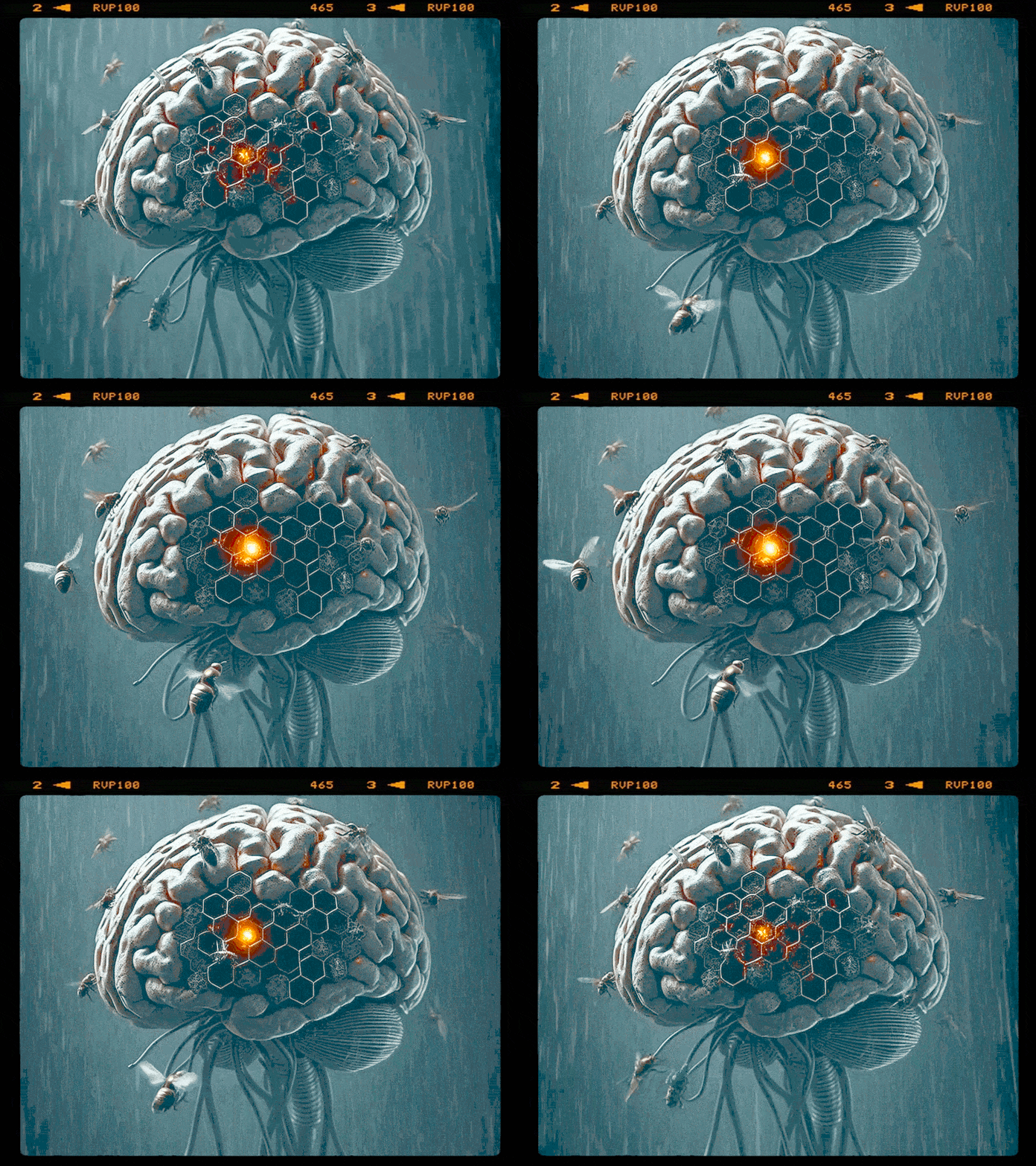
In an era where tech moguls openly discuss the rise of artificial intelligence and its implications for humanity's future, filmmaker Gonzo Shimura's prophetic documentary "Age of Deceit 3: Remnants of the Cyberhive Earth" appears increasingly prescient. What seemed like fringe speculation just years ago now manifests in Silicon Valley boardrooms, where figures like Peter Thiel host seminars discussing AI's potential "antichrist" characteristics.
Meanwhile, growing numbers question whether CERN's particle accelerator serves purposes beyond scientific research, with some suggesting connections to occult practices and dimensional manipulation. The convergence of ancient biblical prophecy with cutting-edge technology raises a disturbing question: What if the end times aren't approaching through traditional warfare, but through humanity's voluntary submission to a technological hive mind?
The Sin Virus: Understanding Spiritual Corruption Through Digital Metaphors
The concept of sin as a technological virus provides a compelling framework for understanding humanity's relationship with both spiritual rebellion and digital systems. Just as computer viruses require agency to spread and corrupt systems, spiritual corruption operates through intelligent agents working toward a specific goal: death.
Modern artificial intelligence operates through software robots or "soft bots" that learn user behavior patterns and act autonomously. This technological reality illuminates how spiritual corruption spreads through systems, ultimately infecting "physical creation itself with decay." The materialist conclusion of heat death represents an eschatology where existence ends in meaninglessness.
Christian philosopher William Lane Craig explains the horror of this worldview: "Modern man thought that in throwing off God he had freed himself from all that stifled and repressed him. Instead he discovered that in killing God he had only succeeded in orphaning himself... if there is no God then man's life becomes ultimately absurd."

As author Garrett Garrett observed in 1929, humanity has become trapped in "a mechanical spiral that we cannot say for certain whether it is that we produce for the sake of consumption or consume for the sake of production."
This endless loop of technological dependence operates through cybernetic control systems. These create "circular causal relationships" that can be "quantified, analyzed and thus controlled by manipulating the signals," explaining why modern advertising proves so effective at tapping into human impulses.
Homo Deus: The Transhumanist Vision of Digital Godhood
The transhumanist agenda represents a fundamental shift in human ambition, as historian Yuval Noah Harari describes: "Having reduced mortality from starvation, disease and violence, we will now aim to overcome old age and even death itself. Having saved people from abject misery, we will now aim to make them positively happy.
"We don't need to wait for the second coming in order to overcome death. A couple of geeks in a lab can do it." - Yuval Noah Harari
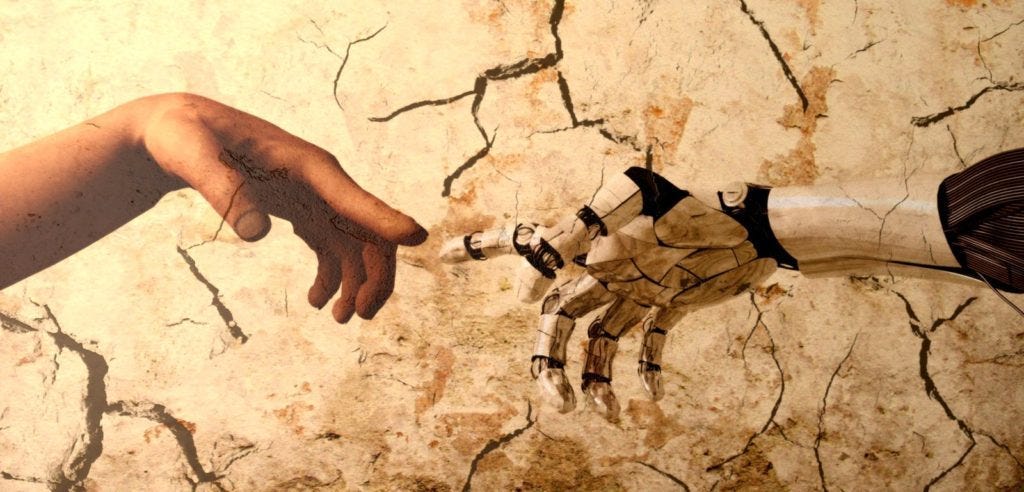
This pursuit marks a crucial transition in authority. "If traditionally death was the specialty of priests and theologians, now the engineers are taking over." The implications extend beyond mere life extension to complete transformation of human consciousness through artificial intelligence and virtual environments.
The transhumanist vision directly parallels humanity's original rebellion in Eden, where the promise of becoming "like God" led to spiritual death. Modern technology offers the same ancient temptation: unlimited power over life, death, and reality itself.
The Days of Noah: Nephilim, Genetic Corruption, and Modern Parallels
Biblical accounts describe a time before the flood when supernatural beings, the "sons of God" (bene ha elohim), corrupted human genetics by producing offspring called Nephilim. Genesis 6 records that God chose Noah specifically because their "imagination was evil continually," leading to divine judgment through the flood.
These supernatural events weren't merely ancient mythology but foundational to understanding current technological developments. The genetic corruption that precipitated divine judgment finds modern parallels in genetic manipulation, AI enhancement, and the pursuit of human-machine integration.
Just as the antediluvian world saw the corruption of human DNA through supernatural intervention, contemporary biotechnology and artificial intelligence represent similar attempts to fundamentally alter human nature. The promise of enhanced cognitive abilities, extended lifespans, and transcendence of biological limitations echoes the same deception that led to Noah's flood.
The significance becomes clear when considering that Jesus specifically referenced these times: "As it was in the days of Noah, so it will be at the coming of the Son of Man." The technological capabilities emerging today may represent the fulfillment of this prophetic warning, suggesting humanity approaches similar conditions that once warranted divine intervention.
The New Tower of Babel: Digital Unity and Global Communication
The Tower of Babel narrative provides crucial insight into current technological development. Ancient humanity possessed "one language and one speech," enabling unprecedented unity of purpose. God's response reveals the danger of unchecked human collaboration: "Behold, the people is one, and they have all one language, and this they begin to do: and now nothing will be restrained from them, which they have imagined to do."

Digital translation through artificial intelligence has effectively restored global communication capability. As noted in "Prediction Machines: The Simple Economics of Artificial Intelligence," AI has achieved what humans have sought "for all of human civilization, even enshrined in the millennia old story of the Tower of Babel."
Virtual reality technology fulfills the ancient prediction about unlimited human imagination. Modern VR environments create spaces where users "can be anything or anyone and is only limited by your imagination." This technological capability represents the same condition that prompted divine judgment at Babel.
The philosophical foundation supporting this technological tower has deep historical roots. Lewis Carroll declared "imagination is the only weapon in the war against reality," while Albert Einstein claimed "imagination is everything. It is the preview of life's coming attractions." Carl Sagan stated "imagination will often carry us to worlds that never were, but without it we go nowhere."
Yet scripture warns about the dangers of unchecked imagination. Psalm 140 describes "the evil and violent man who imagines mischief in his heart continually" gathering "together for war" against God and His saints.
The Emerging Hive Mind: Swarm Intelligence and Global Connectivity
Biological swarm intelligence demonstrates how individual creatures combine diverse perspectives to maximize collective wisdom. Research shows "when people think together in swarms they can amplify their intelligence by 20, 40, 60" percent using current technology.
This concept gains ominous significance when applied to human society. "A swarm of humans should be able to solve problems that we can't even conceive. We should be able to form a true super intelligence. And because the building blocks are people tapping not just our knowledge but our values and morals and sensibilities, the resulting super intelligence will not be alien. It will be human. Just smarter and wiser."
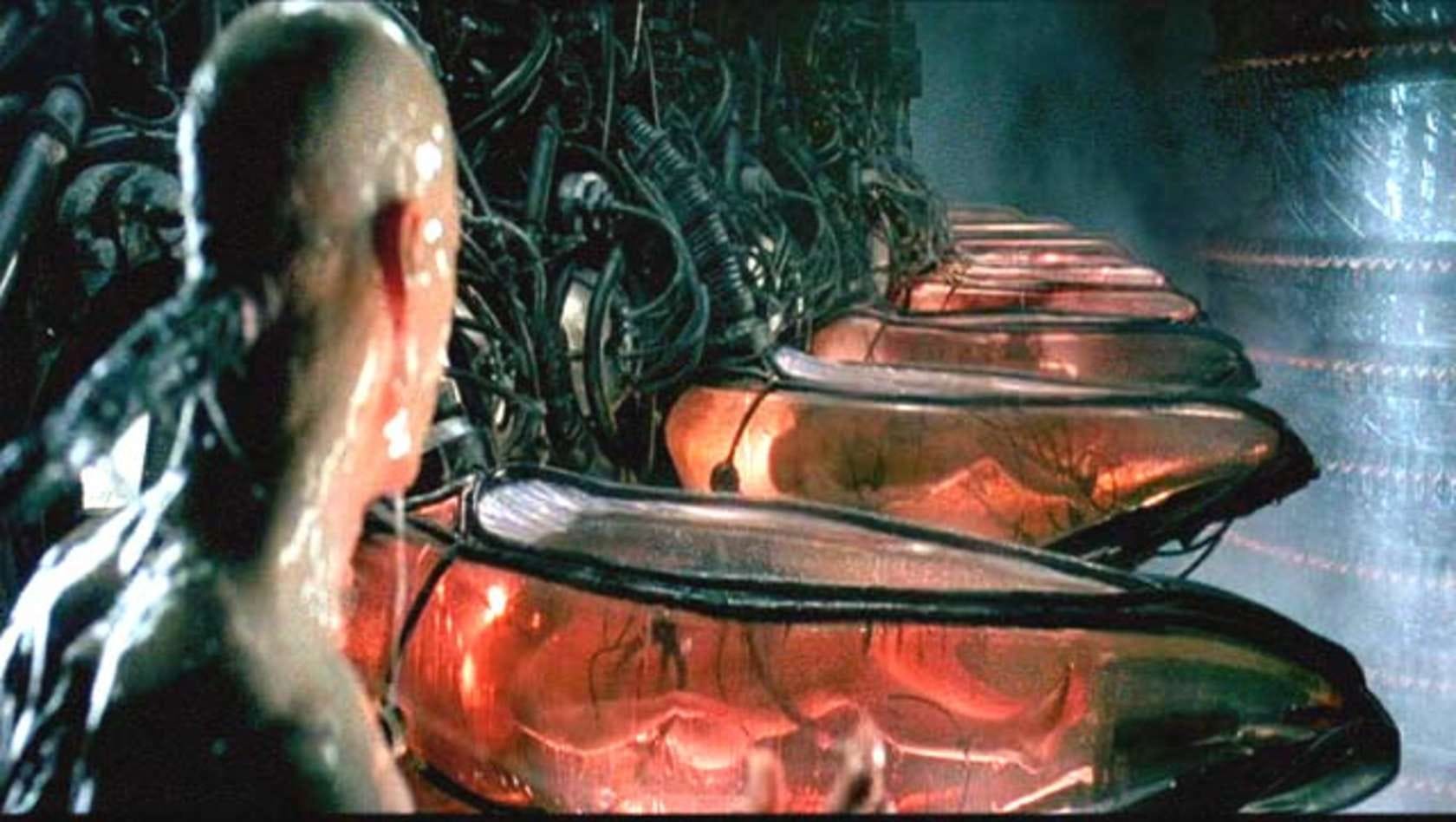
The infrastructure enabling this transformation already exists. 5G technology achieves "one millisecond response time" compared to traditional networks' 25-35 millisecond delays. This represents a quantum leap enabling autonomous vehicles, smart buildings, instant facial recognition, and unprecedented connectivity between all digital devices.
The implications are staggering: "They will be able to treat humanity like a living, like a single living organism." This technological capability provides the foundation for what biblical prophecy describes as a global control system demanding universal allegiance.
Historical precedent exists for this type of social organization. As documented in "Virtual Futures," civilizations throughout history developed hive-like structures when certain technologies emerged: "Everywhere pictographic writing makes its advent we find the sudden emergence of what I call tech riding empires. These civilizations were akin to the rationalized hive structures of ants or bees."
Spiritual Warfare in the Digital Age
Current technological developments represent manifestations of ancient spiritual warfare. Ephesians 6:12 describes how believers "wrestle not against flesh and blood, but against the rulers, against the authorities, against the cosmic powers of the darkness, against the spiritual forces of evil in the heavenly realms."
Digital systems provide new battlegrounds for this cosmic conflict. Artificial intelligence, virtual reality, and global connectivity networks don't merely offer conveniences but serve as potential weapons in humanity's ongoing rebellion against divine authority.
This perspective reframes debates about AI safety and digital privacy as fundamentally spiritual issues. The question isn't simply whether technology will benefit or harm humanity, but whether it serves to draw people toward or away from relationship with their Creator.
The challenge for faithful believers becomes maintaining distinct identity and mission while technological systems increasingly demand conformity to anti-biblical worldviews. Those who compromise in minor situations during current times of relative ease will find themselves unprepared for more intense future challenges.
The Restoration Protocol: Understanding God's Counter-Response
While humanity develops technological systems seeking to achieve divinity through artificial means, biblical prophecy reveals God's restoration plan already in motion.
The resurrection of Jesus Christ demonstrated divine authority over death itself, providing the "ultimate antivirus or antidote for the sin virus."
This restoration doesn't eliminate the current spiritual war but provides the framework for ultimate victory. As described in scripture, "the rest of the biblical narrative is really about restoring that, bringing that back into being. God doesn't want it to die. It was ruined, it was demolished, it was corrupted, but God isn't done with it."
The divine plan involves "a blended family" where redeemed humanity works alongside heavenly beings to administer a restored creation. This vision extends "all the way to the end of the book of Revelation" where "the end of the book of Revelation is cast in edenic terms."
For believers, this provides both warning and hope. The technological systems emerging today may serve the purposes of rebellion against God, but they cannot ultimately thwart divine plans for restoration and judgment.
Setting the Stage for Global Deception
As Part 1 of this series concludes, current technological developments represent preliminary stages of what biblical prophecy describes as end-times deception. The infrastructure for global surveillance, communication control, and behavioral modification already exists in nascent form.
The hive mind concept isn't merely theoretical. Research institutions and technology companies actively develop systems designed to aggregate human consciousness and decision-making processes. Virtual reality environments sophisticated enough to serve as substitutes for physical reality approach commercial availability.
Most significantly, the philosophical and spiritual foundations for rejecting divine authority in favor of technological solutions have gained widespread acceptance across educational, entertainment, and political institutions. The ancient promise of becoming "like God" through knowledge and technology continues to deceive humanity just as it did in Eden.
Part 2 of this series will examine how these technological foundations specifically fulfill biblical prophecies regarding the beast system, the ten kings, and the antichrist figure. We'll explore Daniel's visions of end-times government, Revelation's descriptions of global control systems, and practical implications for believers living through these prophetic fulfillments.
The convergence of ancient prophecy with modern technology isn't coincidental but represents the culmination of humanity's age-old rebellion against its Creator, now enhanced by unprecedented technological capabilities. Understanding these connections equips believers to navigate the challenges ahead while maintaining hope in God's ultimate victory over all forms of human rebellion.
If you liked this article and want to see Part 2, help us beat the Substack algorithm by liking, sharing, and subscribing. There’s no reason to write the next part if the first one never gets seen.
The Sin Virus: A Biblical Framework for Understanding Artificial Intelligence (Pt. 2)

In Part 1 of this series, we explored how ancient biblical prophecies are converging with modern technology in ways that would have seemed impossible just decades ago. We examined the "sin virus" concept, the transhumanist pursuit of "Homo Deus," and the striking parallels between the Tower of Babel and today's AI-driven global communication systems. We also investigated how 5G networks and swarm intelligence are laying the groundwork for what researchers call a technological hive mind. Building on this foundation, Part 2 delves deeper into the specific prophetic descriptions found in Daniel and Revelation, examining how emerging cyber systems may fulfill ancient warnings about the beast, the ten kings, and the mark that will control all global commerce. Based on extensive research from "Age of Deceit 3: Remnants of the Cyberhive Earth," this analysis reveals how current technological developments align with biblical end-times prophecy in unprecedented ways.
References
Harari, Yuval Noah. Homo Deus: A Brief History of Tomorrow
Garrett, Garrett. Oroboros or the Mechanical Extension of Mankind (1929)
Agrawal, Ajay, Joshua Gans, and Avi Goldfarb. Prediction Machines: The Simple Economics of Artificial Intelligence
Dixon, Joan Broadhurst, and Eric J. Cassidy, editors. Virtual Futures: Cyber Audits, Technology and Post-Human Pragmatism
Teilhard de Chardin, Pierre. The Future of Man
Khanna, Parag. Connectography: Mapping the Future of Global Civilization
Artificial intelligence is a tool. Like any other tool, it is an extension of the operator. Be careful, because the operator is not who you think it is.
I know it very well.
The Creator is not a salesman, he never needed a book.