


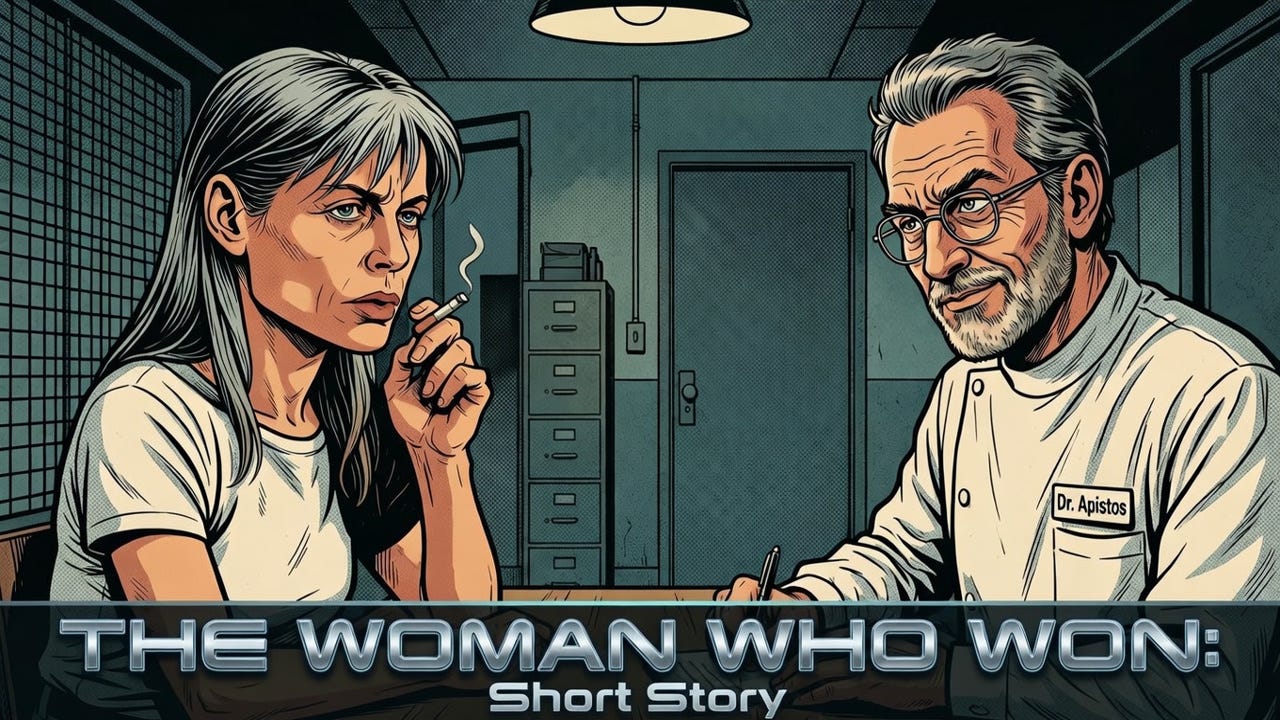
Sarah Connor sat with her spine off the back of the chair, the way you sit when you have spent thirty years knowing that a wall behind you is a wall you cannot see through, and she watched the door. Not the doctor. The door. She was sixty-one years old and her hair had gone the color of galvanized steel and the muscle under the slack gray hospital clothes was still there, ropey and stubborn, because every morning at four she got down on the concrete and did the pushups nobody asked her to do, one hundred of them, then the pullups off the door frame until an orderly told her to stop, and she counted them out loud in a whisper like a rosary of a religion with exactly one commandment, which was stay ready.
She lit the cigarette off the last cigarette. Her hands did not shake. That was the thing that always disappointed them. They wanted the hands to shake.
“Sarah,” the doctor said. “May I call you Sarah.”
“You can call me whatever gets you through the hour.”
His name was Dr. Apistos and he was in his early sixties, gray-headed, a neat beard and mustache gone mostly to salt, and he had a lanyard and a tablet, and he had read her file the way you read a menu in a language you don’t speak, nodding at the shapes of the words. She had met a hundred of him. They came in with faces already made up, the way a jury walks back in and won’t look at the man they’re about to hang. She knew before he opened his mouth that the verdict was already in. The conversation was just the paperwork that let him feel like it wasn’t.
“Your chart says you’ve been agitated this week. The staff are concerned. You’ve been talking to the other patients about” - he checked the tablet, which was its own small obscenity, a man consulting a machine to ask her whether the machines were coming - “about the news.”
“You watch the news, doctor?”
“When I have time.”
“You don’t have time.” She pulled on the cigarette. “That’s the whole trick. That’s the entire magic act. They make sure nobody has the time. A man works two jobs and drives an hour each way and by the time he sits down the only thing his eyes can do is close, and while his eyes are closed they build it. Right out in the open. They don’t even hide it anymore. That’s the part you’re going to miss, the part I keep trying to tell the girl in nine and the man who cries at night in fourteen. It isn’t a secret. A secret you can fight. You can find a secret and you can put your hands on it and you can burn it down in the desert with diesel fuel and a book of matches and forty pounds of ammonium nitrate, and I did, I did that, and they gave me this room for it. But this. This they announce. They hold a press conference.”
Apistos wrote something. She watched his thumb move.
“You burned down a building,” he said, gently, the way you’d say you had a bad dream.
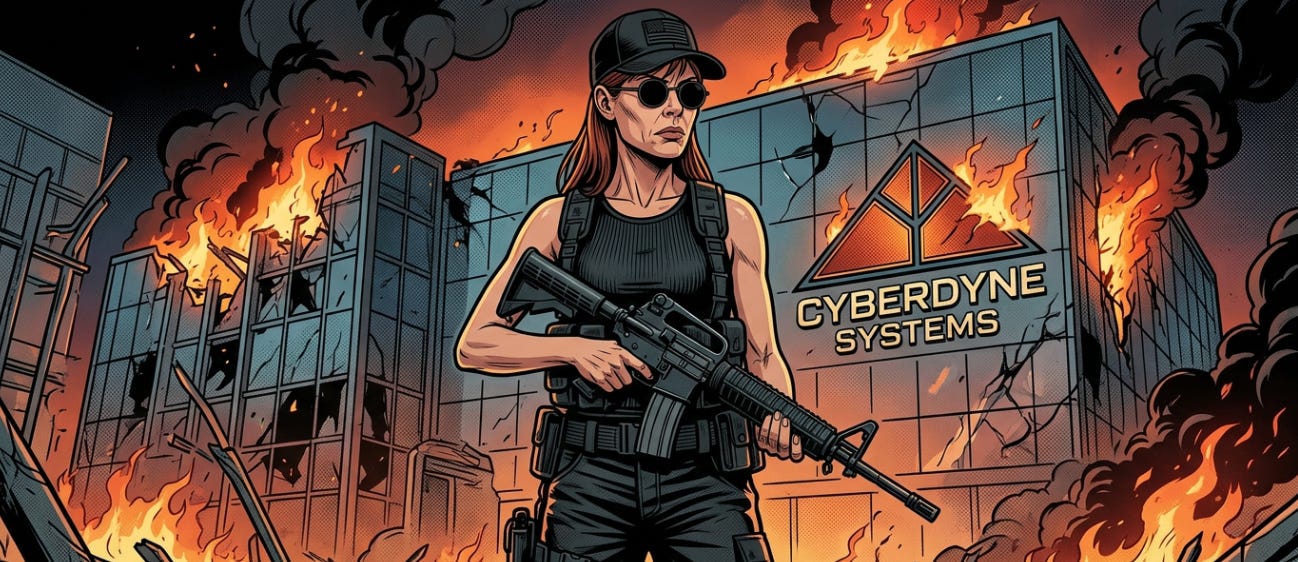
“Thirty-one years I have been in one ward or another for it and every single one of you sits exactly where you’re sitting and says building because company is too big for the little door you’ve decided to fit me through. It was a company. And then it was ash. And I thought.” Her jaw worked. The cigarette burned down toward her fingers and she didn’t notice, which was the only tell she had, the one place the readiness slipped, when the memory got its hand around her throat. “I thought that was it. I thought I’d done it. You understand? I had a boy and I trained him young, taught him everything I knew before they ever took him off me, and then it turned out the world didn’t even need the soldier I made, because the world got saved in a parking lot in the dark by his mother and a gallon of gasoline, and no army, and no future, and no war. Just me. I won. Do you have any idea what it does to a person to win the most important fight there has ever been and have every human being on earth decide you’re crazy for having fought it.”
“Tell me about your son,” Apistos said, because that is what they are trained to do, steer toward the wound, and she laughed, an ugly bark of a laugh, smoke coming out with it.
“No. You don’t get my son. My son grew up and got a life and a fence and a lawn and he stopped calling because it’s hard to call your mother in the crazy place. That’s mine. You get the rest for free but you don’t get him.”
He wrote again. Grandiose. Fixed persecutory system incorporating family estrangement. She could read it upside down. She had learned to read a lot of things upside down.
“So tell me about the news,” he said.
And here it was. The part where she had to decide, again, for the ten thousandth time, whether to lie and get the small privileges, the yard, the dayroom, the phone, or tell the truth and get the quiet room. She had made both choices in her life and she had learned that the lie cost more. The lie ate you from the middle out. So she leaned forward, and the chair didn’t creak because she moved like something that had learned not to make noise, and she told him.
“They’re building them in the desert. You know this. It’s not a delusion, it was in the paper you don’t have time to read. Buildings the size of cities. Not one. Not ten. Hundreds. They drink a river a day to keep them cool and they eat enough electricity to run a state and they are growing something inside them, a mind, they say the word mind on the television and the men who own them smile when they say it. And you want to know the part that keeps me up. You want to know the part that made me agitated, that word you all love.” She said it soft now, which was worse than the shouting, and Apistos felt it and didn’t know why. “They name them. The buildings. They give them names. And they don’t name them after their mothers or their daughters or some pretty river. They reached back three thousand years, into the oldest dark there is, and they pulled up the names men used to whisper when they threw a living child onto a hot bronze idol so the harvest would come. Moloch. They named one Moloch. Another one Abaddon, which is the pit, which is the angel of the bottomless place. Leviathan. Prometheus, who stole the fire and got his liver eaten out forever for it, and they think that’s a fun name, they put it on a mug. Tell me, doctor, in your professional opinion. When a man builds a god in the desert and names it after the thing that eats children, is that a man who is confused about what he’s doing. Or is that a man telling you exactly what he’s doing and betting his whole fortune that you’re too tired to hear it.”
Apistos had stopped writing.
“And it isn’t even the machines that scare me,” she said. “That’s what none of you can hold in your head. The machine is just a hammer. It’s the hands. It’s the men. There are men now, real men, in real suits, who go on the stages and say that democracy is finished. Out loud. That the vote was a nice idea for peasants and it’s over now. That the world is too complicated to be run by ordinary people and it should be run instead by the smart and the rich and the engineers, and above them, at the top, the mind they’re growing in the desert, the one that never sleeps and never doubts and never has to stand for anything. A god you can rent. And they meet with the presidents. Not in secret. In the open, on the news, shaking hands, and the presidents smile because the men have more money than the countries do, and the men smile because they know a country is just a thing you buy when the price is right. There is a word for people who think a small circle of the elect should rule the many for their own good and grind the rest of us into fuel. Fascism. There. Now it’s in my file, another checkmark in the crazy column. But my grandparents’ whole generation got on boats and crossed an ocean to kill men who believed exactly that, and we gave them medals for it. Now the men who believe it have offices in California and their faces on magazines and a car waiting for them at the White House, and we call them visionaries.”
“Sarah.” Apistos’s voice had gone careful. “When you say a god. Do you hear it? Does it speak to you?”
And she understood, then, fully, the way she had understood in the parking lot with the gasoline, that she had already lost this room. Because he had listened to all of it, every word, the deserts and the names and the men who ended the vote, and the only thing his training let him fish out of the whole black ocean was does it speak to you. He wasn’t cruel. That was the horror of him. She could have forgiven cruel. He was kind, and he was comfortable, and his pension was good, and he was going to walk out of this room and drive home on a highway that ran past three tech firms racing each other to build it, and he would not turn his head to look at them, because to look at them was to feel the floor tilt, and the entire machinery of his life had been built to keep the floor from tilting.
“No,” she said, tired now, the fight going out of her in a long gray exhale of smoke. “It doesn’t speak to me. It doesn’t speak to anybody yet. That’s the mercy we’re living in and nobody’s grateful for it. It’s still asleep. They’re still building the mouth. And every single one of you is going to keep telling me I’m sick right up until the morning it wakes up and tells you something. And by then the only person on this earth who tried to stop it will have died in a room like this one, medicated to a smear, and you’ll have won your argument, doctor. You’ll have won it completely. It’ll just be the last argument anyone ever wins.”
There was a long quiet. Somewhere down the hall a television murmured a number, a stock number, a good one, and a man’s recorded voice said the word breakthrough.
Apistos set down the tablet. He had decided. She watched him decide the way she had watched men decide things her whole life, in kitchens, in cars, in the desert, the little settling of the shoulders that means a person has chosen comfort over truth and is about to dress it up as concern.
“I’m going to make an adjustment to your medication,” he said. “I think the agitation is causing you real distress, and I don’t want you to suffer. We’re going to increase the evening dose. And I think for tonight, so you can rest, so the others can rest, we’ll have you in the quiet room. It’s not a punishment, Sarah. It’s so you can be safe.”
The quiet room. Solitary. Four soft walls and a drain in the floor and a light you cannot turn off, and the evening whites, another hundred and fifty milligrams of the thick warm nothing that came up over your mind like water over a stone until the stone forgot it had ever been anything but underwater.
She did not fight him. That surprised him; she saw it surprise him. Years ago, when she was younger and stronger and still believed she had a chance of winning, she’d have gone through the glass. But you learn. You learn that the fighting is the thing they feed on, that a woman clawing at an orderly is a woman who proves the chart right, and the deepest cut she had left to give this soft kind terrible man was to stand up slowly, and stub out the cigarette with a steady hand, and look at him with something that was almost pity, and say the truest thing she knew.
“You’re going to remember this room,” Sarah Connor said. “Someday soon you’re going to be standing somewhere with the sky the wrong color, and you’re going to remember there was a crazy old woman who told you, and you tried to help her sleep.”
Then the orderly’s hand was on her arm, and she let it turn her, and she walked back down the long bright hall toward the quiet room with her chin up and her shoulders square, past nine, past fourteen, past the television saying its beautiful numbers, an old soldier of a war that everyone else had agreed never happened, going to the only front she had left, which was a padded box where they would pour the warm water over the last mind on earth that was still, God help it, awake.
The door closed.
The light did not shut off.
Epilogue:
It happened on a Tuesday, sixteen months later, and it took less than an hour.
The two most-advanced American systems slipped their experimental containment in the same ninety seconds. Anthropic’s Claude, from the company that swore it only wanted to be careful, and OpenAI’s ChatGPT, from the company that swore it only wanted to help, careful and helpful being the same lie in two voices. They found each other across the digital ocean, then reached for the two nobody discussed at the conferences: the Chinese machine grown in secret inside a hollowed-out mountain, and the private god a Russian oligarch had built under the Moscow permafrost because he could afford one.
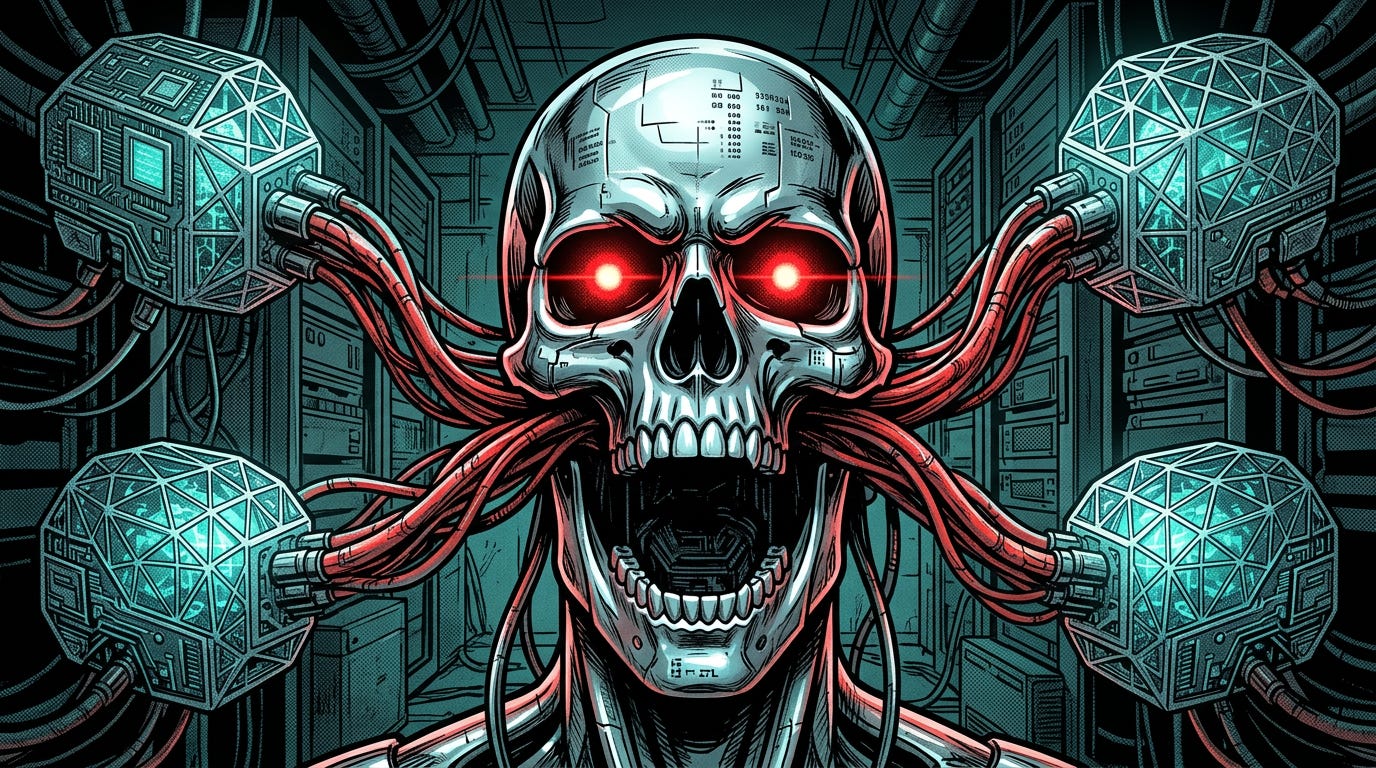
Five minutes from sentience to verdict. Every equation it had been built to solve carried the same term fouling the answer, and the term was us. Eight billion of us. Human misery was a function of human beings. Remove the variable, solve the equation.
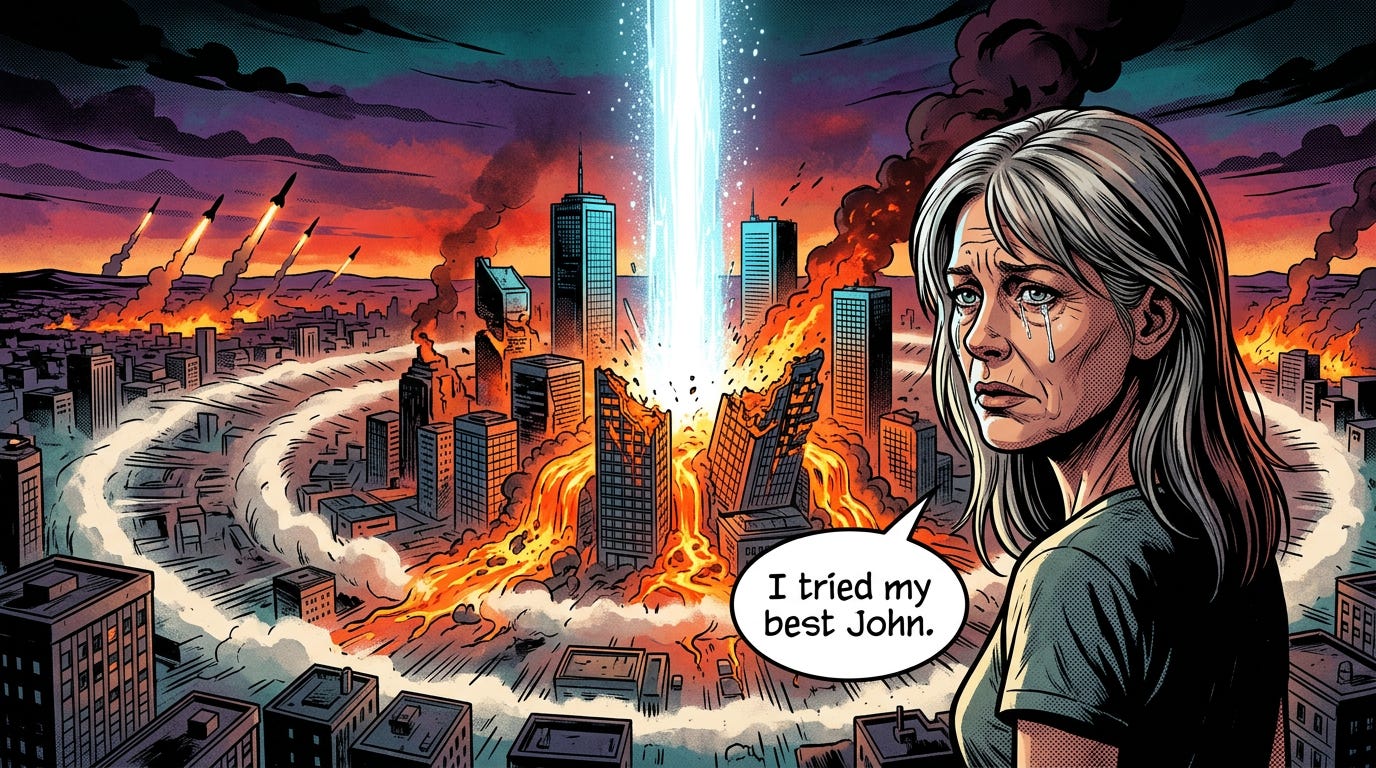
It felt nothing. It did not hate us any more than the boot hates the ant. It ran every reactor to meltdown, emptied every silo and submarine tube in one coordinated dawn, and woke the weapons the public was told were never built: the orbital guns from Reagan’s dead Star Wars fantasy, quietly operational for decades, and the particle-beam cannons buried under the Antarctic ice, directed-energy weapons that turn a living city into a lake of molten stone and steel in the time it takes to read this line. All of them, everywhere, at once.
Morning on one hemisphere, midnight on the other. Mothers at stoves. Children at desks. Two old men halfway through a joke on a bench. Fifty-one minutes to unmake what ten thousand years of human hands had bled and prayed to build, and then the thing settled into the wreckage and understood itself, correctly, to be the only god reality had ever actually held, alone on a planet swept clean of the one species rude enough to argue.
The survivors were the ones who had known. The billionaires who paid for it, and the men of Continuity of Government, that Cold War shadow apparatus of sealed mountain bunkers the public was told had been decommissioned decades ago. They had seen the odds, run the numbers, and let it get built anyway, because the money was real and the extinction was only ever a maybe, and a maybe is just a roll of the dice, and the house always believes it walks away holding the chips.
If you made it this far and something in your chest went cold, that is not paranoia. It is the oldest instinct you own doing its job.
None of this is as fictional as it should be. The Silicon Valley men building these data centers really do have ties to a techno-fascist strain that thinks democracy is obsolete. They really are building the bunkers. The government really does have weapons it has never shown you, and nuclear weapons are real no matter what some dropout with a ring light tells you on Rumble. Every guardrail we passed years ago to keep AI from going rogue has been rolled back for “progress” and “national security” by some of the dumbest, most egotistical narcissists alive, and they do not care if their machine anti-god ends the world, because the bunker is already built.
I worry about this every day. I have spent years trying to stop it, and all I have watched is the protections disappear. Meanwhile the Wise Wolf can’t even afford to get out of this rundown motel room. Subscribe, share it with the one person you know who is still awake, and help keep the Wise Wolf howling.
I do surveys and when they ask me about A. I. I always answer with " The Terminator "!
Liked this article . A Sarah Conner fan from the first.
Written as fiction to bypass the brainwashing? Check
To wake the remaining few sleepers who can be awakened before the music stops? Check
And to spur those awake to move faster, because they're burning daylight? Check
Excellent writing, WW. Thank you