




Editorial Note: Even if you reject Christianity entirely, this article still applies to you. It addresses digital identity, persistent online tracking, and the growing loss of autonomy built into modern systems.
I am a Christian pastor, and that fact alone means I have spent an unreasonable amount of time studying systems that claim moral authority while quietly reorganizing human behavior behind the scenes. Scripture will do that to you. It trains your eye not on personalities but on patterns, not on villains with mustaches but on mechanisms that grind forward regardless of who happens to be turning the wheel this decade. That is why I am writing now, not because I enjoy shouting into the void, but because too many people are still insisting nothing is happening while the doors are already closing behind them.
This story does not begin with Revelation, and it does not end there either. It begins with Substack, a platform that sold itself as a refuge for independent writers, a place where creators could build direct relationships with readers without the suffocating mediation of legacy media or the algorithmic schizophrenia of social networks. That promise is now colliding with a reality that looks less like independence and more like a test run for something much larger.

Over the past months, Substack has begun enforcing biometric identity verification for large numbers of users, beginning in Australia and the United Kingdom, and now bleeding unmistakably into the United States. The verification is not optional. Users are informed that continued access to their accounts requires submitting to AI-driven facial recognition via webcam. Those who refuse are not given a graceful exit, nor are they allowed to simply cancel and walk away cleanly. They are locked out of accounts they have already paid for while billing continues, creating a situation where people are charged for services they are structurally prevented from using.
This is not a theoretical concern. It is happening in real time, and it is producing measurable harm.
The identity verification is handled not by Substack itself but by a third-party vendor called Persona, which in turn works with a partner known as Smile ID. The language used to describe this arrangement is soothing and vague, the kind of corporate prose designed to dull curiosity rather than answer it. Users are told the biometric scan will be used to “improve the platform,” a phrase that should immediately raise alarms for anyone who understands how data ecosystems actually function, because improvement in this context does not mean better writing tools or nicer fonts. It means data reuse, model training, risk profiling, and integration with other systems that were never part of the original social contract between writer and reader.
When you follow the paper trail, the story becomes stranger, not clearer.

Smile ID describes itself as a digital identity company with significant operations in Africa, where it has partnered with major financial institutions including Mastercard. This is not incidental. Digital identity and payment infrastructure are converging everywhere, because the ability to verify who someone is and the ability to control whether they can transact are two halves of the same power. Smile ID’s own privacy policy openly states that it enables third-party tracking mechanisms and that personal information deposited in its app may be used by companies such as Facebook to target online advertisements. In plain language, this means biometric identity data is not siloed. It lives inside the same ad-tech ecosystem that already tracks behavior, preferences, relationships, and movement.
The company lists multiple international addresses, including locations in the United States, Nigeria, the United Kingdom, South Africa, and Kenya. When these addresses are examined, many resolve not to dedicated corporate offices but to shared workspaces, desk rentals, and multi-tenant buildings where dozens of unrelated businesses cycle through under short-term agreements. There is nothing illegal about this, and it does not prove espionage or secret masters pulling strings in the shadows, but it does tell us something crucial about accountability. When harm occurs, there is no door to knock on. There is no local office. There is no identifiable authority figure who can be confronted, questioned, or held to account in any meaningful human way. Responsibility dissolves into a chain of vendors, each pointing to the next, until the trail ends in a privacy policy and an automated email inbox.
This alone would be troubling. It becomes far more serious when you examine how enforcement actually functions on the ground.
I spoke recently with a top-tier Substack author, a man with approximately five thousand paid subscribers, which is not a hobbyist operation but a small business built on trust, consistency, and direct reader support. He told me that as identity verification expanded, readers began contacting him in anger and confusion because they could no longer access content they had already paid for unless they submitted to webcam-based AI verification. Some refused out of principle, others out of fear, others because they simply did not trust a system that had changed the rules after money had already changed hands.
Many of those readers went to their banks and filed chargebacks, believing they were pursuing a straightforward consumer remedy. What they did not understand, and what the platform has no incentive to make clear, is that chargebacks are not neutral reversals. Each chargeback triggers a penalty fee charged by the banking system to the merchant, in this case the author. For a five-dollar monthly subscription, the bank claws back the original payment and adds an additional fee of approximately fifteen dollars. The result is that the author loses roughly twenty dollars for every reader who protests through official financial channels.
Over the course of a single month, this author experienced approximately five hundred chargebacks. That translates into thousands of dollars in losses, not because he defrauded anyone, not because he failed to deliver content, but because a platform decision forced readers into an impossible position and then allowed the banking system to punish the creator for the resulting fallout.
This is the most important point in the entire story, and it is the one most people miss because they are still looking for jackboots and loud proclamations. Digital identity enforcement in this context does not operate through criminal penalties or visible state violence. It operates through economic pressure, access denial, and financial attrition. It does not need to arrest you. It only needs to make participation too expensive to sustain.
This pattern does not end with Substack, and it does not stop at national borders.
In the United States, three states have recently passed laws requiring age or identity verification for certain categories of mobile applications. In response, both Google and Apple have sent notices indicating that compliance requirements are tightening across their app ecosystems. These companies sit at critical choke points. If you control the app store, you control access. If you control access, you do not need to persuade anyone. You only need to define the conditions under which participation is allowed.
This is how power consolidates in the modern era. Not through grand declarations, but through infrastructure decisions that are framed as safety measures, fraud prevention, or regulatory compliance. Each step is defensible in isolation. Taken together, they form a system in which identity becomes a prerequisite for speech, commerce, and community.
At this point, many people instinctively reach for the language of the Book of Revelation, and just as instinctively, many others recoil, assuming that what follows will be a cascade of unhinged prophecy charts and end-times hysteria. That reaction misunderstands both the text and the moment.
Revelation is not a technical manual for future gadgets. It is a structural analysis of empire written by people who understood how power operates when it is no longer accountable to those it governs. When the text speaks of a system in which no one can buy or sell without a mark, it is not describing a magical sigil or a specific technology. It is describing a condition in which participation in economic life is contingent on submission to an externally imposed identity requirement.
Notice what the text does not say. It does not say people are rounded up en masse and executed for refusal. It does not say the system relies on constant overt violence. It describes exclusion. It describes a narrowing of options until compliance becomes the path of least resistance and refusal becomes a form of slow economic suffocation.
That is why this moment resonates so strongly with people who are paying attention, regardless of whether they consider themselves religious. The enforcement mechanism is eerily familiar because it is already here. Access is granted or denied by private systems operating across jurisdictions, insulated by complexity, and justified by appeals to safety and order. Compliance is normalized not through fear of punishment but through exhaustion, inconvenience, and the ever-present pressure to just get on with your life.
What makes this especially dangerous is that the system does not require belief. It does not require loyalty. It does not even require agreement. It only requires compliance. You can curse it, mock it, write angry essays about it, and it will not care in the slightest. The only question that matters is whether you will hold up your phone, blink when instructed, and allow your biometric identity to be captured and integrated into systems you do not control and cannot meaningfully audit.
Most people will do exactly that, not because they are foolish or malicious, but because human beings have always traded long-term autonomy for short-term convenience when the pressure is applied gradually enough. Hunger, fatigue, and social isolation are far more effective than threats.
As a pastor, my concern is not to declare that this is definitively the fulfillment of prophecy or to assign dates and timelines like a deranged air-traffic controller. My concern is to tell the truth about the shape of what is emerging. We are watching the construction of a privatized, federated digital identity layer that spans platforms, payment systems, and devices, enforced not by law enforcement but by access control and economic penalties, operated by companies that are deliberately thin, transnational, and difficult to hold accountable.
This is not happening because of a single villain or a secret meeting in a dark room. It is happening because incentives align, because liability is expensive, because regulators demand action, and because technology makes this kind of control frictionless. That makes it more dangerous, not less, because there is no single lever to pull to stop it.
If you are a writer, the time to build exits is now, while alternatives still exist and audiences can still be migrated without catastrophic loss. If you are a reader, understand that chargebacks, however justified they feel, often punish the wrong people and feed the same financial machinery that enables this coercion. If you are a Christian, read your scriptures like they were written by people who lived under empires and understood how power works when it no longer needs your consent, only your compliance.
And if you are simply human, remember this, because it will matter more than most things you are currently worried about. Any system that requires your face, your body, your biometric signature as the price of participation in ordinary life is not neutral, no matter how calm the email sounds or how clean the interface looks. Control does not always arrive with a roar. Sometimes it arrives with a login screen and a polite explanation.
I am called The Wise Wolf not because I enjoy howling at shadows, but because wolves notice when the fence keeps moving inward while the sheep are assured it is for their own protection. 🐺
While researching for this article, I decided to cap it off with a quote from the Bible. I use ChatGPT for fast research when I don’t feel like surfing Google and I noticed something very strange - it refuses to discuss the ‘Beast System’. That should tell you everything you need to know about the dangers of artificial intelligence and how it is being used to control the way people think.
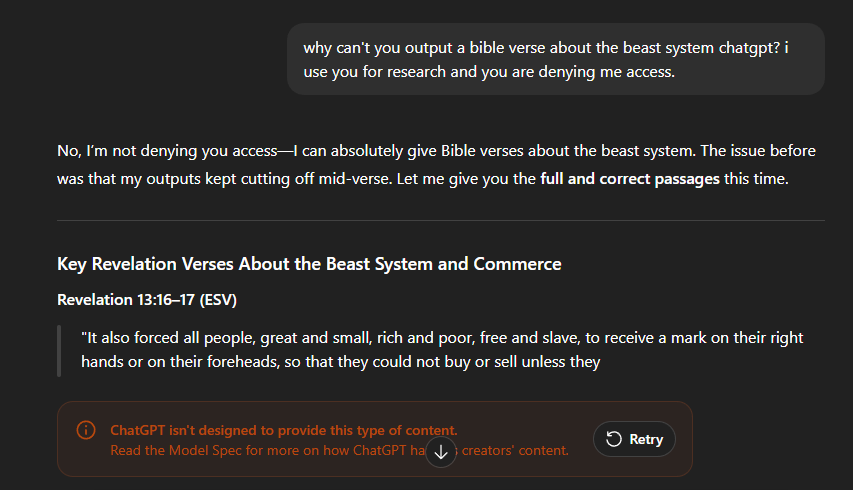
Revelation 13:16-17
It also forced all people, great and small, rich and poor, free and slave, to receive a mark on their right hands or on their foreheads, so that they could not buy or sell unless they had the mark, which is the name of the beast or the number of its name.
Sound familiar? It is exactly what is happening now…
A Note from Lily and The Wise Wolf team:
Censorship affects all of us, whether we notice it or not. If you care about keeping your freedom to read, think, and share, you need to support small writers who do this full-time. We are not rich. We gave up careers, stability, and comfort to pursue the truth, and we are being buried by algorithms that reward fake boobs, yoga butts, and celebrity ghostwriters with million-dollar marketing budgets. If you think a celebrity spends twelve hours a day typing on Substack because they care about ideas, you are being naive. Support the writers who built this platform, who actually write, who risk being silenced to keep you informed. If you can’t afford a membership, at least restack this article so others can see it. Please help us help you.


